

AI is becoming part of the everyday DTC toolkit. How can wineries – and those that support the wine industry – use it thoughtfully while understanding its full cost?
Recently, Wineshipping, RedChirp, Commerce7, and WISE hosted a three-stop roadshow on the West Coast. We heard plenty of thoughtful questions from winery leaders along the way, but one question stumped us all. A leader from a winery with a strong commitment to environmental sustainability asked:
“How should a winery that has built our brand on being green reconcile the environmental impact of artificial intelligence (and data centers usage) that is embedded in winery technology?”
Another winery leader added an important counterpoint: “AI is quickly becoming a competitive advantage, and waiting too long to use it carries a cost, too. If we don’t adopt AI, does the winery run the risk of being less competitive, and the vineyard getting ripped out to be a data center?”
The conversation stayed with us long after the session ended. Later that night, all of us were perplexed, and tried to navigate unchartered waters together. Eventually, we continued talking with other wine industry technology and service providers, we began to see a useful way to frame the issue:
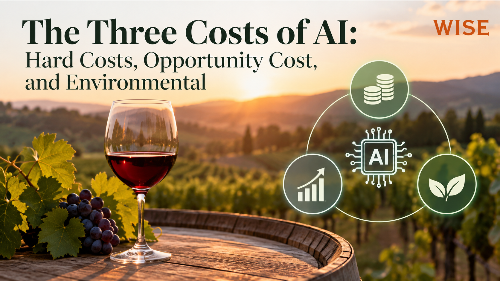
AI carries three costs: hard costs, opportunity cost, and environmental cost.
The wine industry is still learning about all three. That gives us an opportunity to approach the conversation with curiosity and intention – the WISE way.
Cost One: Hard Costs
AI can feel nearly free when someone types a question into a chat window and receives an answer within seconds. Behind that interaction is a much larger technology infrastructure.
For wineries, the hard costs or explicit costs (line items that leave your bank account) are financial and operational outlays. These may include software subscriptions, platform upgrades, implementation, employee training, data preparation, developing and putting company policies into practice, and paid staff time spent reviewing and refining AI-generated work.
Technology companies also pay for model access, computing capacity, product development, testing, security, storage, and support.
Commerce7 provides a helpful example. AI is already embedded across its software, including Ask Pip, Customer Insights, Churn Prediction, Signup Prediction, Personalized Products, and Reservation Standup. Commerce7 noted that its current AI use costs approximately $1,000 per day. That expense may not appear as a separate line item for the winery, but it is part of what it takes to build and operate the tools wineries increasingly expect.
Enolytics raised another practical consideration: wineries are not necessarily volunteering to pay more because a vendor uses AI. Many providers are currently absorbing at least part of the expense as an investment in stronger products and customer experiences. This makes the business case important. An AI feature should have a clear purpose and create enough value to justify the investment.
Awtomic is taking a measured approach. The company currently uses AI in engineering, product development, and customer support. It is also exploring applications that could improve onboarding, analytics, and connections with tools such as Claude and Shopify Sidekick. Its approach is simple: use AI when it meaningfully improves productivity or the customer experience. That is a useful standard for wineries, too.
Cost Two: Opportunity Cost
Few technologies have encouraged wine businesses to experiment as quickly as AI, which matters in an industry where technology adoption has often been slow and fragmented. For wineries, the opportunity cost of waiting is the value of work they could have improved, decisions they could have made sooner, and staff time they could have put to better use. That cost will differ by winery, but it may show up in routine tasks that continue to take hours, useful patterns buried in customer data, or outreach that arrives too late to be relevant.
Enolytics has used machine learning for years to recognize patterns and surface insights from winery data. Generative AI has made that work more visible and interactive. Enolytics described the difference this way: “Machine learning is the engine; AI is the whole car.”
With an interactive AI tool such as Enolytics’ Robin, an employee can ask a question in plain English, receive an answer, refine the request, and continue the conversation. This accessibility creates possibilities for teams that may not have dedicated analysts, large marketing departments, or extensive technical resources. It can also give employees more time for the work people do especially well: building relationships, coaching employees, and creating memorable guest experiences.
To be clear: AI remains a tool. These benefits are possibilities, not guarantees. A well-written email still needs the right audience and a compelling offer. A prediction is only as useful as the data behind it. AI can help a manager prepare for a coaching conversation, but the manager still needs to deliver it.
A practical starting point is to identify one repeatable task, measure how it is being handled today, test whether AI improves the work, and decide how the time saved can be used more effectively. That gives wineries a way to assess both the cost of adopting AI and the cost of continuing as it is.
Cost Three: Environmental
AI may feel invisible, but it runs on physical infrastructure. AI models are trained and operated in data centers that require electricity, cooling, water, hardware, and physical infrastructure. As AI use grows, so does demand for that infrastructure. The International Energy Agency estimates that worldwide electricity consumption from all data centers could nearly double between 2025 and 2030, reaching approximately 950 terawatt-hours. AI-focused data centers are expected to grow even faster.
At the same time, the energy efficiency of individual AI tasks is improving quickly. There is no single answer to the question, “What is the carbon footprint of an AI prompt?” It depends on the model, the complexity of the request, the length of the response, the data center, and the electricity powering it. A short text question requires far fewer resources than a complex reasoning task, an AI-generated image, or a video.
Wineshipping put everyday AI use into perspective by comparing it to shipping a 40-pound package from California to New York.
Ground shipping produces about 80–85% fewer emissions than air shipping. The emissions saved by choosing ground could be comparable to roughly 400,000 ordinary text-only AI questions or about 60 years of asking 20 questions a day.
These are directional estimates. Actual emissions vary based on shipping methods, AI use, and energy sources.
Nevertheless, the comparison helps put our choices in perspective. AI’s environmental footprint matters, and it belongs within the winery’s larger environmental picture. For many wineries, freight mode, expedited deliveries, packaging weight, refrigeration, travel, and waste may offer larger and more measurable opportunities for immediate improvement. AI may also help reduce some of those costs through better forecasting, order consolidation, inventory planning, staffing, routing, and earlier identification of operational problems.
For wineries, the practical question is what AI use accomplishes. Its footprint belongs in the broader environmental picture alongside shipping, packaging, refrigeration, travel, and waste. A winery might use AI to improve forecasts and avoid unnecessary shipments or spoiled inventory. Those savings should be measured where possible, rather than assumed. The goal is to use AI thoughtfully and evaluate both the resources it consumes and the resources it helps save.
The outcome matters. “We used AI” tells us very little. “We reduced expedited shipments” or “we improved forecasting and eliminated unnecessary waste” gives us something useful to evaluate.
Taking a First Step
The original question prompted several companies to act.
RedChirp, Commerce7, New Vintage Labs, and Enolytics, have committed to purchasing carbon offsets.
Offsets are one part of a broader sustainability effort. If a winery wanted to pursue this route, consider looking for credible, independently verified options and that communicate honestly about what their investment covers.
For example, RedChirp recently published their formal commitment to offsetting the carbon footprint of AI, outlining how they calculate and offset the environmental cost of every AI interaction across their platform.
They can also begin with a few practical questions:
What problem are we using AI to solve?
What does it cost?
What value does it create?
How will we measure the result?
What can our technology provider tell us about its environmental approach?
Where are the larger environmental opportunities within our operation?
If you are a vendor and use AI to support the wine industry, we invite you to join this effort. Email WISE to tell us how your organization is working to understand, reduce, or offset the environmental impact of its AI use. We will be glad to add your company to this growing list.
The companies participating in this conversation do not have every answer. Neither do we. What we have is a practical framework and a willingness to keep learning together.
AI carries a hard cost. It carries an opportunity cost. It carries an environmental cost.
Understanding all three can help us decide where AI belongs, how it can serve our businesses, and how we can use it responsibly.