


Ulrich Willmes
The Press as a “Quality Gate”
Ten Practical Rules for Preserving the Grapes’ Potential in the Must
The press is the critical juncture between vineyard and cellar. It is where it becomes clear how much of the grapes’ quality potential actually reaches the must. Anyone seeking to work in the premium segment with as few corrective interventions and additives as possible—and anyone aiming to produce wine as cost-effectively as possible—must plan precisely before the first pressure stage.
Pressing Does Not Begin in the Press House
Pressing is not an isolated machine operation. The condition of the grapes, harvest timing, outdoor temperature, weather, transport containers, waiting time, and route to the press collectively determine the quality that can ultimately be extracted. Even a good press cannot turn damaged, overheated, or microbiologically compromised grapes back into intact fruit.
The most important practical consequence is this: The vineyard, harvest logistics, grape reception, and pressing must be planned as one continuous process. What matters is not the maximum rated capacity of a single machine, but a steady flow of material without long delays or unnecessary transfers. Anyone aiming to reduce SO₂ additions depends on especially gentle processing and rigorous control of oxygen exposure. Good process management can reduce the need for protective and corrective measures, but it cannot replace targeted enological safeguards.
Synchronize Harvest and Press Capacity
The number of harvest workers or mechanical harvesters, transport capacity, and the realistic length of a press cycle must be aligned. If more grapes arrive than can be processed, delays result. If the press is too large for the actual daily throughput, it can take too long to accumulate a full load. Both situations increase the risk of oxidation, unwanted microbial activity, and hygiene problems.
A useful planning guideline is this: With hand harvesting, the press should ideally be fully loaded within three hours after the first grapes are harvested; alternatively, the fruit should be held in cold storage until processing. With machine harvesting, the press should be filled within one hour. These time windows are not universal standards. At high temperatures, with compromised fruit, or for varieties particularly prone to oxidation, schedules must be tighter.
Practical recommendation: Before harvest, do not calculate only throughput in tons per hour. For each lot, also account for arrival time, start of loading, planned program, unloading, cleaning, and available must tanks. A small time buffer is useful; a backlog of grapes generally is not. Holding grapes before processing is advisable only when macerating aromatic varieties or processing chilled fruit.
Protect Grapes During Transport
The more grapes are compacted, crushed, or warmed in a container, the sooner juice release, oxidation, and microbial changes begin. Transport must therefore suit the grape variety, harvesting method, temperature, and intended wine style. Grapes that are delicate or harvested under warm conditions benefit from smaller, well-ventilated containers and short transport distances. Large containers make sense only when compaction and juice pooling can be reliably avoided. In addition, the longer the route, the smaller the transport container should be.
Champagne demonstrates how consistently this principle can be applied to a narrowly defined quality objective: Whole grape clusters are expected to arrive intact at the pressing center, transport crates must quickly drain any released juice, and pressing should begin as soon as possible after harvest. These rules do not automatically apply to every winery, but they underscore the central point: Transport is already part of must extraction.
Loading: Short, Direct, and Gentle
The best route into the press is the shortest. Direct loading or gravity transfer is better for quality than a long sequence of augers, pumps, hoses, and transfers. Every additional length of hose, every bend, every change in elevation, and every abrupt transfer adds mechanical stress. This does not mean that pumps must be ruled out altogether. They should, however, be used only where necessary, with transfer lines that are as short and generously sized as possible and with gentle pumping technology.
The drop height should also be kept as low as possible. During loading, the press drum should not be rotated merely to fit in more grapes. Such distribution or compaction rotations create additional shear forces even before pressing begins and make clean fractionation more difficult later. At most, the press should be rocked gently back and forth to optimize the fill.
Avoid Both Overloading and Underfilling the Press
A press should be loaded in one continuous operation with the intended quantity. Overfilling impedes drainage, lengthens the cycle, and often requires more frequent crumbling. Significant underfilling likewise alters pressure distribution and can cause unnecessarily strong extraction. The goal, therefore, is neither to load as much nor as little as possible, but to remain within the recommended operating range for the specific press.
The implication for investment and harvest planning is clear: A larger press is not automatically a better press. The right capacity is the one that can be operated quickly, fully, and consistently with the actual harvest flow. Capacity planning should therefore be based on representative harvest days.
Allow the Juice to Drain, Then Press with the Flow
Before the first actual pressure stage, the must released during loading needs time to drain. This free-run juice is a distinct fraction and should not be inadvertently blended with later press fractions. Then proceed as follows: Increase pressure slowly and in stages, hold each stage long enough, and monitor must flow. The juice should flow as evenly and continuously as possible. The objective is not the fastest pressure increase, but a consistent flow rate matched to the press’s drainage system.
High pressure is not a mark of quality. As extraction increases, turbidity, phenolic content, acidity, pH, color, and susceptibility to oxidation may change depending on the grapes. An industrial-scale study found that at higher juice yields, pH, turbidity, color index, and phenolic measurements tended to increase, while titratable acidity decreased. The extent of these changes depended on the grape variety and pressing conditions. Higher pressures require more mechanical crumbling.
Crumble Only When the Pomace Cake Requires It
Crumbling is intended to restore drainage through the pomace cake—that is, to reopen drainage paths. It is not an additional grinding step. If crumbling occurs too early or too often, the grape skins and seeds are exposed to greater shear forces. At the same time, decompression and redistribution can release another surge of phenolics and more oxidation-prone must.
Recent studies on Pinot Noir and Pinot Meunier show that marked changes in quality occur not simply at a specific volume of extracted juice, but especially after depressurization and pomace reworking. The practical conclusion: Use crumbling sparingly, then taste and measure with particular care. This effect is especially relevant when the goal is to obtain as much lightly colored juice as possible for Blanc de Noirs.
Separate Must Fractions by Quality, Not Just Quantity
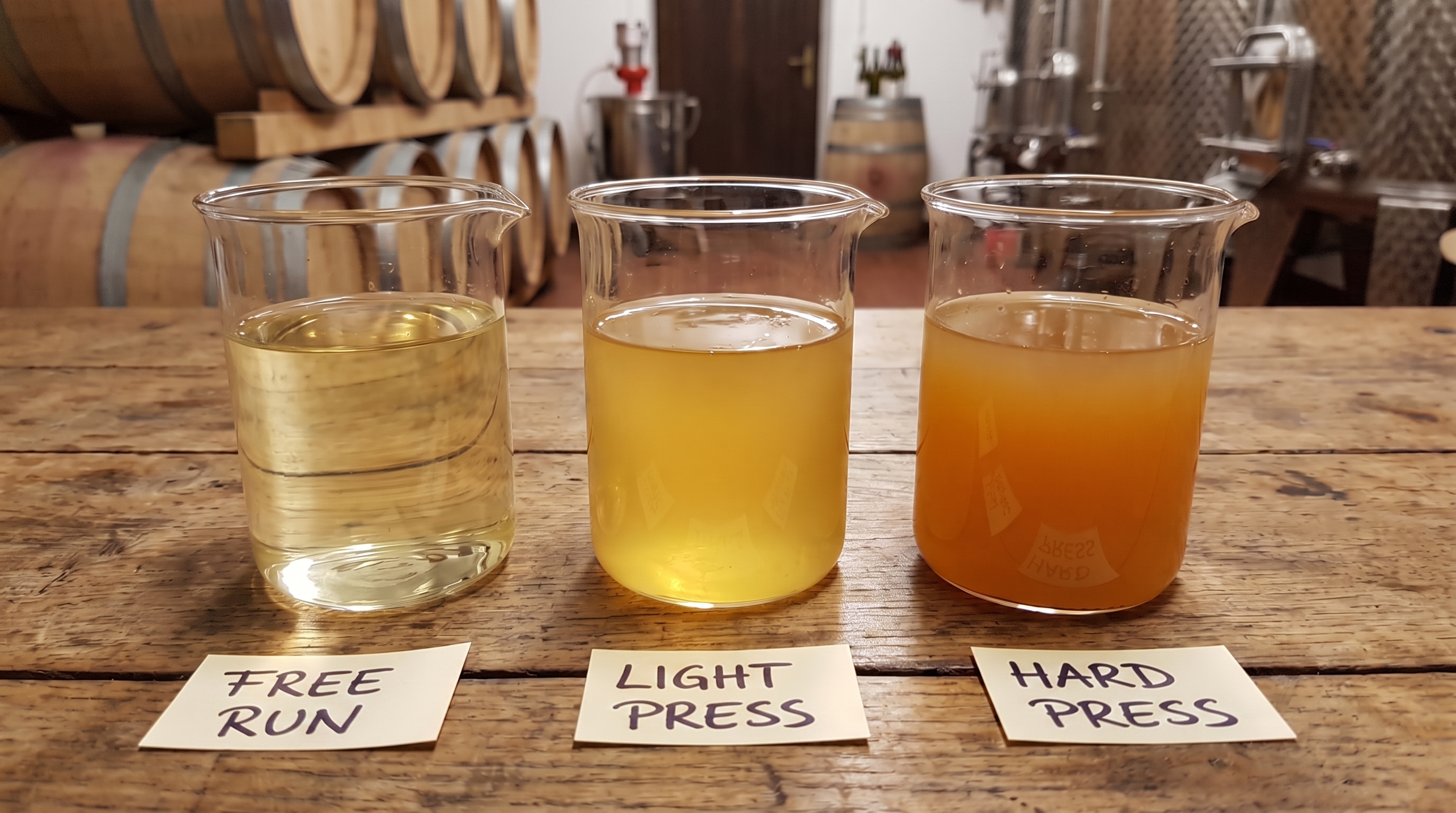
Fractionation is not just for sparkling wine. In still white and rosé wines, free-run juice, early press fractions, and later press juice can also make very different contributions to aroma, acidity, structure, color, and aging potential. Combining these musts immediately means giving up one of the most effective ways to manage quality and select the appropriate must treatment without later corrections.
At a minimum, free-run juice and press juice should be evaluated separately. In the premium segment, several clearly defined fractions are useful, provided sufficient tanks, cooling capacity, and documentation are available. The switching point should be determined not solely by time or volume, but by must flow, taste, turbidity, pH, color, and, where appropriate, dissolved oxygen. Ideally, fraction changes would also be guided by polyphenol content.
Fractionation does not automatically mean discarding later fractions. They may be valuable for a different wine style, separate fermentation, or later targeted blending. The key is to make the differences visible and manageable first.
Choose the Right Program for Every Lot of Grapes
A standard program can provide a reliable starting point, but it cannot replace an enological objective. The press program must be suited to the grape variety, vintage, ripeness and condition, harvest temperature, harvesting method, press type, and desired wine. A sparkling base wine requires different priorities than an aromatic white wine or a color-stable rosé.
This is especially true of automatic or so-called intelligent programs. Many algorithms initially optimize throughput and yield. For premium quality, pressure stages, hold times, pressure compensation, crumbling, and fraction boundaries must be deliberately aligned with the target wine profile. In the interest of quality, the program should be controlled to maintain a consistent flow of must.
Let the Senses Lead—Confirm with Measurements
Regular sampling remains the most important control. Color, aroma, taste, turbidity, and flow behavior often reveal a change in fraction earlier than a fixed time-based program. A tasting glass at the press outlet is therefore just as essential as a well-defined sampling plan.
Measurements of volume or flow rate, turbidity, and pH are particularly useful. For stringent quality requirements, measurements of dissolved oxygen, polyphenol content, and conductivity can provide additional insight. What matters is not having the greatest possible number of instruments, but selecting a small, consistently documented set that actually informs decisions.
Hygiene and Learning Are Part of the Press Program
Spilled must, warm holding areas, and hard-to-reach lines are prime trouble spots. Crates, the receiving area, the press, collection vessels, hoses, and tanks must therefore be cleaned as an integral part of the harvest rhythm. Cleaning is not a break from the process; it is a planned process stage.
Documentation is equally important. Recording the grape condition, temperature, loading time, program, pressure profile, must flow, fraction boundaries, analytical data, and sensory impressions for each lot creates a winery-specific knowledge base. In this way, a good pressing operation becomes a reproducible process the following year.
The 60-Second Harvest Check
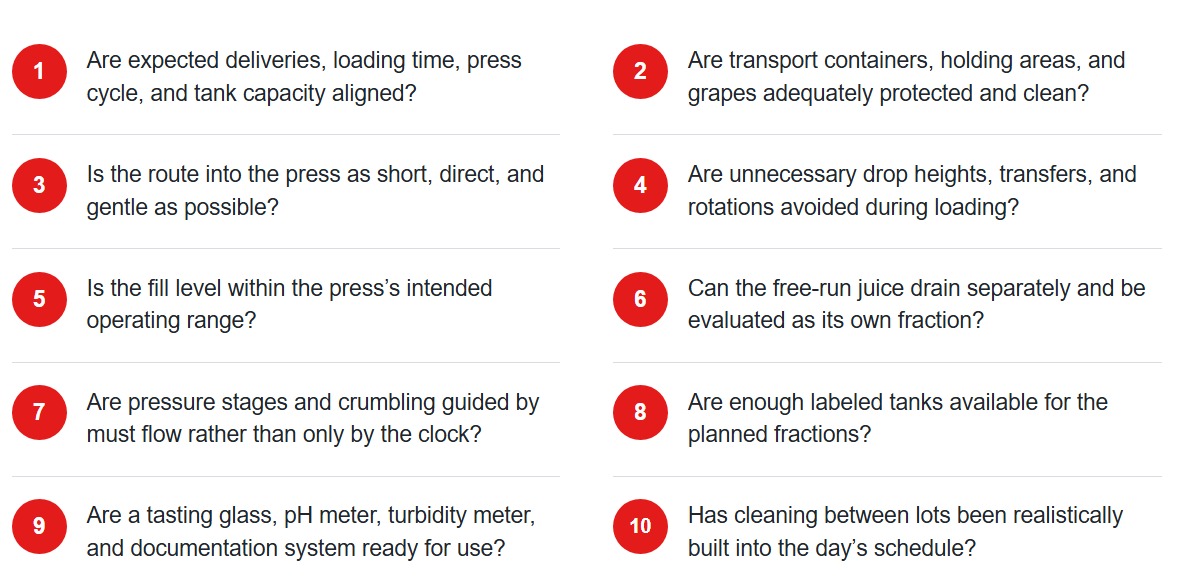
The press is the culmination of the work in the vineyard and, at the same time, the starting point for the work in the cellar. Its primary task is not to extract as much juice as possible as quickly as possible. It should reveal the grapes’ quality potential, separate the fractions cleanly, and preserve that potential for further winemaking. This provides the foundation for the best possible economic result.
Scope: These recommendations primarily apply to the direct processing of grapes for white, rosé, and sparkling wine. For red wine, pressing usually takes place only after fermentation on the skins; however, the principles of gentle handling, separate fractions, and sensory and analytical control remain relevant.
Sources
Secondé, Nicolas (2025): The Press and Its Programming: Operating Instructions. L’Enologo, No. 7–8/2025.
Comité Champagne (2024): Cahier des charges de l’appellation d’origine contrôlée Champagne. View source
Comité Champagne: Arrival at the pressing centre. Official overview of gentle pressing and fractionation. View source
Shanshiashvili, G. et al. (2024): Insight the impact of grape pressing on must composition. IVES Conference Series. View source
Marchal, R. et al. (2022): Impact of press fractioning on current and phenolic compositions of Pinot noir and Pinot meunier wines. IVES Conference Series. View source
García-Roldán, A. et al. (2026): Influence of pressing conditions on the chemical composition, oxygen consumption rate and tyrosinase activity of the grape must. OENO One. View source
Shanshiashvili, G. et al. (2025): Extraction of Grape Juice: Impact of Laboratory-Scale Pressing Methods on the Chemical Composition. Beverages 11(1), 23. View source
More about Willmes and Armbruster
Willmes Armbruster deliver integrated grape processing solutions from vineyard-to-cellar, combining leadership in gentle grape pressing with expertise in grape reception, destemming and sorting. Through customized, high-quality systems, we help wineries achieve optimal grape quality, maximum efficiency, and superior juice results at every step.