

You can’t report what you haven’t identified
Reporting for any EPR Program starts with the same question: what packaging did you use on the things you sold, and what is it made of?
It sounds simple. Then you start listing it out. There’s the bottle, of course, and the cork and the capsule. The box, and the dividers inside it. The shipping box for the wine club, and the pulp trays that keep the bottles from breaking. The tape. The tasting room bags. The gift boxes you bring out for the holidays.
Suddenly you’re looking at a list of 20 or 30 things you buy from a dozen different vendors, and you’re not sure what half of them are made of.
That’s what this post is for. Whether you’re filing reports in California, or you’re exempt in California but ship wine to customers in Oregon, Colorado, or another EPR state, you’ll need the same information: a list of your packaging, the weight of each piece, and what each piece is made of.
In this post, you’ll learn:
• What counts as packaging for a small winery, channel by channel
• How to weigh each piece accurately (and why rounding is a costly mistake)
• How to find out what your packaging is made of, including any plastic
• Why California cares so much about plastic
• How to get the details from your vendors, with free email templates to make it easy
If you’re new to the EPR Program, start with our overview, EPR for Wineries: Start Here.
This post goes deep on Step 5 of that roadmap: documenting your packaging.
Two different questions: “What is packaging?” and “Is it covered material?”
Before we start, keep one distinction in mind.
“What is packaging?” is a different question from “Is it covered material?”
This post answers the first question only. Your job right now is to make a complete list of the packaging your winery uses.
The second question depends on the state’s rules and regulations. Covered material is the term the regulations use for the packaging an EPR Program applies to, and not all packaging is considered covered material in every state.
Think about going to the grocery store. Your rule is “I’m only going to buy what is on my shopping list”. When you get to the checkout, though, another set of rules applies. The government decides “We’re only going to tax these items and not those.”
Here’s the one example of material that is not covered in California: the glass bottle is not covered material because it’s already part of the CRV program. Other states treat it as covered material. So the glass bottle goes on your list, even though it isn’t covered material in California.
We’ll look at covered material and the reports in the next post. For now, list everything.
The package around your wine (primary packaging)
Start with the package that holds the wine itself. These are the primary packaging materials:
• Container: the glass bottle
• Closure: the cork or screwcap
• Capsule: if you use one
• Label: front and back
These are primary materials because they contain the wine or are attached to the container that does.
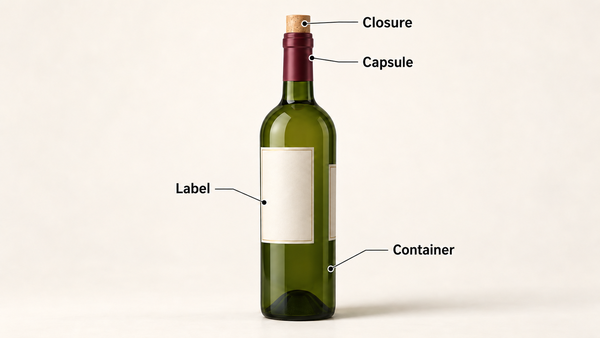 Primary packaging: container, closure, capsule, and label
Boxes and inserts (secondary packaging)
The regulations say packaging also includes the materials used for grouping, protection, handling, delivery, or presentation. That’s where secondary and tertiary packaging come in.
Secondary packaging groups your bottles together. For most wineries, that’s the box. To keep things simple, include the dividers or inserts with the box.
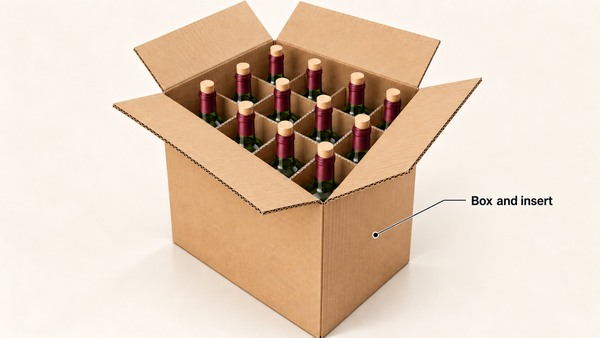 Secondary packaging: the box and its inserts
Pallets, wrap, and box labels (tertiary packaging)
Tertiary packaging protects your wine while it travels to distributors and wholesale accounts. For a winery, that usually includes:
• Pallets
• Stretch wrap
• Labels on the boxes
• The pallet label
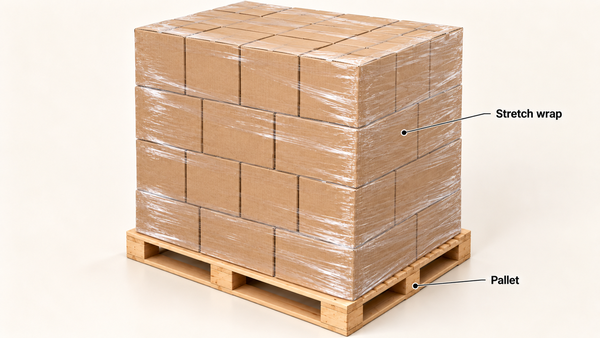 Tertiary packaging: pallet, stretch wrap, box labels, and pallet label
I’m not going to quibble over the exact distinction between primary, secondary, and tertiary, because the categories overlap. The key thing is to identify every piece of packaging your winery uses. The categories matter later, when you work out what each state wants you to report.
If you sell DTC, your list gets longer
If you sell only through distribution, the list above is most of what you need. If you sell direct to consumers, there’s more.
Tasting room
When customers carry wine out of your tasting room, they often take it in something:
• Bags
• Bottle carriers
• Totes
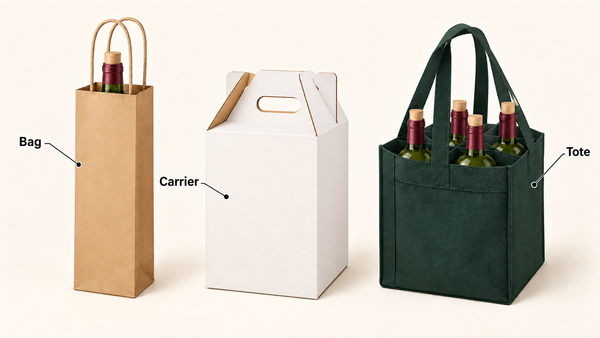 Tasting room packaging: bags, carriers, and totes
Wine club and eCommerce shipments
When you ship wine through your club or web store, you add packaging that protects the wine on its way to the customer:
• Shipping boxes
• Trays or inserts (molded pulp, foam, or corrugated)
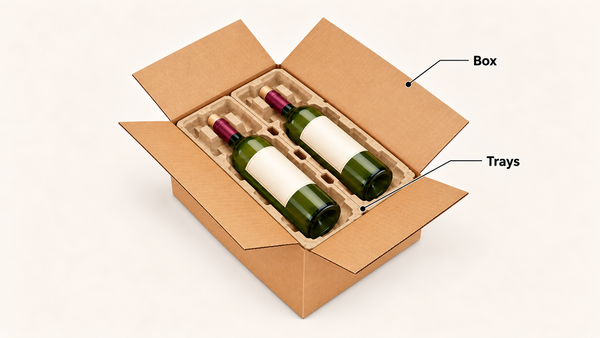 DTC shipping packaging: box and trays
And don’t forget the small stuff that holds the shipment together:
• Tape
• Shipping labels
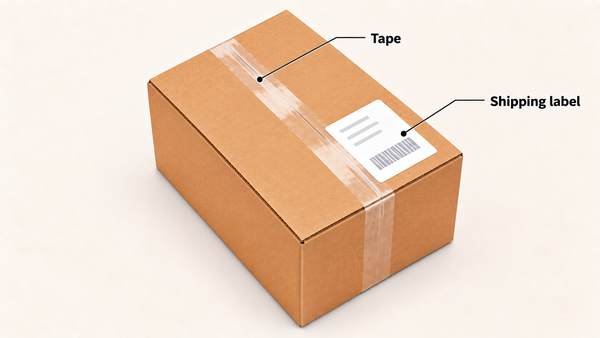 The small stuff: tape and shipping label
What if a fulfillment house ships for you?
If a fulfillment house packs and ships your wine club or eCommerce orders, the packaging it selects and buys (shipping boxes, trays, tape) is its responsibility, not yours. But any packaging you provide to the fulfillment house is still yours to report, so it goes on your list.
Gift boxes
If you use gift boxes or wooden crates, they’re secondary packaging too. Their main job is presentation more than protection, and packaging for presentation is one of the purposes the regulations list.
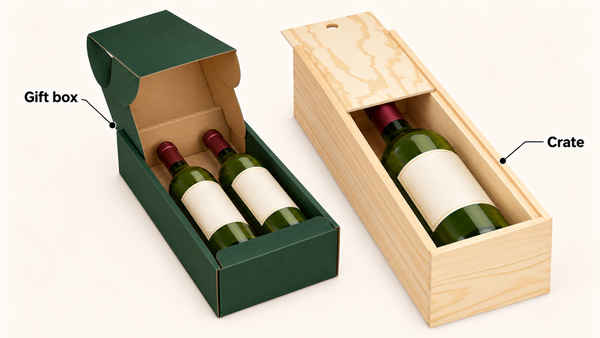 Gift boxes and crates
What about merch and club gifts?
In our Start Here post, we said the EPR producer is generally the business whose brand is on the product. So what about branded merchandise, or the little gifts that go into a club shipment?
The merch itself isn’t packaging. But the packaging around it might be. Picture a box of chocolates with your winery’s logo: the tin and the plastic wrapper are packaging, and your brand is on the product.
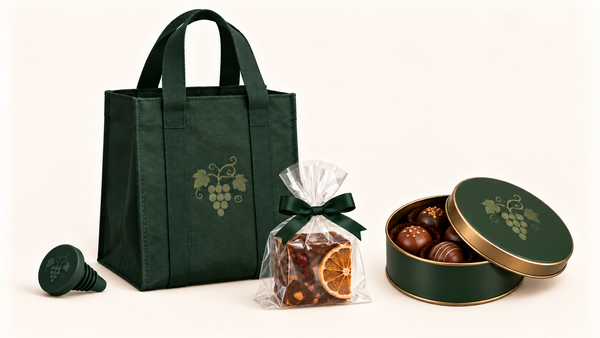 Branded merch and club gifts: the packaging around them may count
I’m not going to go down this rabbit hole here, because this is a gray area. Check with your attorney or packaging consultant about your specific items.
What I will say is this: don’t let the gray areas stop you from documenting the obvious packaging first. Start with the bottles, wine boxes, and shipping boxes. Those make up most of the weight you’ll report. A chocolate tin is small by comparison, unless you start selling more chocolate than wine. In that case, you’re in a different business.
Your packaging checklist
Use this as a starting point. Your list will look a little different depending on how you sell, and the images in this post are examples, not a complete list.
Where it’s used | Packaging to list |
|---|---|
Every bottle | Bottle, closure, front and back labels, capsule (if used) |
Distribution and wholesale | Boxes, dividers and inserts, box labels, pallets, stretch wrap, pallet labels |
Tasting room | Bags, bottle carriers, totes |
Wine club and eCommerce | Shipping boxes, trays and inserts, tape, shipping labels |
Gifts and presentation | Gift boxes, packaging around branded merch and club gifts |
Remember that most wineries use more than one version of some items. You might have different bottles (magnums, sparkling, splits) or different corks (100% natural, composite, sparkling). Each version gets its own line on your list of materials.
Once your list is done, you need two pieces of information for every item:
• how much it weighs
and
• what it’s made of.
Step 1: Weigh it
The weight is the easy part. Get out a good postal or kitchen scale and weigh everything.
Use grams. EPR reporting multiplies small numbers many times, and grams are easier to work with than fractions of an ounce or pound.
Weigh the small things in batches
Corks, capsules, and labels only weigh a few grams each, which is too small for most scales to measure accurately one at a time. So weigh 10 of them together and divide by 10.
Keep the decimals. Don’t round.
Here’s why: Say 10 corks weigh 41.7 grams, so each cork weighs 4.17 grams.
Round that to 4 grams and you’ve dropped 0.17 grams per cork.
That sounds like nothing. But if you sell 5,000 cases a year, that’s 60,000 corks.
Multiply 0.17 grams by 60,000 and you’re off by 10,200 grams, or more than 22 pounds.
And that’s just one item on one SKU.
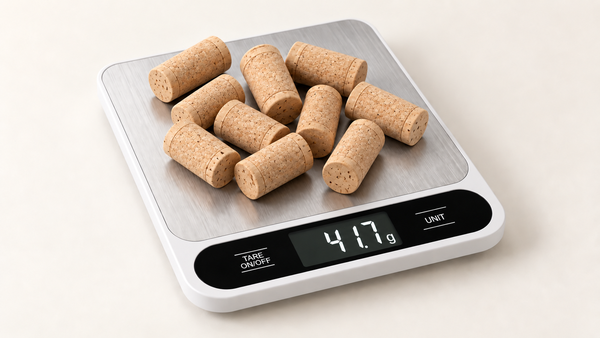 Weigh 10 corks, then divide by 10
Weigh each box size separately
You probably have more than one box size. For example:
• A standard 12-pack of 750 ml bottles
• A 6-pack of magnums
• A 12-pack for sparkling wine (this one is usually heavier)
• A 12-pack of splits
Weigh each one empty, with its dividers and inserts. You want only the weight of the box. No wine bottles
Do the same for your DTC shipping boxes and trays. Weigh each type you use.
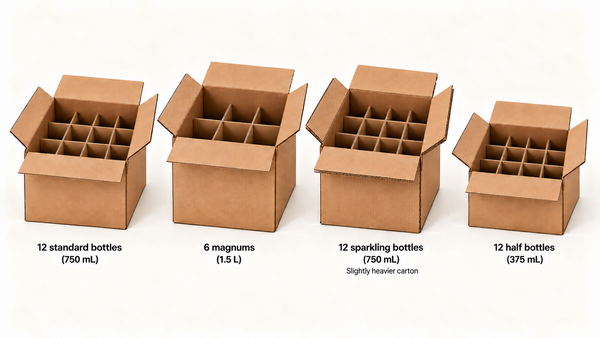 Weigh each box size empty, with its insertsStep 2: Find out what it’s made of
The last piece of information you need is the composition of each item: its main material, whether it includes any other materials, and whether it contains any plastic and, if so, how much.
The easy ones
A few winery packaging materials are straightforward:
• The glass bottle
• An untreated, 100% natural cork
• An ordinary corrugated wine box
For these, you can usually write down the material with confidence.
The not-so-easy ones
After that, the packaging wild goose chase begins. Some materials look simple but aren’t.
There could be plastic hiding in places you wouldn’t expect.
• A composite cork is mostly cork, but the binder that holds the cork granules together may include plastic.
• A label looks like paper, but the adhesive, the coating, or the face stock itself may contain plastic.
You can’t tell by looking. The only way to know for sure is to ask the vendor.
Check what you already have first
Before you email anyone, look through what’s already in your files. Start Here described how most wineries already have a lot of this information. It’s just scattered. Look for:
• Spec sheets from your glass, closure, and box suppliers
• Label proofs from your printer, which often list the paper and adhesive
• Product pages on your vendors’ websites
• Past invoices, which at least tell you what you bought and from whom
Anything you find here is one less question to ask. Anything you can’t find goes on your vendor email list.
Why California asks about plastic
You might wonder why all this attention goes to plastic. A label that’s 98% paper is still mostly paper, right?
The answer is that California’s EPR law, SB 54, was driven largely by concerns about plastic pollution. Its full name is the Plastic Pollution Prevention and Packaging Producer Responsibility Act (we refer to this as SB 54 and not PPP&PPRA). While it covers packaging of every material, plastic has its own set of goals:
• Reduce plastic packaging. Producers as a group must cut plastic packaging 25% by 2032, with steps along the way (10% by 2027 and 20% by 2030). That reduction is measured two ways: by the weight of plastic, and by the number of plastic components.
• Recycle more of it. Plastic packaging on products sold in California must reach a 65% recycling rate by 2032.
• Pay for plastic pollution. Starting in 2027, producers will pay $500 million a year for 10 years to help reduce the environmental effects of plastic pollution in California.
To measure progress toward those goals, California needs to know how much plastic is in the packaging on products sold in the state, even when it’s a small amount buried inside a cork or a label. That’s why one of California’s reports is the Annual Source Reduction Report, and why Start Here’s roadmap tells you to identify the weight of any plastic in each component.
So for every item on your list, you need to answer two plastic questions:
Does it contain any plastic?
If so, how much?
Those two questions are why the vendor emails matter.
Step 3: Email your vendors
Only your vendor can tell you exactly what’s in the products they sell you. And because it can take weeks to hear back, start this step now, even before the rest of your list is finished.
Free vendor email templates
To make this easier, I’ve put together free email templates you can send to each of your vendors. Each template is written for a specific type of vendor and asks exactly what you need to know:
• What the item is made of
• Whether it contains any plastic
• If it does, how much
• Whether it includes any post-consumer recycled (PCR) content, which some other states ask about
Download the free vendor email templates
You’ll likely send templates to vendors like these:
Vendor | What you’re asking about |
|---|---|
Glass supplier | Bottle weight, if you don’t have any empties on hand |
Keg or other container supplier | Container and component weights and materials, and any plastic |
Cork supplier | Cork material, including any plastic in a composite cork |
Screwcap or crown cap supplier | Cap materials and any plastic |
Capsule supplier | Capsule material and any plastic |
Label printer | Paper, adhesive, and coatings, and any plastic in them |
Box supplier | Box and divider material, and any plastic or coatings |
Shipping supplies vendor | Shipping boxes, trays, tape, and labels, and any plastic in them |
Decoding the vendor’s answer
Here’s what often happens next. The vendor replies, and the answer is a chemical name you’ve never seen before. Is that plastic or not?
That’s why the download also includes a ChatGPT prompt you can use to find out whether the chemical names your vendor gives you refer to any plastic.
A word of caution about asking ChatGPT instead
You might be tempted to skip the vendor and ask ChatGPT what your packaging is made of. Treat any answer you get that way as an assumption, not a fact.
There are two reasons. First, the materials common at small wineries aren’t necessarily common across the wine industry. Information about large wineries’ packaging shows up far more often in the industry publications that ChatGPT draws from for its “research.” So its answer may describe someone else’s packaging, not yours.
Second, ChatGPT can tell you whether an ingredient name means plastic. But that alone doesn’t tell you how much plastic is in your particular product. Treat any percentage that didn’t come from your vendor as an unverified estimate.
Use ChatGPT to translate your vendor’s answer. Don’t use it to replace your vendor’s answer.
What to record for each item
As the answers come in, keep everything in one place. In Start Here, we described what it looks like when the EPR Program is under control: every piece of packaging, what it’s made of, and what it weighs, saved in one document instead of scattered across files and inboxes. This is where you build that document.
A simple spreadsheet works. For each item, record:
Column | Example |
|---|---|
Item | Natural cork, 49 mm |
Vendor | [Your cork supplier] |
Used on (SKUs) | All 750 ml still wines |
Weight per unit (grams) | 4.17 |
Main material | Cork |
Contains plastic? | No |
Plastic weight per unit (grams) | 0 |
Recycled content (PCR) | None |
Source of the information | Vendor email, March 2026 |
That last row is easy to skip, but don’t. When the CAA asks how you got your numbers, or when you’re updating the list next year, you’ll want to know which answers came from a vendor, which came from your own scale, and which are still estimates.
The “Used on” column matters too. It’s the first step toward a chart that lists every piece of packaging on every SKU. Later, you’ll combine that chart with your sales by SKU and by state to calculate how much material went to each state.
Fair warning: that chart can get detailed fast, and the math to match it against your sales is where most wineries get stuck. Different box sizes, gift packs, club shipments, and mixed cases all have to be counted correctly. This is exactly what our EPR for Wineries – Guide + Workbook is built to handle. The Workbook does the matching for you, so you’re not building that math from scratch.
For now, just note which SKUs use each item. That alone will save you a lot of work later.
And here’s the good news: once this list is built, it doesn’t change much. If you buy the same packaging next year, you’ll only need to update the items that changed.
The 30-second recap
What counts as packaging for a small winery:
Primary: bottle, closure, capsule, label
Secondary: boxes, inserts, gift boxes
Tertiary: pallets, wrap,, box and pallet labels
DTC packaging: tasting room bags, shipping boxes, trays, and tape
How to weigh it: in grams, small items in batches of 10, with no rounding.
How to find the composition: start with what you already have, then ask your vendors, including whether there’s any plastic and how much.
And remember: “What is packaging?” and “Is it covered material?” are two different questions. You’ve now answered the first one.
Where to go next
Get EPR updates? Sign up for our newsletter where we share EPR updates and other information useful for the small wineries..
Ready to get it done? Our EPR for Wineries – Guide + Workbook translates California’s EPR rules into just what a winery needs to know, and the workbook does the math for you. With your packaging and sales data in hand, open a bottle of wine, and you will be finished in no time.
New to the EPR Program? Read EPR for Wineries: Start Here for the full overview and the 8-step roadmap.