


vinSUITE
1625 Trancas St #2280, Napa, CA, United States of America, 94559
vinSUITE Partners with Propelr to Give Wineries More Control Over Payment Processing

New integration brings transparent, negotiable payment processing across ecommerce, wine club, and the tasting room, with a no-obligation way to compare costs first

Napa, CA, July 7th, 2026 – vinSUITE, the software platform built for the winery direct-to-consumer market, today announced a partnership with Propelr to give wineries a new payment processing option across ecommerce, wine club, and tasting room transactions.

The integration gives wineries more than one payment processing option to choose from, along with transparent, negotiable processing and live, 24/7 support. Rather than being limited to a single provider, wineries can choose the option that fits how their business runs, and revisit that choice as their needs change.

Payment processing can be one of the most significant recurring costs for a winery’s DTC business, yet many wineries do not have a clear view of what they are paying, where fees are coming from, or whether better options are available. The Propelr integration is built to help change that.

Before committing to anything, wineries can request a complimentary, no-obligation statement analysis that compares their current processing costs against Propelr’s pricing. The analysis is designed to identify potential savings opportunities, unnecessary or hidden processor fees, and effective-rate improvements so wineries can make a more informed decision before switching.


“Wineries tell us all the time that payment processing is hard to understand, hard to compare, and hard to change,” said Jimmy Wu, President of vinSUITE. “With Propelr, they get a clearer look at their costs and a practical way to evaluate a new option across the tools they already use to run their club, tasting room, and online store.”

Through the integration, wineries can accept credit cards, debit cards, ACH, online invoices, and digital wallets. Payments can be taken online, over the phone, and in person across wine club, ecommerce, and TabletPOS.

Propelr backs the integration with 24/7 live support, real-time reporting down to the transaction, and the option to offset processing fees through a compliant surcharge program, where available. For wineries that decide to move forward, Propelr specialists help manage the transition so they can continue taking payments without disruption.

"Partnering with an industry leader like vinSUITE is an incredible opportunity to help wineries streamline their operations across all sales channels," said Michael Mertz, President at Propelr. "By combining our advanced payment technology with vinSUITE’s robust platform, wineries have the tools and confidence they need to manage their payments smoothly, securely, and seamlessly."

The Propelr payment option is available now across vinSUITE.


00
Your Tasting Room Is Your #1 Club Acquisition Channel. Here's What Top Wineries Do Differently.

Your Tasting Room Is Your #1 Club Acquisition Channel. Here's What Top Wineries Do Differently.

A guest walks into your tasting room. They're already engaged. They're already drinking your wine. They're already emotionally invested in the experience.

And then they leave without joining your club.

If that sounds familiar, you're not alone. SVB's Direct-to-Consumer Wine Survey benchmarks conversion rates at 8 to 10% for top-performing tasting rooms, but the average is significantly lower. That means most wineries are leaving signups on the table at the exact moment guests are most ready to say yes.

With tasting room visitation down roughly 8% year over year and wine clubs now accounting for 39% of total DTC sales, the pressure to convert visitors into members has never been higher. The good news is that the wineries growing their clubs aren't doing anything mysterious. They're executing three things consistently. Here's what to focus on.

1. Make the ask easy in the moment

The single biggest predictor of tasting room club conversion isn't the offer, the tier structure, or even the wine. It's how quickly and cleanly your staff can enroll someone once they say yes.

Every winery has lost a signup this way. A guest is enthusiastic. The staff member steps away to grab a laptop. Someone else at the bar needs a pour. A phone rings. The moment passes. By the time the paperwork is ready, the guest has cooled off.

Your POS should let staff open a new club enrollment in seconds, capture the guest's information, assign their tier, and apply the first-visit member discount before the conversation gets cold.

This is one of the most underappreciated factors in club conversion. The technology either makes the ask easy or it makes it awkward. There is no middle.

2. Follow up within 48 hours, and make it personal

Not every guest is ready to join at the bar. That's fine. What matters is what happens next.

Wineries that follow up with tasting room visitors within 48 hours convert at meaningfully higher rates than those who wait. A generic "thanks for visiting" email a week later almost never moves the needle. A specific email that references the wines the guest tried, sent while the memory is still fresh, does.

This only works if your tasting room POS is capturing guest data at the register and feeding it into a CRM your marketing team can actually use. If that data lives in a spreadsheet or worse, in your team's memory, personalized follow-up isn't happening at scale.

The wineries doing this well have a second segment worth building too: repeat buyers who haven't joined the club. If a guest has visited three times and bought a bottle each time, that's not a missed sale. That's a warm prospect waiting for the right nudge.

3. Offer flexibility that removes the objection before it happens

The most common reason guests decline a club signup isn't lack of interest. It's the perception that the commitment is too rigid.

Wine Market Council's research consistently shows that flexibility is one of the top motivators for joining a club, second only to member discounts. Guests want the option to pause a shipment, swap a bottle, or adjust their tier. When your club offers those options and your staff can explain them clearly, the "I'm not sure I want to commit" objection disappears.

A well-structured tier system helps too. A two-bottle quarterly entry tier removes the barrier for wine-curious guests. A six-bottle tier with library access appeals to your most enthusiastic buyers. Each tier should have a value proposition your team can explain in two sentences or less. If the explanation takes longer than that, the signup is already at risk.

Where technology fits in

None of this is new. Most tasting room managers already know that great experiences, fast enrollment, timely follow-up, and flexible tiers drive signups. The gap is usually execution, and execution problems are often technology problems in disguise.

When your tasting room POS, wine club management, ecommerce, and CRM live in separate systems, staff spend more time switching between tools than talking to guests. Signup flows get clunky. Follow-up emails pull from incomplete records. Members who want to update their shipment have to call instead of self-serving.

At vinSUITE, we've spent 20 years helping small and mid-sized wineries run their DTC operations from one connected platform. TabletPOS lets staff enroll new members from the counter in seconds. Guest data captured at the register flows directly into the CRM, ready for follow-up campaigns. Wine club, ecommerce, and tasting room live on the same backend, so what your staff sees, your members see, and your marketing team sees are all the same version of the truth.

The wineries growing their clubs the fastest aren't necessarily the ones with the biggest marketing budgets. They're the ones who removed friction at every step of the acquisition process, from the pour to the ask to the follow-up.

Book a demo with vinSUITE to see how it works for wineries like yours.

00
Beyond Wine: Customer Growth Strategies Wineries Can Borrow from High-Performing Industries

Event Type: Webinar

Date: 7/28/202611:00 AM to 12:45 PM

Beyond Wine: Customer Growth Strategies Wineries Can Borrow from High-Performing Industries

Many of today's most effective customer acquisition, retention, and loyalty strategies weren't developed in the wine industry. They emerged from technology companies, subscription businesses, hospitality brands, and consumer platforms that have mastered customer engagement. In this session, we'll explore seven proven approaches wineries can adapt to strengthen customer relationships, increase loyalty, improve retention, and create more meaningful guest experiences. The goal isn't to copy other industries. It's to identify principles that can be translated into the unique world of wine.

Register here.

00

Wine Club Members Rarely Cancel Out of Nowhere. Here’s What to Watch For Before They Do.

In our recent webinar with Sovos ShipCompliant, we talked about a challenge many wineries know too well: wine club cancellations rarely happen without warning.

Most of the time, the signals show up earlier.
Engagement drops.
Shipments get skipped.
Purchase behavior changes.
The member starts drifting long before they officially cancel.

That was one of the big takeaways from the conversation. In a tougher DtC market, retention has to start before the cancellation report. Wineries need better visibility into which members are still engaged, which ones are slipping, and where to focus outreach before the window closes.

We recapped the key points in this blog, including the churn patterns wineries should watch for and how RFM segmentation can help teams act sooner.

Read the recap: https://vinsuite.com/wine-club-churn-signs-before-cancellation

00
vinSUITE’s New vinSIGHT Helps Wineries Predict and Prevent Lost Sales

Combating declining consumption and tasting room visits is the current pressing priority for small and medium-sized wineries whose primary source of revenue has been direct-to-consumer (DtC) sales. Waiting for the situation to change is no longer an option. Instead, wineries are turning to their existing customers to maximize short-term revenue and draw in new customers to rebuild their base. 

This task can seem daunting, but wineries with the vinSUITE integrated DtC software platform have a powerful new tool at hand. The recently released vinSIGHT transforms the sales data automatically collected by vinSUITE into actionable insights. This new predictive analytical platform analyzes the winery’s historical customer behavior patterns and predicts wine club churn with up to 94% confidence, enabling wineries to prevent revenue loss before members cancel.

Jimmy Wu, vinSUITE’s President, explains: “By the time wine club churn shows up in standard reports, that revenue is already lost.  vinSIGHT  changes that by bringing into view hidden patterns that signal disengagement long before a cancellation occurs, such as declining engagement, reduced interaction and other changes in purchase patterns.  vinSIGHT  gives wineries the ability to see these warning signs weeks or even months in advance, providing the clarity and foresight needed to save relationships and protect their revenue.” 

vinSIGHT  is only one part of Wu’s strategy to help its customers succeed. He emphasizes the value of “breaking bread over dinner with our customers to understand their daily challenges and identify pain points.” Wu believes that by proactively engaging rather than waiting for customer issues to arise, the vinSUITE team can design solutions like vinSIGHT to help winery customers overcome their challenges. 

“Our new leadership philosophy is to drive home our customer service for clients and reflect the impressive level of their hospitality,” Wu says. “Feedback on vinSUITE and vinSIGHT has been very positive.” In addition to predicting churn, the feedback Wu is receiving has led to new reports that help wineries better segment their club members and create more targeted marketing messages. The vinSUITE staff have winery backgrounds and share their winery customers’ passion for the industry. They help wineries properly integrate data into the system, so when they make a sale, they know where it’s coming from—down to the county or city.

For over twenty years, Napa-based vinSUITE, a subsidiary of Constellation Software, Inc ., has helped wineries in California and throughout the US navigate industry headwinds. Its DtC software platform integrates and streamlines wine club management, tasting room POS and eCommerce operations with reports and other analytical tools. 

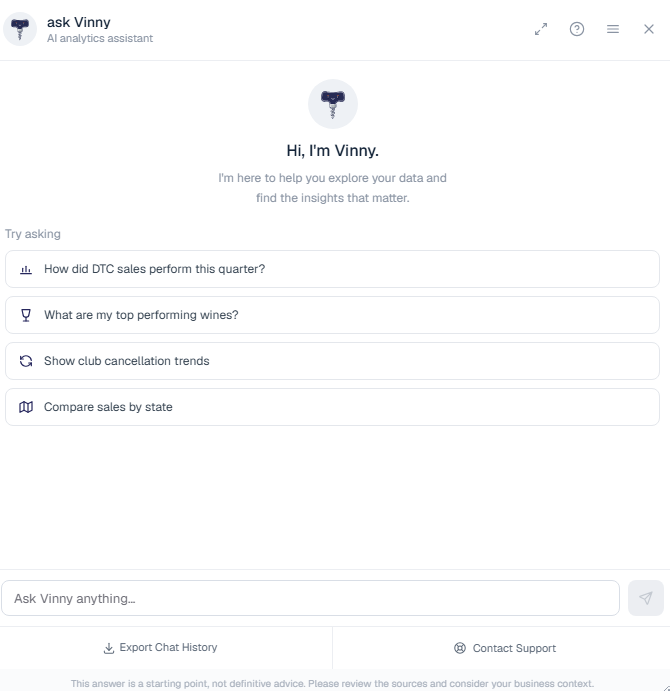
vinSUITE’s next step in elevating its user-friendliness is a chatbot that will make analytics more accessible to everyone, even those who may not be numbers-oriented. They’ll be able to ask the chatbot questions about any issue, just as they do with ChatGPT or other chatbots, but the analytical definitions and insights they receive will be based on each winery’s vinSUITE database of sales history, club member behavior, tasting room sales and e-commerce. 

Stop by vinSUITE’s booth at the Wine Sales Symposium for a demo of the new predictive vinSIGHT and upcoming innovations.

Use code VINSUITE2026 for a discount and register here .

00

Wine Club Scorecard

For Winery Owners, GMs & Wine Club Managers


Your Wine Club Deserves Better Than a Best Guess


Talk to enough wine club managers and a pattern starts to emerge. The club is running. Shipments are going out. Members are renewing, mostly. And yet there is this persistent, low-grade frustration that things could be doing so much more, and nobody can quite agree on what better actually looks like or where to start.


That is not a people problem. It is not even really a strategy problem. It is what happens when you are managing something genuinely complex without a clear baseline to work from.


Wine clubs are one of the most valuable revenue channels a winery can have. Done well, they create reliable recurring income, deepen customer loyalty, and turn occasional buyers into genuine advocates. But they are also difficult to manage well. You are balancing member experience, logistics, pricing, retention, acquisition, and brand storytelling all at once. And most teams are doing it without any real benchmark for how they are performing relative to what is possible.


You fix what is loudest, not necessarily what matters most.

So decisions get made on feel. Churn ticks up and the instinct is to throw a discount at it. Acquisition slows and suddenly everyone is debating whether to restructure the club tiers. Revenue per shipment plateaus and nobody is quite sure if that is a pricing issue, a product issue, or just the market.


What the best clubs do differently

The wineries that run their clubs well tend to have one thing in common: they have taken the time to actually understand where they stand. Not in a vague, gut-check kind of way, but specifically. They know their retention rate and what is driving it. They know which member segments are most valuable and why. They know where their acquisition funnel leaks and what a realistic cost per new member should look like. That clarity changes how they make decisions.

Most clubs do not have that clarity. Not because the people running them are not capable, but because nobody ever gave them a framework to build it from. That is the gap the Wine Club Scorecard was designed to fill.


What you actually get

The Wine Club Scorecard is a free assessment built specifically for winery owners, GMs, and wine club managers who want an honest read on how their club is performing. It covers the areas that actually drive club health: member retention, acquisition strategy, engagement, revenue per shipment, and overall club structure.


You answer a series of questions about how your club operates today, and what comes back is a genuine report with benchmarks, clear data on where you stand, and specific steps you can take to improve. Whether your club has 200 members or 2,000, the output is the same: real information you can act on.


The whole thing takes about five minutes. And the conversations it tends to start, with your team, with ownership, with whoever makes decisions about where to invest, are usually long overdue.


If you have had that nagging sense that your club is running but not quite performing, this is a good place to start. Not because it will hand you a magic fix, but because you cannot fix what you have not clearly identified. A lot of wine clubs are leaving real money and real member relationships on the table, not out of negligence, but simply because no one has stepped back to look at the full picture.


Now is a good time to look.

Free report. Benchmarked data. Clear next steps. Takes five minutes.

Take the Free Scorecard wineclubscorecard.com


© 2026 WineClubScorecard.com  ·  Built for the wine industry.

00
Why Influencers Are Suddenly Working for Wine (And What Most Wineries Miss)


Wine Ignored Influencers. Now It Needs Them.

The wine industry once mocked influencers.

Now, even Forbes is saying we may need them.

As wine faces declining consumption and changing buyer behavior, the voices once dismissed as “unserious” are starting to look a lot more powerful. Read the Forbes article →

What’s interesting is, we’ve been talking about this shift for a while.

Last year, we hosted a webinar with MiniSocial on how wineries can use micro-influencers and user-generated content (UGC) to drive engagement and sales.

Here’s what still holds true:

  • UGC outperforms brand content—everywhere
    Content created by real customers feels more natural—and consistently drives higher engagement across social, ads, and email.
  • Micro-influencers build trust faster
    Smaller audiences, but far more engaged—and far more believable than traditional ads.
  • Your customers are your best marketers
    UGC shows how people actually experience your wine—how they describe it, when they drink it, and why they buy again.
  • You don’t need a big budget to start
    Test with a handful of creators, send product, and learn fast. The key is actually using that content across channels.
  • The real ROI comes from reuse
    Top-performing wineries don’t just post UGC—they turn it into ads, emails, and website content.

The bigger picture:

This isn’t just a marketing trend.
It’s about building trust at scale, something the wine industry has struggled with for years.

If you want to see exactly how UGC fits into your strategy, watch the full webinar here →


👉 Take the Wine Club Scorecard to see how strong your DTC foundation really is.

00
New Approaches to Preventing Wine Club Churn


Wine club churn has always been a challenge, but the stakes are even higher as the direct-to-consumer (DtC) wine shipping channel has entered a period of sustained contraction.

With 2025 seeing the largest year-over-year declines in both DtC wine shipment volume and value — according to the 2026 Direct-to-Consumer Wine Shipping Report — the channel is smaller, more concentrated, and increasingly reliant on a pool of higher-end customers. Stabilizing revenue in this environment means wineries must be more focused than ever on retaining customers in your winery’s wine club.

In practice, churn rarely begins with a cancellation request. It typically starts with subtle changes in behavior that are easy to overlook in standard reports. This webinar will discuss:

  • What those signals are — where and how to look for them
  • How early churn forecasting differs from traditional churn reporting
  • Which member behaviors tend to signal increased churn risk before cancellation occurs
  • How forecasting enables better prioritization of retention efforts based on member value and risk
  • Why retention has become a primary revenue lever as DtC shipment volumes decline and average bottle prices rise

This webinar is designed for winery owners, executives, and DtC leaders at wineries of all sizes.

Can’t attend the live webinar? Register anyway and you’ll receive a link to the recording. 


Presented by Sovos ShipCompliant and vinSUITE

00

Best Wine Club Management Software for Wineries (2026 Quick Guide)

Your wine club is likely your most predictable DTC revenue stream.

Members buy on schedule. They purchase more outside of shipments. They refer friends. According to Silicon Valley Bank’s State of the U.S. Wine Industry Report, direct-to-consumer revenue, particularly wine clubs, remains one of the most controllable and margin-protective channels for wineries.

Yet many wineries are still running their wine club:

  • Manually

  • Across disconnected systems

  • On software not built for winery operations

That friction quietly costs money every week.

What Wine Club Software Should Actually Do in 2026

At minimum, your system should:

1. Increase retention

  • Flexible club levels and shipment schedules

  • Clear, automated member benefits

  • Customization options that members value

2. Reduce revenue leakage

  • Automated expired card updater

  • Clean billing workflows

  • Fewer manual errors

3. Speed up tasting room enrollment

  • POS-connected signup in under a minute

  • Automatic benefit application

  • No duplicate data entry

4. Support compliant shipping

  • Integration with compliance tools

  • Workflow checks before shipments run

5. Unify your customer data

  • One profile across POS, ecommerce, and club

  • Reporting by club level

  • Clear visibility into retention and churn

If your POS, wine club, and ecommerce don’t live in the same ecosystem, your team is likely spending too much time managing systems instead of growing revenue.


A Quick Reality Check

When evaluating wine club platforms, ask yourself:

  • How many clicks does it take to enroll a member?

  • Can staff see full purchase and visit history in one place?

  • How easily can you report retention by club level?

  • How much spreadsheet work is still required?

For small to mid-sized wineries, operational simplicity and connected data matter more than flashy feature lists.


If you're evaluating wine club software this year, we put together a detailed breakdown of what to look for, comparison criteria, and questions to ask vendors.

👉 Read the full 2026 guide here:
https://vinsuite.com/best-wine-club-management-software

00
The Hidden Signs Your Wine Club Members Are About to Cancel
 Wine Club Retention 
 
Predict Churn Risk and Act Earlier
Churn rarely starts with a cancellation. It starts with drift.
 
What drift looks like
• Stops opening emails
• Engages less with releases
• Buys less between shipments
• Feels less connected while still “active”
 
That is why retention is not one save campaign. It is a system. The fastest way to improve retention is to catch risk earlier, then focus your time on the members who are drifting.
 
3 signals that spot drift early
 
Recency
Recent opens, clicks, site activity, add-on purchases
 
Do: simple check-in or personal invite
Consistency
A normally engaged member suddenly goes quiet
 
Do: ask what they want more of, adjust cadence
Value
High lifetime value behaviors, add-ons, referrals, events
 
Do: human outreach, recognition, insider access
 
Match outreach to the moment
 
VIPs who are drifting: personal outreach that feels human.
Uncertain fit: value clarity and preference check-ins.
Core loyalists: reinforce belonging with insider moments.
Stable but quiet: light, relevant touchpoints that build connection.
 
 Read the full post 
00