
Filter Post Type
NewsVideoProductEventLink
Sort:
Most Recent
1–10 of 146

Autonomy, live from the field. Tyler Niday joined @TBPNLive to show Bonsai Intelligence running across a mixed fleet of OEM retrofits and our autonomous-first Amiga lineup, all powered by our foundation model and world model stack. We’re putting physical AI to work in rugged environments to reduce labor needs and lower capital and operating costs. Thanks to Jordi Hays, John Coogan, and the @TBPNLive team for having us and giving viewers a look at the machines in action. See you again soon. What We Covered: Real-World Physical AI: Why farming is the ultimate proving ground for off-road world models and vision-first autonomy. Mixed Fleet Deployment: Unifying factory OEM retrofits and purpose-built Amiga platforms under a single intelligent system. Economic ROI: How autonomous field ops reduce fuel, chemical, and labor overhead while maximizing daily equipment runtime. Explore Bonsai Robotics: 👉 Learn More & Request a Field Demo: https://bonsairobotics.ai/
00


For manufacturers and distributors, the true cost of wooden pallets extends far beyond the initial purchase price. Storage requirements, material handling, freight inefficiencies, product damage, and workplace injuries can quietly erode profitability across the supply chain. Wooden pallet-related accidents are a particularly costly concern. Broken boards, exposed nails, splinters, falling loads, and the physical handling of empty pallets create workplace hazards that can result in injuries, lost workdays, overtime expenses, disrupted production, and increased workers' compensation premiums. In some cases, elevated workers' compensation ratings can translate into hundreds of thousands of dollars in additional annual costs. Repsco's recycled SuperSheets offer a different approach to material handling—and a compelling financial opportunity. In one modeled scenario involving a 300-person food manufacturer operating 200,000 square feet of facilities and using 40,000 SuperSheets annually, th
00

Every few days, I like to monitor the questions and comments that Enolytics customers are asking Robin, our AI, about that winery’s own data. Here are ten examples of questions and comments that users of Enolytics have asked Robin over the course of one day: One How do I find customers who haven’t bought from us in the last two years, who live within 35 miles of the winery? Two I'm gathering data for customers whose Club Membership Status is Cancelled or On Hold. I'd like to include their total orders by channel, their total order revenue by channel, and their total shipping revenue by channel. What metrics should I use? Three Show me how to create a report of the daily count of tasters. And the monthly count of tasters, day by day. And separate them by SKU. Four Tell me all about gifting, i.e., corporate gifting, personal gifting, likely gifters, etc. Five If we can pull a list of gifting buyers on corporate domains [which is available within Enolytics], that’s the cheapest corporate
00

September 8, 2026
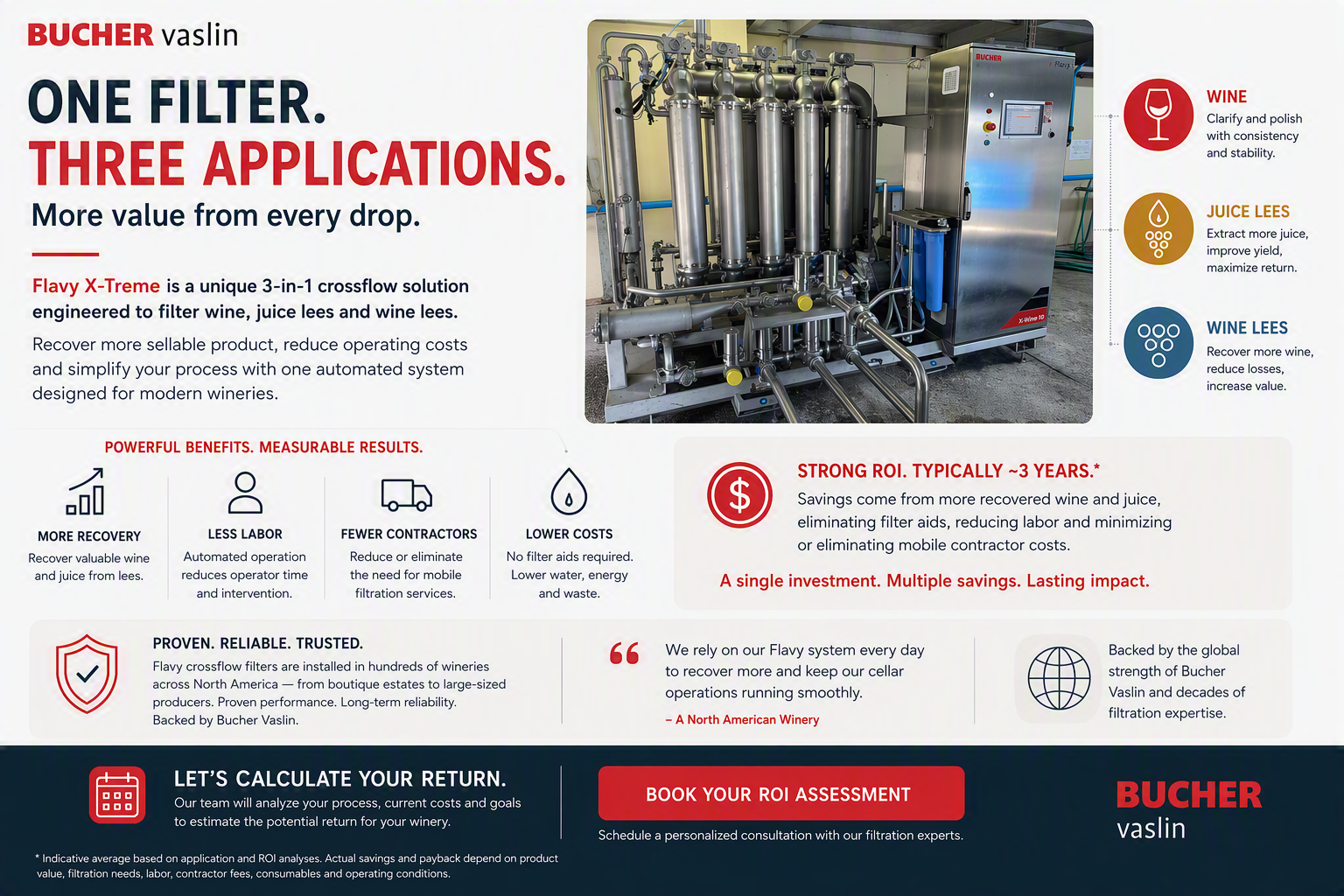
Valuable wine and juice can remain trapped in juice lees and wine lees. Flavy X-Treme is a unique 3-in-1 crossflow solution engineered to filter: Wine Juice lees Wine lees With one automated system, wineries can improve their return on investment by: Recovering more sellable wine and juice Reducing consumables, waste and disposal costs Minimizing operator time Reducing or eliminating reliance on mobile filtration contractors Together, these savings can support an average return on investment of approximately three years, depending on each winery’s production, product value and current filtration costs. Backed by decades of crossflow expertise and numerous Flavy installations across North America, Flavy X-Treme gives wineries greater recovery, autonomy and control. Let’s calculate the potential return for your winery. Call to action: Book Your ROI Assessment
00


Is your sales forecasting leaving money on the table? Sales forecasting problems in beverage alcohol don’t always look like forecasting problems. Imagine shipments are up 7%. On the surface, that’s good news. But a few months later, distributor inventory is high, the warehouse is filling up, and the next shipment forecast needs to come down. What happened? The shipment forecast may have been telling a different story than the depletion forecast. That disconnect is worth paying attention to because, in BevAlc, shipments and depletions tell us two different things. Shipments measure what leaves the winery, distillery, or brewery and goes to the distributor. Depletions measure what distributors actually sell through to retailers and accounts. Shipments may represent revenue today, but depletions provide an important signal of what the market is actually pulling. When forecasts drift apart At many beverage alcohol companies, depletion and shipment forecasts are built separately. Sales
00


I've been quiet since May. Here's the honest reason why. After the Wine Sales Symposium in Rohnert Park this spring, I stopped posting. Not because nothing was happening — the opposite. We'd just onboarded our first winery, Scott Harvey Wines, and real life hit. The product worked. It solved real problems. But the moment I watched it handle actual guests, I knew it wasn't yet something I could stand behind proudly. Maybe that's my perfectionism talking — but I couldn't market something I didn't yet believe was great. So for almost two months, we went heads-down: sharpening the AI's answers, smoothing out how the whole system feels to use, and solving problems we never saw coming when we designed it. Like the spam. When we connected that first winery's inbox, 50–100 emails were landing every day — bots, shipping notices, sales pitches. On a typical day, maybe five were real guest questions. Their team started every morning sorting, not pouring: digging for the five that mattered under a
00
Imagine if your salespeople could look into a crystal ball before every guest visit to the Tasting Room, before every outbound sales call, and before every email or text they send. Imagine if the crystal ball could tell them answers to questions like this: 1 - The customer’s last sale, and the cadence of their purchases. What was their most recent purchase, and in which channel? Who was the last sales associate they interacted with, and when? Are there any flags or signals to their purchasing patterns you should know? 2 - The arc of their Club membership. When did they join? Has their membership been consistent? Did they upgrade? Downgrade? Customize shipments? Do they ever buy outside the Club? 3 - The bottom line of sales outreach to this customer. Which wine exactly should I pitch to this customer, and why? How many bottles should I suggest they buy? How much money will this make? What “hooks” does the customer respond to? Imagine if your sales team had access to this kind of inform
00
July 22, 2026
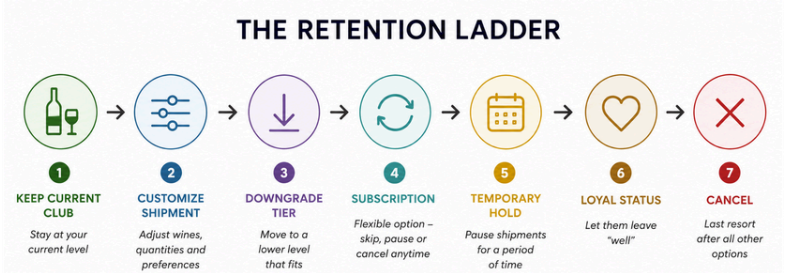
Dutton-Goldfield did it. Why can’t you? No reason at all! Ed Thralls, the General Manager at Dutton-Goldfield Winery in Sebastopol, led his team to significant improvements in their Wine Club performance. Here’s how they did it, in three key steps. 1. Stop attrition before it happens. Anticipate churn by leaning into member data, and counteract changing consumer behavior, declining traffic, and higher attrition trends. The result? 16.5% decrease in Club attrition! 2. Prioritize relationships through a Membership Success program. Shift to a metric based on lifetime value and long-term relationships. The result? Membership tenure and Club member lifetime value are both up by 7.8%! 3. Check out Ed’s unique “Retention Ladder” that visualizes Dutton-Goldfield’s Relationship Management program inside our newly-released case study, available now! Check out our new Club Retention Case Study here! We’re ready, whenever you are, to give Enolytics a try for your winery too. You can see the same
00

What To Do Next: Actionable Takeaways from Our Fall Club Webinar In last week’s Enolytics webinar, three industry DTC pros dropped best tips on making the most of your Fall wine club shipment. Here’s a summary—short and sweet!—with thanks to April Enos from Joseph Phelps, Nadia Kinkade from PEJU, and Ed Thralls from Dutton-Goldfield. Audit data quality before club processing. Identify missing phone, email, address, or name data, and clean records up front rather than discovering gaps mid-processing. Thank you, April! Check default shipment acceptance rates by club tier. Do this at budget time and again right before the Fall shipment. If acceptance is slipping, revisit whether the wine offerings still match what each tier’s customers actually want. Thank you, Nadia! Adopt a structured retention workflow, not ad hoc outreach. Predict → Prepare → Reach Out → Take Action → Record Disposition → Follow Up → Learn → Predict Again, with special attention to new members in their first 90 days
00