

Filter Post Type
Sort:
Most Recent
Tagged:marketing
1–10 of 346
Release 2 of The Performance Marketing Playbook, written by Premier Cru Solutions in partnership with Pour Now, explains why alcohol brands face a tougher path to measurable advertising: the three-tier system, added ad platform review, and a trail that goes cold once the shopper leaves to buy a bottle at retail. The release lays out three standards for every alcohol campaign and shows how sending ads to a shoppable Pour Now Listing of licensed retailers keeps the path to purchase measurable. Download the free playbook at [LINK].
00
Premier Cru Solutions, a digital marketing agency for premium and luxury wineries, has released The Performance Marketing Playbook in partnership with Pour Now. The free five-part guide walks alcohol beverage marketers through setting a trackable goal, planning campaigns in order, and reading results market by market. It proves its merit with one winery's live two-market Meta campaign, which returned 2.67x demand on ad spend in three weeks. Release 1 opens with a simple rule: if you can't count the action, it isn't performance marketing. Get the playbook [here]
00
Black Friday for Wineries: Bundle Before You Discount
A holiday offer only works when a shopper can see it, understand it, and buy it in a few taps. By October, winery teams are juggling harvest, club shipments, holiday events, and a dozen other priorities. Then someone opens the Black Friday conversation with the question I hear every year: Are we doing 20 percent off or 25 percent? The percentage is one tool inside the strategy. Too often it becomes the whole thing because it is fast to build and easy to explain internally. Black Friday exposes weak merchandising quickly. A strong offer can still lose the sale when the gift set has no image, the discount only appears at checkout, or the holiday collection is buried under three menus. The job is to make the right purchase feel obvious. Give the offer a job The best holiday offers I have watched help the customer finish a specific task. Someone needs wine for a gathering, several polished client gifts, or a personal gift despite knowing very little about wine. In practice, the strongest
00
The Holiday Sale Doesn’t End at Checkout
A winery can send a beautiful holiday email, feature the right bottle, and get a customer all the way to checkout. Then the customer notices the gift message field is missing. Or they can’t tell whether the order will arrive in time. Or the wine they wanted was already committed to the next club shipment. These sound like small operational details. To the customer, they are the holiday shopping experience. As wineries plan for OND 2026, I’d spend less time asking, “What campaigns should we run?” and more time asking, “Can we deliver on every promise those campaigns make?” That question connects marketing to inventory, the tasting room, the wine club, and fulfillment. Here’s how to put it to work. Choose offers your whole team can stand behind Start with last year’s holiday orders. Look at what sold, what customers added to club shipments, and which gifts required the most back-and-forth from staff. Then check those opportunities against the inventory you’ll actually have available. A w
00
The Winery Customer Journey Changed. Has Your DTC Technology Kept Up?
Winery DTC technology has changed considerably over the years, but so has the customer journey it needs to support. For a long time, the winery direct-to-consumer model followed a fairly predictable path. A guest visited the tasting room, had a great experience, joined the wine club, and stayed connected through allocations, events, email offers, and return visits. That path still exists, and the tasting room remains one of the most valuable customer acquisition channels available to wineries. But it is no longer the only way consumers build relationships with wine brands. Today, a customer's first interaction with your winery may happen long before they walk through the tasting room door—or they may never visit at all. They might discover a bottle at a restaurant, see it in an Instagram post, hear about it from a friend, encounter your winery while planning a trip, search for a varietal or region online, receive a bottle as a gift, or come across your brand in an online wine community
00
Pour Now is hiring Business Development Representatives!

Pour Now is hiring commission-only business development representatives. We're a small but growing team, and we now have over 500 brands on the platform. With so much more growth ahead of us, it's time to build our outbound sales motion, which is exactly why we are looking for hunters in this role.

Here's what you'd be selling: Alcohol beverage brands dedicate significant budget to marketing and, outside of DTC, cannot prove any of it drove sales to their accounts. Pour Now closes that gap. We aggregate live digital catalogs from more than 30,000 e-commerce-enabled retailers into shoppable Consumer Listings, so brands can see how much demand they drove and to which retail accounts. We're changing the story brands are using to maintain and grow placements. It's no longer "we spent marketing dollars in your market"; it's now "our marketing drove this many dollars in sales directly to your store last month for you to convert".

If you have supplier-side beverage alcohol sales experience, some exposure to marketing or alcohol beverage technology, and you are a hunter by nature, send a resume and a short note about your background to andrew@pour.now.

Business Development Representative at Pour Now, Inc.
00
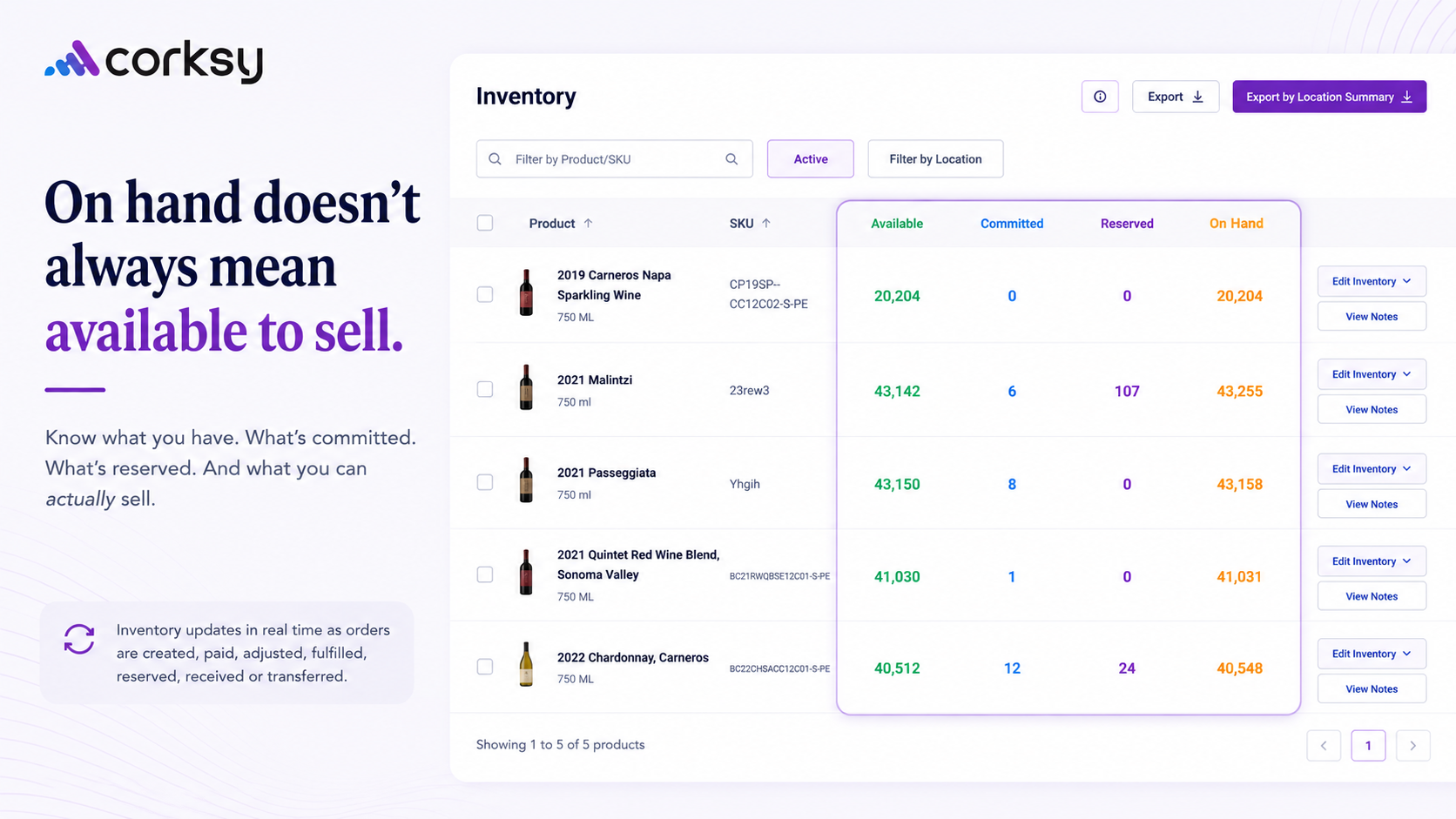
On Hand Doesn’t Always Mean Available to Sell: Rethinking Winery Inventory
For wineries, inventory has never been quite as simple as the number of bottles sitting in the warehouse. But as DTC programs have expanded across ecommerce, tasting rooms, wine clubs, multiple locations and fulfillment methods, knowing what you have has become increasingly different from knowing what you can actually sell. That distinction matters operationally, but it also matters for revenue. A wine can show 500 bottles on hand while some of those bottles are already committed to online orders, others are reserved for an upcoming event or release, and still others may be sitting at a location that doesn’t supply the sales channel trying to sell them. If every team is working from the same “500 bottles” number, the winery doesn’t really have inventory visibility. It has a physical count. The Four Numbers Behind Better Inventory Visibility One useful way to think about modern winery inventory is through four different numbers: Available: Stock that can be sold right now. Committed: St
00
Next in Pour Now Insights: DTC or retail? Why our CEO says that was always the wrong question
The next piece in Pour Now's Insights series is for anyone who has sat through the DTC-versus-retail debate one too many times. Our cofounder and CEO Andrew Levy, who has spent twenty-five years on the commercial side of this industry, from the supplier tier to a digital marketplace to the investor's chair, makes the case that it was the wrong debate to begin with. He opens with a single number: The same person who won't pay for shipping on an eighteen-dollar Tuesday bottle will spend seventy dollars on tequila [at their local store] without blinking on a Friday. Same customer. Different moment. Different money. That difference matters more than almost anything else in this business. For wine specifically, he puts a hard figure on how much of the market DTC actually reaches: Direct-to-consumer wine shipments run about $4 billion a year against $28 to $32 billion in total U.S. off-premise wine sales, or roughly 5% of the category, and wine is the easy case. His argument is not that DTC
00
Pour Now launches Insights: a candid, data-backed look at how alcohol shoppers actually buy
Everyone in beverage alcohol has a theory about how shoppers buy, but very few have the data to prove it. Today, Pour Now launched Insights, a new series where cofounder and COO Paul Mabray shares what two decades in the category, and a platform now working with nearly 500 brands, have taught the team about how alcohol shoppers actually move from wanting a bottle to buying one. It is a plain look at what works, what quietly breaks on the way to checkout, and what the data says about fixing it. The opening pieces take direct aim at tools the industry has leaned on for years. "We Brought Receipts" lays out the measurable path to purchase the category has been missing, backed by real sales results instead of a vision deck. "The map is a dead end" argues that the store-locator map, after a decade and a fortune spent on it, is one of the worst-converting tools in alcohol commerce for all but a sliver of the market. The throughline is the shopper. Where do they lose the thread between discov
00
Wine's "where to buy" dead end, and the solution you can shop right now
Pour Now's cofounder, Paul Mabray, just published his first piece in nine months. This part is for anyone in the wine industry who has ever tried to guide their shoppers to buy online, only to cross their fingers and hope it worked. For years, the trail from interest to purchase has ended at a static list or map. Paul explains why plainly, then does the thing that matters most: instead of asking you to picture the fix, he tells you to go use it. In his words: The reason it's so hard for alcohol beverage brands to succeed online is that there has never been a comprehensive, compliant, successful path to purchase. He is just as blunt about what that has meant on the ground: And so for years, "Where to buy" has been a dead end. A desert of maps, complicated networks of grey shipping methods, or marketplaces that consume our industry. And then, rather than sell the vision, he hands over the keys: Instead of telling you about a vision and asking you to imagine how it works, I can simply sho
00