Filter Post Type
NewsVideoProductEventLink
Sort:
Most Recent
1–10 of 20

Key Takeaways A winery is legally two businesses at once: an agricultural employer and a licensed wine producer, and most HR platforms are only built to handle one. Job title doesn’t determine treatment. Duties do. The same employee can move between agricultural and non-agricultural work within a single week. Crush season exposes problems built months earlier, from rushed seasonal hiring to unverified worker classifications. A structured self-audit beats reconstructing records during a DOL, TTB, or state inquiry. Würk’s tools help wineries stay prepared year-round. A winery’s obligations touch more regulatory categories than almost any other small business: agricultural labor law, guest-facing wage rules, wine-production rules, multi-state payroll withholding, and immigration regulations, often within a single organizational chart. This guide walks through a practical internal-review framework for wineries and vineyards with 10 to 500 employees. It’s operational guidance, not advic
00

August 10, 2026

Fundraising milestone comes as the company gears up for rapid expansion Contact BioSolutions, the maker of FireHawk® Bioherbicide, has completed a $5.6 million USD capital raise through the conversion of options, with participation exceeding 98%. This exceptional rate reflects strong confidence in the company's Board of Directors. This capital will enable the fast-acting, non-selective contact herbicide, which is already gaining traction across the United States, to speed up growth and make significant advances towards profitability. This announcement comes on the heels of a number of other significant milestones for the company. FireHawk’s RTU product has been EPA-registered in all 50 states. Its Super Concentrate product has been registered in 48 states and is expected to gain CDPR approval to register in California this fall. Its Super Concentrate product will soon be available for order through Amazon, enabling broader commercialization across the States. “We are thrilled about thi
00
Food and beverage (F&B) manufacturers and distributors fill a vital role in our world by developing, producing, and distributing the consumable products we need to live on. Opportunities abound in this industry, where food trends are constantly shifting, innovation is both revered and duplicated, and new products are always welcome. The F&B space is also fraught with complexities and challenges. Not only is this a highly regulated industry, but organizations also have to keep a close eye on thinning margins, high input costs and economic factors like shifts in consumer spending habits. External factors like inflation, high interest rates, and labor shortages are also impacting F&B companies’ operations and bottom lines. Amid these complexities, the last thing an F&B manufacturer wants to deal with are business systems that throttle growth, yet this is exactly what’s happening on many plant floors and in distribution centers around the globe. Companies know they have to
00

June 4, 2026

No one is born knowing how to lead, and great leadership is rarely spontaneous. Despite how natural some may seem in the role, a great leader is developed, not discovered. That’s good news if you’re a business owner because investing in leadership training in Boise might be the smartest decision you make this year. Let’s break down exactly how leadership training can transform your organization, from reducing conflict to running better meetings. TL;DR: The Key Takeaways Better conflict resolution = fewer HR headaches More effective meetings = less time wasted Stronger leaders = higher retention, better morale The Personnel Perspective offers customized training Why Should You Invest in Leadership Training? Leadership affects everything in your business. Good leadership creates clarity, alignment, and a culture where people actually want to work. Bad leadership? It leads to confusion, tension, and turnover. What Great Leaders Actually Do Communicate expectations clearly Make decis
00

May 26, 2026

Project Overview TM Process & Controls, Inc. executed large-scale mechanical, electrical, and automation modifications across multiple fermentation tanks to support micro-oxygenation, automated pump-over capability, and upgraded pump systems. The project included installation of new tank ports, piping, sensors, wiring, VFD connections, and structural supports, along with calibration, testing, and commissioning services. Work was carefully sequenced to minimize operational disruption while upgrading critical production capabilities. The Challenge The facility required enhanced process control, product quality monitoring, and automation capabilities across a large number of tanks to support modern winemaking techniques. Existing infrastructure lacked standardized instrumentation, automated pump-over functionality, and integration with updated process equipment. The Solution TMPC implemented coordinated mechanical retrofits, electrical installations, and automation integration across
00


The biggest challenge in ag technology isn’t innovation. It’s building tools that actually work on the farm. In a recent episode of Sustainable Winegrowing with Vineyard Team, Craig Macmillan sat down with Matthew Hoffman, PhD , General Partner and Head of Farms at Reservoir, to discuss a growing challenge in ag tech: how to bridge the gap between promising ideas and practical vineyard solutions. Reservoir is taking a unique approach. Instead of developing technology in isolation, the company partners directly with growers to help startups test and refine tools in real farming environments before they reach the market. Their work focuses on specialty crops, including winegrapes, where vineyard variability, labor demands, and regional differences make technology adoption especially complex. Why Grower Feedback Matters As Hoffman explains in the episode, many startups entering agriculture have strong engineering talent and funding, but limited experience in production agriculture. Grower
00

July 24, 2025
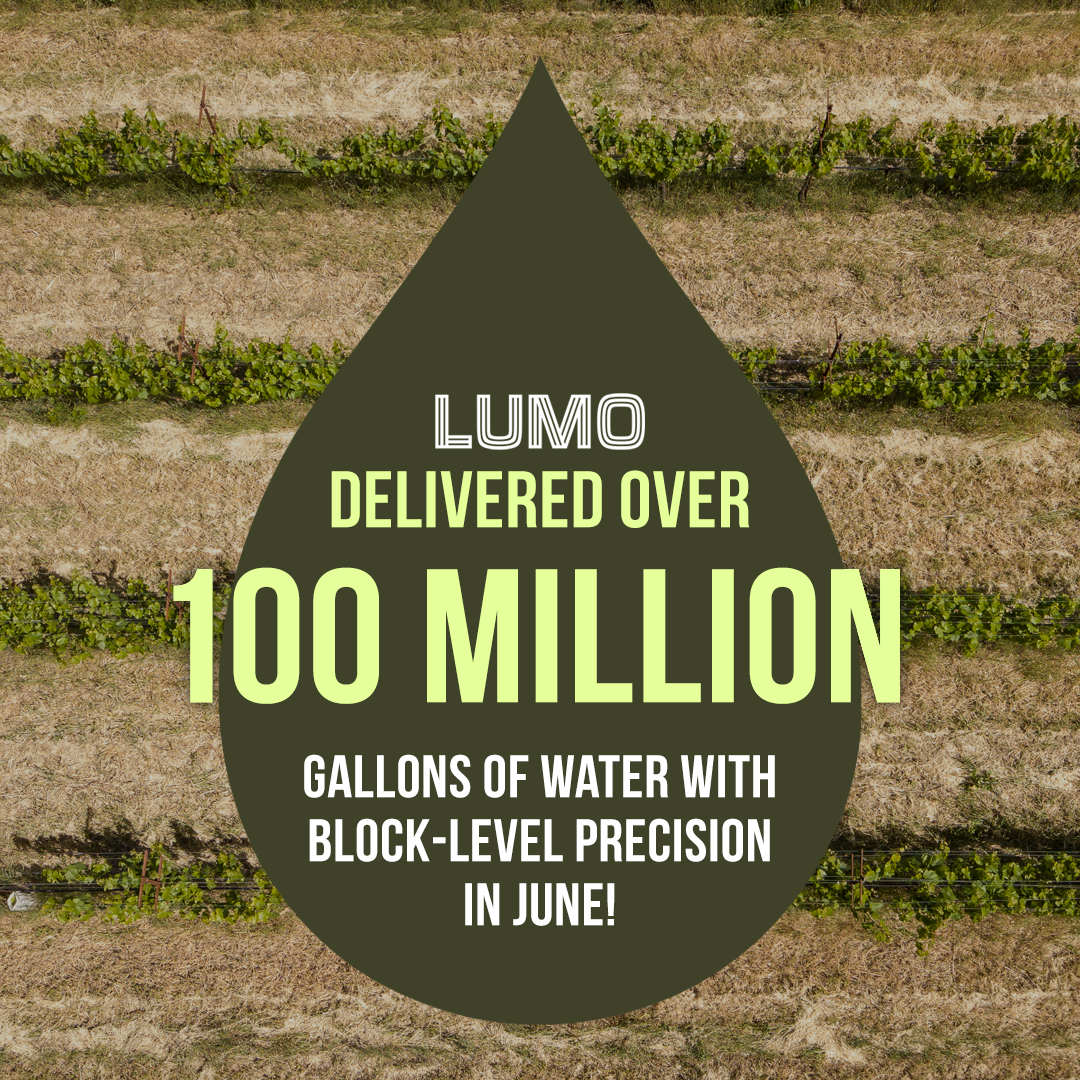
In June, growers used Lumo to precisely deliver over a hundred million gallons of water. That’s over two million bathtubs full. Last week, the system delivered over 40+ million gallons as temperatures continue to rise. From just an idea to delivering millions of gallons across thousands of devices and over a hundred ranches in a little over three years is just a mind-boggling pace. It’s a testament to the market need for a solution that delivers both automation and block-level visibility. It’s a testament to the hard work of countless growers who helped us understand the problem, gave us ideas for a solution, and helped shape the execution and implementation of that solution across thousands of acres. And it’s a testament to the energy and persistence of the entire Lumo team—engineering solutions, working with partners, providing support in the field, helping irrigators get irrigations scheduled, automating pumps, reaching new growers and showing them
00
August 8, 2024
Client Background A food and beverage company with both e-commerce and brick and mortar channels and over 400 employees. The Situation The client had disparate processes and systems due to high growth across multiple channels, including e-commerce and brick and mortar retail. There was a lack of visibility into key metrics like sales, financials, manufacturing, and distribution. Additionally, the absence of automation was becoming costly given their growth trajectory. The Solution & Results Moss Adams performed a systems assessment and uncovered key immediate and long-term requirements to meet their business objectives: Create a system structure that would support all business channels and scale with their rapid growth Automate reporting processes to reduce headcount costs Implement a solution that allows visibility across all locations, segments, and channels of the business in real-time With the holistic view the client needed into their business to be successful, Moss Adam
00

May 13, 2024

San Jose, California, May 13, 2024—LibDib, an innovative web-based distribution platform, is proud to announce its integration and collaboration with Diverse Powered Brands™, the premier centralized B2B global digital catalog for diverse suppliers in the beverage alcohol industry. The collaboration marks a significant milestone in LibDib’s mission to revolutionize beverage distribution by integrating Diverse Powered Brands into its expansive digital marketplace. Diverse Powered Brands, the industry’s trusted resource, connects diverse suppliers, buyers, and industry professionals, facilitating a seamless discovery process across all beverage categories. By incorporating Diverse Powered Brands, LibDib Buyers will now have access to a rich catalog of diverse owners, leaders and makers that reflect the modern consumer’s desire for inclusivity and social responsibility in their purchasing choices. Subscribers in the Diverse Powered Brands digital catalog
00


As consultants and custom crush winemakers, we work with seasoned and novice winemakers alike. When people think about making wine, they are sometimes ready to source grapes and start a wine label. However, making wine is only part of the process. The first thing we often tell aspiring vintners is that one must start with a business plan—because after all, making wine is a business. A common question relating to the business plan relates to winery finances. How do you build a budget? What numbers are important to consider? What data can give a readout of business performance? Mark Pisoni is a co-owner of Gravity Wine House and conducted investment analysis for his Master’s Degree while at Cornell University. We used that as a basis for assembling this blog post to give you some ideas for how to get started. The information was developed for wineries in the Finger Lakes region of Upstate New York, but can apply to anywhere. If you’re ready to jump in with budgeting, sk
00