
Event Type: Trade Show
Location: Chicago, Il
Date: 10/18/2026 — 9:00 AM to 5:00 PM
End of Line Packaging Solutions at Pack Expo International for Distilled Spirit Lines at Booths - N-5104 & N-5106
For more information click here...
Machines in Operation...
- Case Erector - Erect and seal a wide range of case sizes with quick changeover, increasing line efficiency and reliablity
- Case Packer - Robotic case packer, new and improved features for higher speeds, and easier changeovers
- Case Sealer - Automatically close and seal shipping cases with tape or adhesive-speeds from 10-75 cpm
- Palletizer - Palletize cases, trays and totes with speeds to 3 layers/minute
End of Line Packaging Solutions for Distilled Spirit Lines at Booth - N-5104 & N-5106
For more information click here...
Machines in Operation...
- Case Erector - Erect and seal a wide range of case sizes with quick changeover, increasing line efficiency and reliablity
- Case Packer - Robotic case packer, new and improved features for higher speeds, and easier changeovers.
- Case Sealer - Automatically close and seal shipping cases with tape or adhesive-speeds from 10-75 cpm
- Palletizer - Palletize cases, trays or totes with speeds to 3 layers/minute
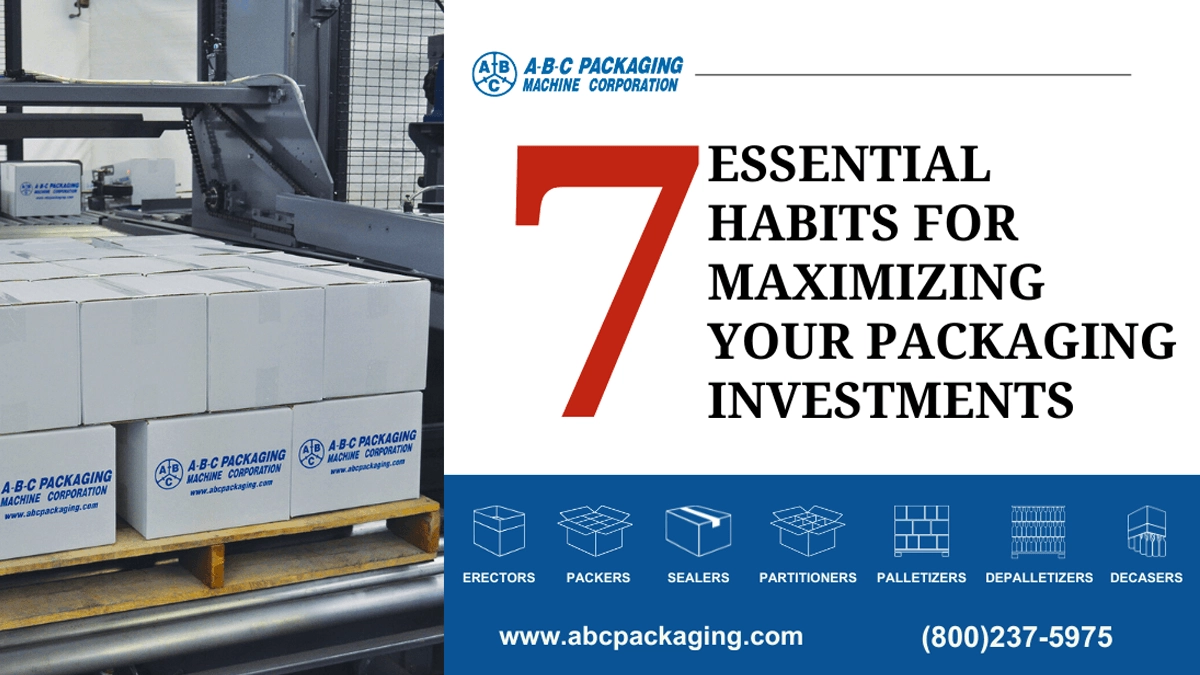
Buying packaging equipment is a pivotal decision for your company. The right machine can improve your production, boost line efficiency and ensure a good return on your investment. On the other hand, a poor choice can create consequences you’ll have to live with for a long time. To make sure you get it right, follow these seven habits inspired by the classic success principles.
Habit 1: Define Your Needs
Take control from the start by proactively evaluating your overall automation needs. Talk to your key people, including line operators and technicians, to get their views based on their valuable real-world experience. Consider your budget, timeline, and available floor space. Account for any special requirements for your product with regards to handling or storage, as well as how it will be shipped and displayed by the end user. Think about your required automation and the level of human intervention you plan to maintain. Speed is crucial — in specifying secondary packaging machinery, speed is determined by the maximum speed of your cartoner or filler, with at least a 10-15% cushion for unplanned production events. Plan for near-future upgrades, but be realistic, as faster equipment typically comes with a higher price tag. Evaluate your current product lineup and any anticipated changes to ensure your equipment is flexible enough to handle these demands. Most equipment has a good degree of flexibility, but if you anticipate major changes, you should discuss this with prospective suppliers.
Habit 2: Choose the Right Partner
Automating your packaging line is not a one and done deal. As you will be in a continued partnership, finding the right supplier is the cornerstone of your packaging line’s success. To narrow the field, do your research in industry forums and trade publications, and talk to people in your industry. Check their financial stability and after-sales support. Ask potential suppliers for references and talk to these customers about their experiences. These insights, good and bad, can help you find a vendor that you can trust.
Habit 3: Think About Ongoing Costs
Look past the machinery purchase price and consider the long-term costs of your packaging line including maintenance, parts and service. While an attractive purchase price is tempting, focus on the long-term value of your machinery investment. Quality equipment paired with robust support can enhance reliability, uptime, and efficiency. Invest in training for your staff to give them the skills they need to confidently operate and maintain your equipment. Schedule follow-up training if needed, to reinforce key concepts and consider service contracts to address any issues. Plan for spare parts and establish preventive maintenance practices to avoid unplanned downtime. Remote troubleshooting and repair options are available on many packaging systems giving you a direct connection to your OEM’s service department to quickly resolve any issues that may arise.
Habit 4: Build a Strategic Partnership
Consider your supplier as a partner. Think long-term when looking for solutions and stay flexible…don't fall into the trap of solely focusing on a specific technology or finding the cheapest option. Find what best fits your goals and production needs and customize where it makes sense. With a close relationship with your supplier, leverage their experience to create solutions that meet your individual requirements.
Habit 5: Tap into Expertise
Open communication with your chosen supplier is key to a successful packaging investment. Listen and learn from their sales team to understand their technology, best practices, and applications. Ask about their past projects that apply to your industry and if possible, visit a customer’s plant, where you can get a first-hand view of the machinery and talk to the end users. Be open with your supplier about your needs; provide more than just your specifications. Discuss your goals, ongoing challenges, any issues with other technology, potential line layout conflicts. With this full picture, your supplier can help you avoid problems and make sure your machines are the right fit for your production situation.
Habit 6: Work Together
By combining the strengths of your team with that of your supplier’s, you create a collaborative environment that results in a competitive, goal-aligned packaging process. Multiple viewpoints and conversations are extremely beneficial in the long term, but it is also important to designate a key contact at your company and your supplier. This simple step can help keep the teams on task for all post-order actions, eliminating potential miscommunication and ensuring that there are no unfulfilled promises on either side.
Habit 7: Keep Improving
Investing in packaging equipment is an ongoing journey rather than just a one-time event, especially as your needs evolve. Consider modular machinery that can be easily reworked at a lower cost if you anticipate changes, such as adding a product line or altering product packaging. With today's rapidly advancing technology, having a supplier that efficiently provides control and software updates is essential. Look for remote troubleshooting and repair options to connect directly with your OEM’s service department and quickly resolve any issues. By continuously seeking ways to improve your operations, you ensure that your packaging line remains competitive and efficient, keeping your company adaptable to evolving market dynamics.'
Conclusion
By enacting these seven habits, you can ensure that you are making a smart packaging investment that will meet your needs and exceed your initial expectations. Remember, your packaging machinery supplier is a partner in this journey towards improved productivity. Choose wisely and you’ll be on the right path to reach your automation goals.For more tips on buying packaging equipment, inquire about A-B-C’s full purchasing checklist here.
A Final Word
Taking the time to analyze your needs and identifying exactly what suits your requirements can pay dividends, as a good quality, well-maintained machine can provide reliable service for many years. We hope that the information in this article will help you achieve that goal. At A-B-C, we build hardworking packaging machines that stand the test of time, supported by our comprehensive service, parts and support for the life of your equipment. With over seven decades of serving the industry, we have earned many loyal customers, and repeat business is the cornerstone of our success. When it comes to packaging machines, we know the business. We would appreciate the opportunity to earn yours.
Utilize our user-friendly RFQ tool for tailored solutions, to streamline the process of defining your requirements. With just a few clicks on our website, you can input your specifications and receive expert recommendations from our seasoned team of packaging specialists. With customizable solutions tailored to your specific needs, seamless integration, and ongoing support, A-B-C is your trusted partner in packaging, committed to maximizing your productivity and success.

Knowing your options and selection considerations will help you to make the right decision for long-term productivity gains.
The decision to upgrade your packaging line can benefit your operation in many ways: increased production, reduced labor and insurance costs, less liability, improved product handling and protection during transport. Or maybe you are looking to solve an operating issue that has been plaguing your line. In any case, the decisions you make during the upgrade can affect your productivity for years to come. Understanding your options, and what you need to consider during your selection, will help you to make the right decision that will bring long-term gains to your productivity.
Palletizer Selection Considerations
Robotic, conventional, hybrid? Automatic or semi-auto? High or low level? The right machine for your line will depend on many factors. Not long ago, there were major differences in cost and capabilities between conventional and robotic palletizers. Robots were best for multi-SKU applications that ran at relatively low speeds, while conventional palletizers were applicable for dedicated medium and high-speed lines. Today’s robotic palletizers can achieve higher speeds, and new control technology has given conventional units greatly increased flexibility with no downtime for changeover. Added to the mix is a new breed of hybrid palletizers that combine robotic product placement with conventional squaring devices. Finally, semi-automatic palletizers that offer a cost effective upgrade from manual palletizing for low speed lines. So, what is best for your application? First, you need to analyze your requirements:
Product Type
Packed in a case, tray, display tray, tote or shrink-wrapped bulk packaging?
Are shippers solidly packed, or is there headspace that can affect stacking strength?
Is it fragile or of high value?
Is it very heavy or lightweight?
If bags, are they paper or poly? Are the contents settled or will bags need to be flattened for palletizing?
How many SKUs do you palletize?
Line Layout
Where will the palletizer be located in your plant?
Will you feed multiple lines to the palletizer?
How are products conveyed to the palletizer?
How much floor space is available?
Pallet Requirements
What are your current pallet patterns? How often will this change?
Do you make display pallets? End-of-aisle displays? Label out loads?
Do you make dedicated or mixed load pallets, or both?
Do you require tier sheets, glue dots or full pallet shrink-wrap?
Speed Requirement: As the final piece on the packaging line, your line efficiency will be directly related to your palletizer’s speed and production. Mismatched speed capability and/or downtime at the palletizer can cause backups on the entire line. Make sure you are talking the same language as your supplier when discussing speed. Conventional high-level palletizers are generally rated at cases/minute, while low-level units are rated at layers/minute and robotic palletizers spec at cycles per hour.
Budget: No small consideration, your budget can help to define your selection. If your budget is tight, look for palletizers with modular designs, which allow you to add future upgrades as your budget allows.
A top choice for mid-range lines and those with limited floor space,
conventional low-level palletizers require about 30% less space.
Selection Guidelines
Once you have all of your specifications and production goals in place, it’s time to talk to suppliers. Here are some basic guidelines that are applicable to palletizer selection today — keeping in mind that with advancing technology on all fronts, these guidelines may not be applicable for every situation. That is why it is important to have all of your specifications for potential suppliers, so they can evaluate your operation and help you choose the best technology for your line.
Speed: Conventional high-level palletizers are still king for high-speed lines. Conventional low-level and robotic palletizers excel on mid-range lines, and semi-auto palletizers are a solid choice as an upgrade from manual labor. When determining your required speed, it is best not to inflate your speed requirement as this can increase your machinery expenditure for speed capability you do not need. More importantly, make sure the machine you are buying has a good track record of performance and buy the speed capability you actually need.
Budget: High-level conventional palletizers have typically been more costly than low level, due to the cost of the catwalks, stairways and accessory equipment. Both high- and low-level machines typically can be programmed for new products at the operator station. Robotic palletizers usually are in line with high-level palletizers. However, their price will depend on the complexity of the application and programming required, with a simple, one-axis robot at a lower price point. Semi-automatic, low-level machines are typically one-third the cost of high-level palletizers.
Maintenance: Conventional palletizers require regular maintenance; however, the maintenance can be performed by a qualified plant mechanic. Low-level palletizers can be serviced at floor level, where high-level machines that operate at ceiling height can be more challenging to service or repair. Robotic palletizers have fewer mechanical components and extended duty cycles, but need regular lubrication and maintenance of end of arm tools (EOATs), which typically is best performed by a specially trained mechanic. However, as robots continue to enter the palletizing space, this specialty work will become mainstream.
Flexibility: All palletizing styles offer a great deal of flexibility, and most offer pallet configuration programming at the control panel. Robotic and hybrid palletizers can be fitted with a great variety of EOATs to handle a wide variety of sizes and shapes and can assemble mixed load pallets and “rainbow” loads with different products on each layer for specialized shipments to retailers and club stores.
Floor Space: This is an important concern, with floor space at a premium in many plants. Conventional high-level palletizers typically occupy the most floor space due to their construction and related catwalks and conveyors, conventional low-level palletizers require about 30% less floor space. Robotic palletizers can fit in smaller spaces, depending on the configuration and conveyor requirements. If floor space is an issue in your plant, this should be covered in your initial discussions with suppliers to determine whether a small footprint conventional palletizer or robotic palletizer will best suit your line layout.
Bulk Container Depalletizer Selection Considerations
Your depalletizing solution can literally make or break your production line, as consistent and reliable empty container feed is essential to packaging your product and meeting your production goals. Whether you are transitioning to bulk from reshipper cases or planning a new line, careful consideration of these key points will help you to avoid problems and reach your productivity goals.
Container Specifications: Bulk depalletizers run a wide range of container types including glass, plastic, steel and aluminum cans, and composite containers, in standard and many non-standard shapes and sizes. Once unloaded from the pallet, the discharge and line feed configuration will be determined by your actual container size and orientation requirements, so it is important to discuss this with your potential suppliers and provide samples for evaluation. You can rely on their expertise to help you determine the best line feeding solution: whether a simple single filer or laning device, to a row stripper that maintains container orientation, or possibly a bottle unscrambler to orient and single file small or lightweight plastic containers.
Line Speed: The industry-accepted standard is to spec your depalletizer volume at 20% higher than your filler volume. In evaluating depalletizers, it is important to look at layers/hour, not layers/minute, because different manufacturers rate their equipment by sweeps/minute and may not include cycle time between pallets. For companies that run slow speeds, a manual depalletizer may be the first step to automating this operation.
Plant Layout: Your decision between a low-level and high-level depalletizer will likely depend on your line layout. If you are planning to depalletize at the receiving dock and transport containers overhead to the production line, a high-level depalletizer is a solid choice. However, low-level depalletizers can also discharge containers at ceiling height so this is best discussed with potential suppliers. If your depalletizer will be positioned before the bottle cleaner, a low-level machine with line elevation discharge will save you the expense of overhead conveyor and lowerator that would be required with a high-level machine.
Budget: The purchase price and installation costs are typically higher for high-level depalletizers, due to the platforms, catwalks and lowerator required to transport containers back to line elevation. Low-level depalletizers require less time for installation fitting to existing line conveyors.
Additional Considerations: Many companies plan machinery upgrades to reduce costs. This makes perfect sense, as reducing production costs through automation can generate increased profits. Considering that the cost of automating your depalletizing and/or palletizing operations can easily reach hundreds of thousands of dollars, it can be appealing to look for the least cost solution to realize a quick payback. However, some would consider this a shortsighted approach, as the typical packaging machine has a projected operating life of 20 years. It is important to evaluate more than the original purchase price. Also factor the costs of installation, operation, training, maintenance, change-
over, upgrades/spare parts and even utilities, as all of these costs will impact your ultimate return on investment.
By Bryan Sinicrope, published in Packaging Strategies magazine

End of Line Packaging Solutions for Distilled Spirit Lines at Booth #1944
Event Type: Trade Show
Location: Philadelphia, PA USA
Date: 2/17/2026
End of line Packaging Solutions for Distilled Spirit Lines at Booth #1000
Click here for more information...
End of line Packaging Solutions for Distilled Spirit Lines at Booth #1000
Click here for more information...
Event Type: Reception
Location: Tarpon Springs, FL
Date: 2/4/2026
A-B-C Packaging Machine Corporation, headquartered in Tarpon Springs, FL, engineers and manufactures a comprehensive line of automatic secondary packaging equipment designed to maximize efficiency, reliability, and flexibility at the beginning and end of the packaging line. Serving industries such as food and beverage, pharmaceutical, personal care, chemical, and consumer products, A-B-C Packaging delivers proven solutions that help manufacturers streamline operations and reduce total cost of ownership.
A-B-C Packaging’s full product portfolio includes case erectors, case sealers, case packers, palletizers, depalletizers, decasers, and partition inserters. With more than 85 years of packaging automation expertise, the company is recognized for rugged, workhorse machine construction, user-friendly designs, and systems that seamlessly integrate into new or existing production lines. Their secondary packaging machinery supports a wide range of case styles, pack patterns, and throughput requirements, making it ideal for both growing manufacturers and high-volume operations.
During the Tampa Bay Packaging Open House, A-B-C Packaging will have a wide variety of machinery on the floor in various stages of manufacturing. Attendees will have the opportunity to see how these automated systems improve line efficiency, reduce labor dependency, and deliver consistent, high-quality packaging performance.
This event provides a unique opportunity to connect with A-B-C Packaging’s experienced team, explore real-world secondary packaging applications, and discover how customized end-of-line automation can elevate productivity and future-proof your packaging operation.
Don’t miss this opportunity to see complete secondary packaging automation in action. Join A-B-C Packaging at the Tampa Bay Packaging Open House and discover how smarter automation can elevate your end-of-line operations.
Open House Dates - February 4-6, 2026
A-B-C Packaging Machine Corporation
Address: 811 Live Oak St, Tarpon Springs, FL, 34689
Contact: Patricia Uribe (727) 937-5144
Website: www.abcpackaging.com
Click on Video Below
A-B-C Packaging Machine Corporation, headquartered in Tarpon Springs, FL, engineers and manufactures a comprehensive line of automatic secondary packaging equipment designed to maximize efficiency, reliability, and flexibility at the beginning and end of the packaging line. Serving industries such as food and beverage, pharmaceutical, personal care, chemical, and consumer products, A-B-C Packaging delivers proven solutions that help manufacturers streamline operations and reduce total cost of ownership.
A-B-C Packaging’s full product portfolio includes case erectors, case sealers, case packers, palletizers, depalletizers, decasers, and partition inserters. With more than 85 years of packaging automation expertise, the company is recognized for rugged, workhorse machine construction, user-friendly designs, and systems that seamlessly integrate into new or existing production lines. Their secondary packaging machinery supports a wide range of case styles, pack patterns, and throughput requirements, making it ideal for both growing manufacturers and high-volume operations.
During the Tampa Bay Packaging Open House, A-B-C Packaging will have a wide variety of machinery on the floor in various stages of manufacturing. Attendees will have the opportunity to see how these automated systems improve line efficiency, reduce labor dependency, and deliver consistent, high-quality packaging performance.
This event provides a unique opportunity to connect with A-B-C Packaging’s experienced team, explore real-world secondary packaging applications, and discover how customized end-of-line automation can elevate productivity and future-proof your packaging operation.
Don’t miss this opportunity to see complete secondary packaging automation in action. Join A-B-C Packaging at the Tampa Bay Packaging Open House and discover how smarter automation can elevate your end-of-line operations.
Open House Dates - February 4-6, 2026
A-B-C Packaging Machine Corporation
Address: 811 Live Oak St, Tarpon Springs, FL, 34689
Contact: Patricia Uribe (727) 937-5144
Website: www.abcpackaging.com
Click on Video Below