
Artificial intelligence (AI) is transforming industries across the globe, and the wine sector is no exception. Amid the growing climate crisis, embracing AI is crucial. Researchers are leveraging the technology to assist wineries in adapting to climate changes and improving day-to-day farming practices with its predictive capabilities. In many instances, winemakers are integrating AI to refine agricultural methods, boost efficiency and promote sustainability. Here’s a glimpse into the future of the wine industry, revealing what lies ahead as AI continues to shape its evolution in the vineyard.
Swift and ongoing development
David Carter is CEO and co-founder of Deep Planet, a groundbreaking agritech startup born from the vision of Oxford University scientists and engineers. The company, granted by the European Space Agency, aims to aid agriculture in adapting to climate change using advanced machine learning. Deep Planet’s technology supports growers, winemakers and sustainability teams in optimizing vineyard management, efficiency, disease control and overall sustainability.
One notable AI product from Deep Planet is VineSignal, which monitors regenerative agriculture, soil health and sustainability. VineSignal tracks soil and plant nutrients, soil organic carbon and water management, including irrigation leaks and evapotranspiration. It also improves harvest logistics and efficiency, enhances grape quality by pinpointing the best harvest times, and creates yield maps. Additionally, it detects diseases and risks to vine health, covering major pests and diseases and supporting regular vineyard surveys. Vine technology aids in achieving carbon-neutral certifications and enhances sustainability throughout supply chains.
Big News!
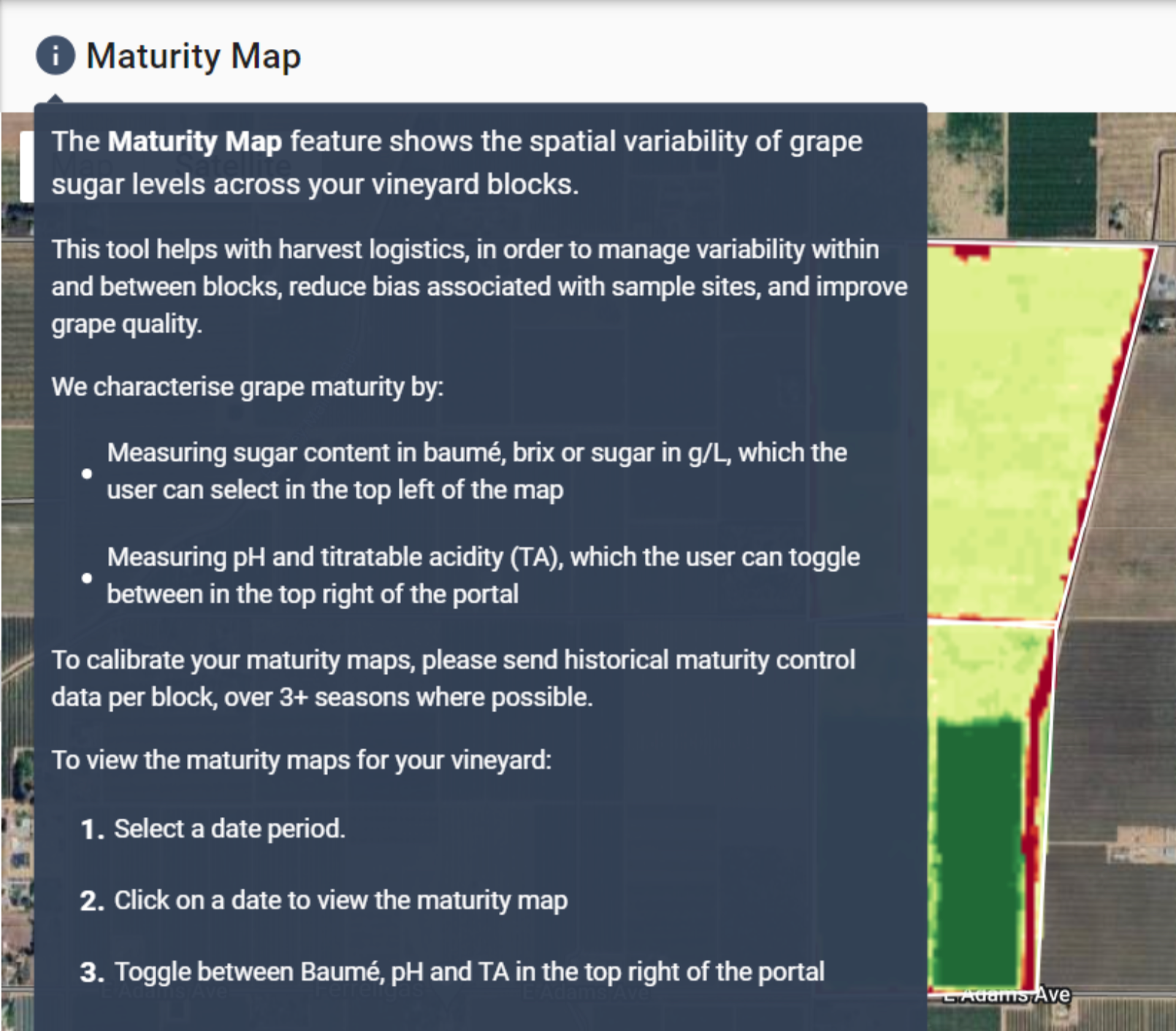
We're excited to announce that Deep Planet VineSignal Now Offers Advanced TA and pH grape Monitoring maps!This gives growers and winemaking teams an unprecedented level of insight into their maturity at both the vineyard block/plot/parcel level and produces heat maps identifying areas of the vineyard with higher and lower levels of pH and TA on a weekly basis from the time of veraison.
Reach out if you're like to monitor pH and TA (along with our Brix maps and harvest date features) in your vineyards for the current season.
Thanks for the hard work team in developing this great feature for the industry.
In this Video, Alex Pomerantz from Subject to Change Wine Co. one of the leaders in Natural Wine making, chats with Deep Planet CEO David Carter about how VineSignal helps them:
- Optimizing harvest logistics and resource allocation
- Safeguarding vineyard health and advanced pest & disease detection
- Providing insights to navigate the evolving climate conditions
- Measurement of soil carbon, nutrients, irrigation for better farming outcomes
Watch the full video to discover how Deep Planet empowers wineries and growers to adapt and flourish.
Penn Yan, NY, November 28, 2023: The New York Wine & Grape Foundation (NYWGF) is pleased to announce a new partnership with Upstate NY-based brand-building firm, Agency 29 to lead a comprehensive statewide Vineyard Survey initiative. Ag Access and Deep Planet AI will also partner with NYWGF and Agency 29 on this collaborative effort.
“We are pleased to announce this historic collaborative effort designed to accurately document New York State’s grape acreage,” Sam Filler, Executive Director of NYWGF, said. “Each of our partners brings unmatched expertise in different areas, and we are confident that will result in an invaluable report for our community. It is critical to the industry’s continued strategic growth that stakeholders have this data to inform planting, investment, research, and marketing decisions. We are proud to champion this process for all New York growers.”
This survey will gather data in 2024 and 2025 with the goal of ensuring an accurate and consistent record of acreage and grape varietals grown throughout New York State. The intention is for the survey to continue into the future beyond these two years.
“We’re thrilled to work with NYWGF and grape growers from across the state to develop this critical information,” Maureen Ballatori, Founder and CEO of Agency 29 said. “We’re looking forward to collaborating with Deep Planet, who provide AI and satellite data for vineyards, and Ag Access to conduct the agricultural market research through a proven research logistics process.”
Colson Steber, co-CEO of Ag Access, noted, “This partnership is a true compliment to our business, and connecting with agriculture professionals and prioritizing their point of view in research is what we do best. We look forward to bringing clarity to decision-making and serving as a measure of economic impact in the state for the New York Wine and Grape Foundation.”
The proposed survey will address an industry need for a wide range of accurate information about new acreage, bearing acreage, non-bearing acreage, varieties, tonnage, average price, and data by growing region.
This project was made possible by grant funding from the Genesee Valley Regional Market Authority and the New York State Department of Agriculture and Markets. It will be the first comprehensive Statewide Vineyard Survey conducted since the 2011 USDA NASS survey.
New York State Agriculture Commissioner Richard A. Ball said, “New York’s wine industry continues to set itself apart as a leader in innovation, research, and growth, producing some of the very best wines in the world. At the Department, we’re proud to be able to support the work of the New York Wine and Grape Foundation as they kick off a new statewide Vineyard Survey. This is a critical effort that will help us to better meet the needs of the industry moving forward, so that our wineries and grape farmers can continue to thrive.”
Brendan Tydings, Administrator, Genesee Valley Regional Market Authority said “GVRMA is thrilled to support the statewide Vineyard Survey orchestrated by the New York Wine & Grape Foundation. We have proudly supported numerous projects of the NYWGF over the years and we strongly believe in the work they are doing. NYWGF has done a phenomenal job of assembling a team of experts to provide us with information on the true footprint the wine and grape growers hold in our state, and this will position the industry well to bring success for years to come.
Data collected from the vineyards will create a baseline for changes in New York’s grape industry. Survey data will facilitate strategic decision-making for both NYWGF and the private sector, as well as provide benchmark figures required to compare New York State with key domestic and international wine-growing regions.
The comprehensive statewide Vineyard Survey is forecasted for distribution to vineyards for response in the first quarter of 2024.
###
About Agency 29: Agency 29 is a brand-building agency for food, beverage, and agriculture brands. The firm leverages strategy, branding, and marketing to help clients scale. Serving clients globally from Upstate NY, Agency 29 has offices in Rochester, NY, and Geneva, NY. Learn more at www.agency-29.com.
About Ag Access: Ag Access (a Qlarity Access company) conducts agricultural market research through a proven research logistics process and their Ag Access insights community. With a full-time engagement center and a research logistics team of 20+ years of experience, Ag Access helps design and execute custom research projects with any outcome. Learn more at www.ag-access.com.
About Deep Planet: Deep Planet is a global Agri Tech startup using Machine Learning and Satellite Imagery to help the wine industry adapt to climate change. The founding team has more than 15 years of experience starting and scaling deep technology companies worldwide. Learn more at www.deepplanet.ai.
About the New York Wine & Grape Foundation: The mission of the New York Wine & Grape Foundation (NYWGF) is to promote the world-class image of New York grapes and wines from our diverse regions to responsibly benefit farmers, producers, and consumers through innovative marketing, research, communication, and advocacy. NYWGF endeavors to ensure that New York State is recognized as the world’s premier region for cool and cold climate viticulture. Learn more at www.newyorkwines.org.
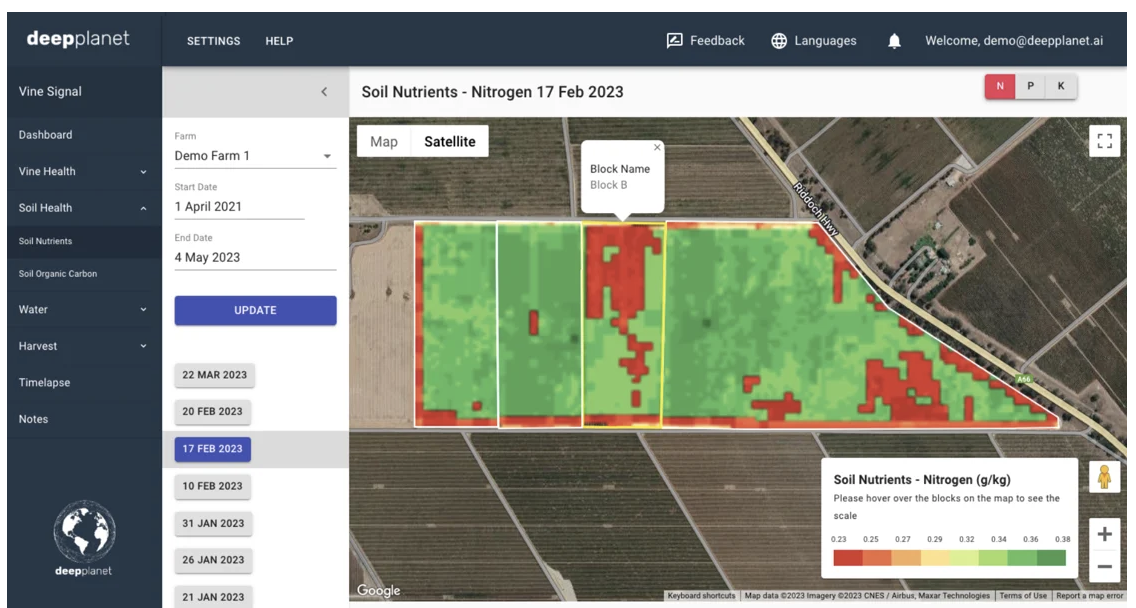
Now that harvest is drawing to a close and people are focused on preparing the vineyard for winter, Deep Planet are offering Compost Application Maps which show areas of the vineyard with higher and lower soil organic carbon. Reach out for your map and report today, to make the most of your compost application.
As world class AI, Machine Learning, Satellite, Data Science and Computer Vision specialists, it is an honour to be selected to collaborate with first class international wine producer Treasury Wine Estates.
We look forward to adding value to their vineyard management and ESG goals through the Deloitte GRAVITY Challenge program.
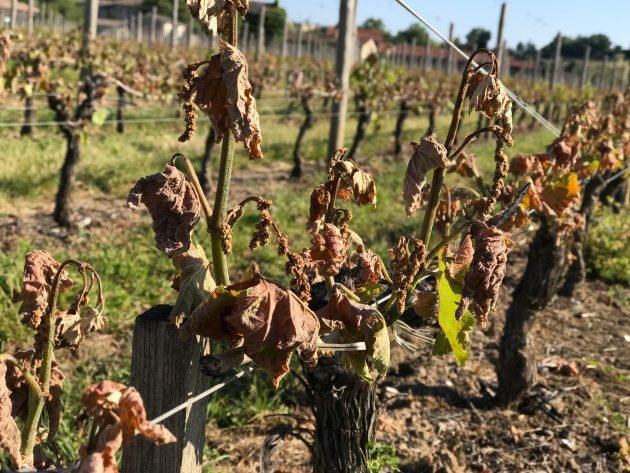
Frost at bud break is one of winegrowers’ worst nightmares. At best, vines affected by frost produce smaller bunches and lower yields and at worst, frost can wipe out up to 100 percent of the crop. The start of the 2022 vintage has been quite turbulent in the Northern hemisphere, with winegrowing regions from France to California and Oregon reporting devastating frost events.
Vines damaged by frost in a vineyard in Bordeaux (Image courtesy of Chateau Bauduc)
Assessing frost damage
The status quo
Some vineyards, where frost is a fairly regular occurrence, have various methods to prevent frost damage. These include frost candles, frost fans, heating wires that automatically turn on below a certain temperature, and turning on sprinklers to cover the vines in ice (sounds counterintuitive, but seems to work and looks magical!).
However, areas that are warmer and where frosts are historically uncommon are not prepared for frost and when it does happen, growers are left to the mercy of things they can’t control and to deal with any consequences. The first step in this is to assess the extent of damage that the vineyard has suffered.
The industry standard for assessing frost damage hasn’t changed for decades. It essentially involves the viticulturist or the winegrower making observations in the field. The impact of frost can be immediately visible with shoots turning brown and shrivelling. However, frost damage can sometimes not be immediately visible - it will look like the vines are doing alright but in reality they have lost vigor and problems become more apparent later in the season. There is also no way of understanding the effect of frost damage on crop estimates until later in the season (unless it’s an obvious loss of everything…) at which point it becomes more difficult and stressful to try to mitigate these effects. The inability to quantify frost damage and to show it on paper has also made it very difficult to make any insurance claims or to qualify for public subsidies designed to soften the blow for producers losing production. So all in all, when frost takes place grape growers are left to keep their fingers crossed and to wait and see.
A screenshot from VineSignal platform showing decline in vine vigor in the areas of the vineyard that were affected by frost
A new approach to frost damage analysis
Artificial intelligence can be used to assess frost damage where it’s not immediately visible and to be able to predict its effect on yield and harvest date. This approach involves using satellite imagery and data from local weather stations and analysing these with machine learning algorithms. Machine learning is a powerful predictive tool, so where in the past growers had to ‘wait and see’, it gives them the insights earlier in the season in order to adjust plans and take direct action. The frost damage analysis feature of Deep Planet’s VineSignal platform is state-of-the-art technology, giving actionable insights to grape growers that traditional methods do not provide. It can effectively detect the leaf damage areas with detailed spatial resolution. It analyzes dynamic change in NDVI within and between seasons to detect anomalous reduction in vigor and incorporates info on frost in its weekly yield prediction model for accurate crop estimation throughout the season.
Benefits of using AI to analyze frost damage
Benefits for growers and viticulturists
Where frost impact is not immediately visible, using VineSignal’s frost damage analysis tool allows grape growers and viticulturists to be ahead of the game. This minimizes the risk of unpleasant surprises post-frost and allows them to tend to damaged vines even before the damage becomes visible.
For growers and viticulturists that are overseeing hundreds of acres/hectares of vineyards, this also makes their work more efficient. It takes weeks to physically visit every vineyard, which are usually located far from each other, and make in person assessments. The use of automated frost analysis significantly reduces this time, making the process less stressful.
Benefits for wineries
Given the huge effect that frost can have on yield, it is very important for wineries to understand the extent of crop loss expected in the vineyards where they get their grapes from. There are no conventional ways of assessing the impact of early season frost on crop estimates until later in the season. Machine learning and AI help to address this challenge by giving the ability to understand the effect of frost on grape yield earlier in the season. This is important for planning winery intake and filling in any gaps that might have been created.
Benefits for regional bodies and industry associations
When a winegrowing region is hit by frost, the regional associations representing growers in that area then undertake the task of helping their growers assess the impact of frost. This is not an easy task. Given the consequences that frost damage can have on growers, the associations need to act quickly and provide as accurate assessments as possible. Conventional methods of assessment by in person observations support neither of these key needs.
Using a hands-off approach that utilizes the power of AI, such as Deep Planet’s automated frost damage detection tool, helps industry associations address these challenges and become more effective in supporting their growers in the aftermath of early season frost. Regional bodies can use these insights in providing agronomy support to their growers, as well as in helping them make any insurance claims.
How can I try automated frost damage analysis for my vineyard?
To get a feel for what this groundbreaking technology could mean for your vineyard operations, you can trial the technology on all or part of your vineyard in this growing season. Just drop us a line using the button below and we’ll be in touch!
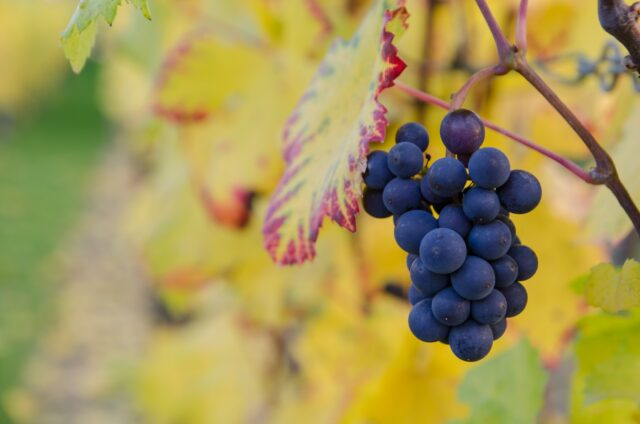
An innovative Australian-developed smartphone app that uses artificial intelligence to help winegrape growers easily diagnose nutrient disorders in grapevines is set to grow following a new commercialisation agreement.
The prototype app which assesses images of vine leaf symptoms captured using a standard smartphone camera was developed by a team of viticulturists, plant physiologists and machine learning specialists through a research partnership between NSW Department of Primary Industries (NSW DPI) and Charles Sturt University with funding from Wine Australia.
Global agtech start-up Deep Planet has obtained exclusively licensing of the technology with a view of adding to its capabilities and commercialising the technology to further benefit grape and wine producers.
Deep Planet CEO, David Carter, is excited at the prospect of taking on the technology and adding it to the suite of viticulture remote sensing, monitoring and prediction features offered by their industry leading VineSignal platform.
“We’ve been working closely with a number of Australian producers to help them manage their vine health, irrigation, yield and maturity using satellite imagery combined with our machine learning and AI capabilities. Adding and improving this technology as a practical tool for on the ground nutrition monitoring is an obvious next step to enhance the impact we can offer our clients,” Carter said.
Vine nutrition is a significant cost to the management of a vineyard, and if not handled correctly, yield and quality can suffer. The prototype app was developed as a technical solution to help wine grapegrowers deal with symptom confusion of vine nutritional disorders.
Charles Sturt Pro Vice-Chancellor (Research and Innovation) Professor Michael Friend, said the University’s image analysis experts, including Associate Professor Lihong Zeng and Professor Manoranjan Paul, worked with NSW DPI researchers to develop disease image libraries for artificial intelligence assessment of vines in the field.
“The detection and diagnostic capability of the app works through the image analysis algorithms developed by the team and allows users to quickly identify vine nutrient deficiencies and access remedial actions based upon the diagnosis, Professor Friend said.
NSW DPI Deputy Director General Dr Adrian Zammit said the commercialisation of research through government, industry and corporate agreements can help farmers address practical challenges.
“It is encouraging to see these research bodies working together with a global agtech company, and together recognising the value of this key co-operative research project,” Dr Zammit said.
“NSW DPI is committed to understanding and researching the challenges of our agriculture sector and ultimately delivering practical outcomes that add capability and competitiveness to the farm gate.”
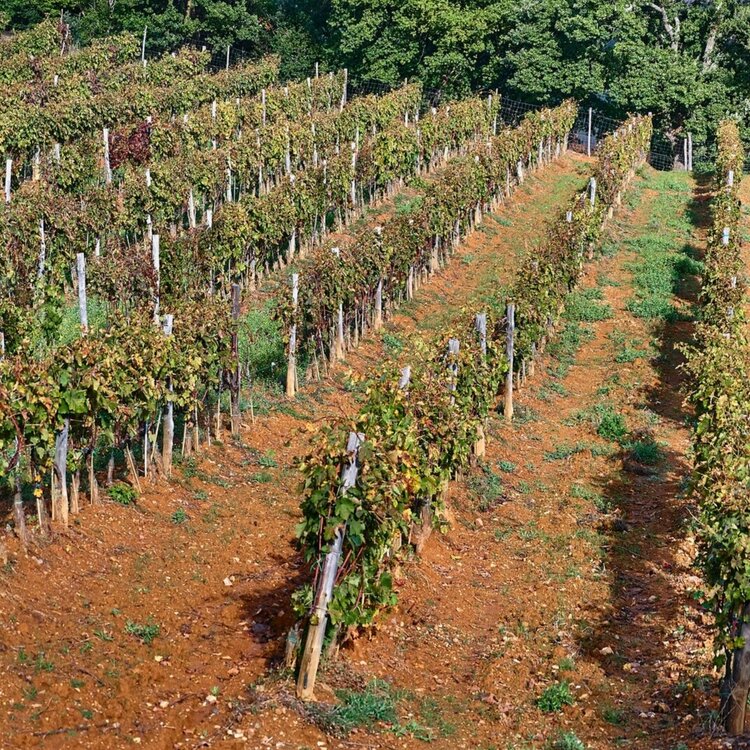
Deep Planet has acquired the rights to a smartphone app that uses artificial intelligence to help wine grape growers easily diagnose nutrient disorders in grapevines using smartphone photos instead of lab tests, following a new commercialization agreement.
Deep Planet CEO, David Carter, is excited at the prospect of taking on the technology and adding it to the suite of viticulture remote sensing, monitoring and prediction features offered by their industry leading VineSignal platform.
“We’ve been working closely with over 300 users including wineries, growers, major corporates and regional associations to help them manage their vine health, soil health, soil carbon, nutrients, irrigation, yield and maturity using satellite imagery combined with our machine learning and AI capabilities. Adding and improving this technology as a practical tool for on the ground nutrition monitoring is an obvious next step to enhance the impact we can offer our clients,” Carter said.
Vine nutrition is a significant cost to the management of a vineyard, and if not handled correctly, yield and quality can suffer. The prototype app was developed as a technical solution to help wine grapegrowers deal with symptom confusion of vine nutritional disorders.
To participate and use the new product feature, reach out below or sign up on our website https://www.deepplanet.ai/vinesignal:
Deep Planet
David Carter – CEO/Co-Founder
T: +1 (713) 724 2207 [Alameda, California, USA]
Matthew Moate - Head of Sales
T: +61 409 783 221 [Tanunda, Barossa, SA, Australia]
Christopher Pang - Commercial Director
T: +44 7562 109672 [Bordeaux, France]
As part of the EIT Food RisingFoodStars programme, Deep Planet has partnered with EIT Food and Bernard Magrez to demonstrate the impacts of its AI climate adaptation solution for vineyards, VineSignal.
July 22nd – Oxford-based startup Deep Planet has partnered with EIT Food, the world’s largest and most dynamic food innovation community, and Bordeaux wine grower Bernard Magrez (BM) to demonstrate the benefits of VineSignal – a satellite and AI based solution that reduces vineyard variability, monitors yield and improves crop quality. EIT Food is supported by the European Institute of Innovation and Technology (EIT), a body of the European Union.
VineSignal aims to help winegrowers in France and across the world adapt to the increasing impacts of climate change, embed more sustainable and efficient management practices to improve grape and wine quality, and increase harvest efficiency.
VineSignal is currently being used by more than 60 customers worldwide including global winemakers such as Pernod Ricard and small and premium producers in Bordeaux. Having monitored over 50,000 hectares of vineyards and more than 100 varieties of grapes, the AI system has been developed and optimised to predict the nuances of grape production.
Deep Planet has been part of the EIT Food RisingFoodStars network since 2020, a programme designed to help startups grow and scale faster through market testing new ideas, providing support from experts, connecting with leading corporate partners in the food industry and facilitating access to investors. As part of the programme, Deep Planet received financing to help scale its solutions by accelerating the commercialisation of its technology.
Sushma Shankar, Co-Founder of Deep Planet, said:
“Deep Planet’s vision to help farmers build resiliency against the impact of climate change. The wine industry is our first market. Our product VineSignal is helping growers and winemakers to improve productivity, quality and sustainability in their vineyards through monitoring maturity, yield, vigour, evapotranspiration, soil nutrients and soil carbon. We’ve worked with premium producers, small and large growers and corporates globally but mainly in France, Australia and US with strong case studies. We’re excited to have partnered with EIT Food and Bernard Magrez as we prepare for the next chapter of our mission to help more growers to adapt to changing weather conditions and to benefit from the technology.”
Narjis Chakir, EIT Food RisingFoodStars Manager, said:
“Deep Planet has been a fantastic contributor to the RisingFoodStars community. The success of their solution to increase vineyard efficiency and sustainability management is a testament to their dedication and innovation efforts. I am looking forward to continuing our support for Deep Planet and following the next stage of their journey.”
Deep Planet is also part of Bernard Magrez Start-Up Win, the first startup incubator entirely dedicated to the wine, vines, wine tourism and digitisation sectors. As part of the incubator, Deep Planet has benefited from dedicated support to expand its market presence in France and to better understand regional production challenges.
Sébastien Labat, Director of Bernard Magrez Start-Up Win Incubator, said:
“We are glad to be a partner of Deep Planet’s incredible VineSignal project. We created an R&D department a few years ago and a startup incubator two years ago, in order to work on and support such game-changing projects.
Today, we hope that our partnership with Deep Planet helps us and other winegrowers adapt to increasingly difficult natural conditions that we have to tackle!”
About RisingFoodStars Association
RisingFoodStars is a programme aimed at early scaleups that already have paying customers or a paid pilot project and are ready to expand globally on a significant scale. The RisingFoodStars Association aims to help the scaleups grow even faster by testing new ideas in the marketplace, providing expert support, connecting the scaleups with leading corporate partners in the food industry and facilitating access to investors.
About EIT Food
EIT Food is the world’s largest and most dynamic food innovation community. We accelerate innovation to build a future-fit food system that produces healthy and sustainable food for all.
Supported by the European Institute of Innovation and Technology (EIT), a body of the European Union, we invest in projects, organisations and individuals that share our goals for a healthy and sustainable food system. We unlock innovation potential in businesses and universities, and create and scale agrifood startups to bring new technologies and products to market. We equip entrepreneurs and professionals with the skills needed to transform the food system and put consumers at the heart of our work, helping build trust by reconnecting them to the origins of their food.
We are one of nine innovation communities established by the European Institute for Innovation & Technology (EIT), an independent EU body set up in 2008 to drive innovation and entrepreneurship across Europe.
Find out more at www.eitfood.eu or follow us via social media: Twitter, Facebook, LinkedIn, YouTube and Instagram.