
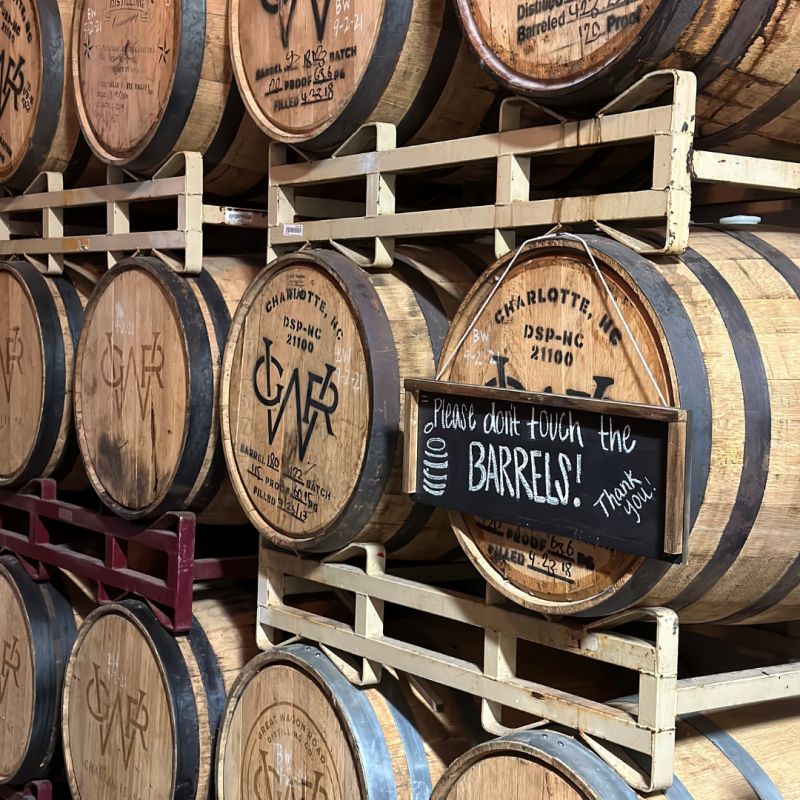
Data associated with your barrels can easily get lost in day-to-day operations if you're not staying organized. Allow Ekos to fuel your team's efficiency better by tracking your barrel's attributes in one place.
Not sure how to get started? Check out our Knowledge Base and enter the keyword: "Barrel" to find all the instructions you need to set up your barrels! As always, reach out to us at help@goekos.com if you need assistance.
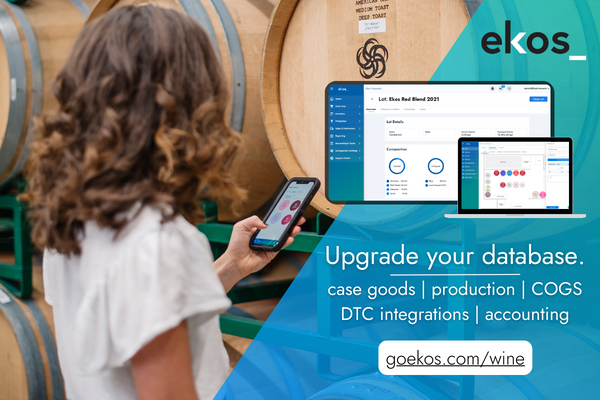
If you’re still using outdated databases and manual spreadsheets to run your winery, there’s a better option. Ekos is a modern, cloud-based software that connects data across your business. Imagine what you could do with better visibility into case goods, COGS, accounting, DTC sales, and production. Plus, we can easily migrate your existing data into our system so you don’t lose any historical information.
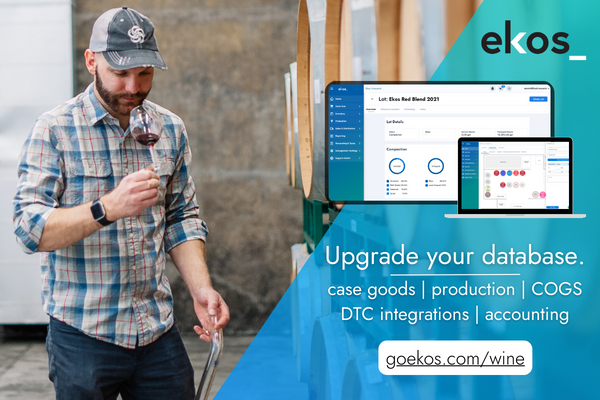
If you’re still using an outdated database to track production, there’s a better option. Ekos is a modern, cloud-based winery software that houses your production data — including chemistry, composition, intakes, volume and vessel locations — and helps you connect the dots across your business. Plus, we can easily migrate your existing data into our system so you don’t lose any historical information.
It’s been a stressful couple of days as the Silicon Valley Bank crisis has unfolded. While the SVB name has become synonymous with tech, it has also been a major lender to the wine industry for decades. As the CEO of a tech company that serves the wine industry, I’ve been hit with news from every angle.
Our winery customers are wondering if their assets are safe, and now they face the challenge of securing new loans from banks without SVB’s deep industry knowledge. Industry partners like Rob McMillan are reeling from the sudden collapse of their company, and we all face the potential loss of the gold-standard of industry benchmarking with the annual state of the industry report. And our software company peers are facing yet another blow to the already unstable tech industry.
In times of turmoil and uncertainty, my first instinct is to find a way to help. In the past few days, I’ve had conversations with industry peers about next steps for their company’s banking needs. Access to capital and making payroll are crucial in the near term. For the long term, it’s about finding the right financial partner that believes in your business and wants to grow alongside you — that is what so many had in SVB.
I’ve also been thinking specifically about what Ekos can do to serve the wine industry during this time. From the beginning, the goal of Ekos has always been to help businesses run better. Especially in difficult times, we believe that having the right information at your fingertips can help you make data-driven decisions that mean the difference between failure and success. We saw this during the early months of the pandemic as our winery and brewery customers had to shift their operations due to government regulations and changing consumer habits. Those who were able to understand the state of their business and pivot were the ones who made it through.
Now, with more financial uncertainty than ever for SVB customers, we at Ekos want to offer up help where we can. We’re offering support and financial relief to new and existing Ekos customers who are affected by the SVB shutdown. We’re contacting all of our customers today to let them know that we are here to help.
While the ripple effects of the past couple of days will still take a while to reveal their full impact, we will do what we can to alleviate some immediate stress. Ekos is a proud member of the wine community, and we’re dedicated to supporting businesses navigating tumultuous times. We’re here for you.
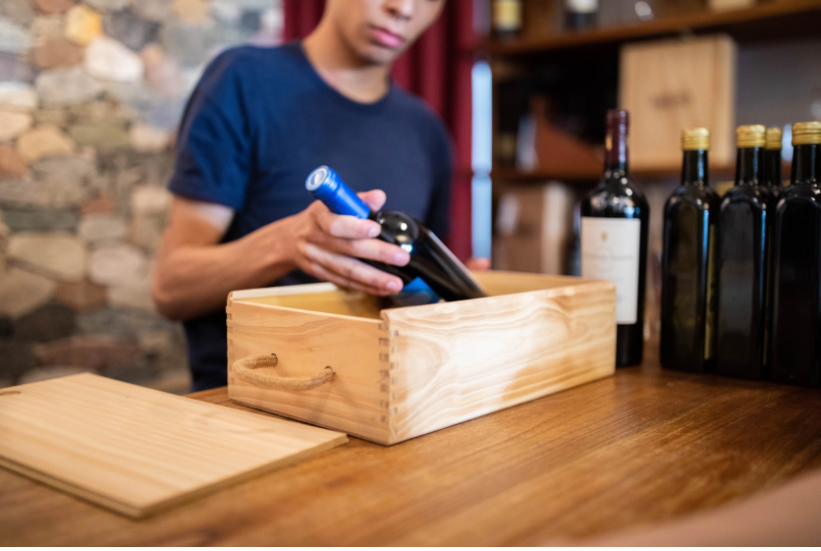
Tips for hiring employees who will represent your brand
The only thing as important as your wine is the people you hire to make and serve it. With every customer interaction or wine club order packed, your employees are a living, breathing testament to your brand and reputation. Without them, you wouldn’t have anyone to share your winery’s story and educate customers about the history of your wines.
When adding to the team, it’s important to take the time to hire the right candidates for the job. You don’t want to hire someone simply because they can fulfill the job requirements. You want to choose the ideal candidate who will exemplify your brand and maintain your winery’s reputation.
Satisfied employees are the backbone of any successful company, but building the perfect team is a lot easier said than done. A good hiring strategy can help you identify the right candidate for the role in question and one whose values align with your winery’s.
How to Evaluate Candidates for Your Winery
Anyone can look through a pile of resumes and find applicants that fit the mark. Before doing that, take stock of your company’s strengths and weaknesses and find the candidate that not only meets the job requirements but adds value to your team in an area that might be lacking. When hiring, you should look for experience, skills, and aptitude.
- Experience – Hiring someone with a background in the wine industry is a sure way to add value to your team. With less time needed for onboarding, an experienced candidate will be able to start contributing to the company on day one. Their background knowledge will enable them to provide insights that can help you shape the future of your winery. Plus, with a background in wine, you can spend more time training employees on the history of your wines instead of the basics.
- Skills – When hiring for a position, take the time to learn about other skills or passions the candidate has. Just because you hire them for one role doesn’t mean they can’t help out with your social media, videography, graphic design, or another area if it’s what they love. Not only does this help your company by saving you from hiring someone else, but it also keeps your core employees more engaged in all facets of the business.
- Aptitude – Although related experience is important, it’s not the be-all and end-all of the hiring process. Some positions might require direct experience, while less technical positions can be taught to any individual that is enthusiastic and eager to learn about the wine industry. Determine what skills are a must-have for the role and don’t limit your pool of candidates because of a lack of experience. Hiring an employee with the right attitude to successfully take on whatever tasks are thrown their way adds unmatched value to your company.
Standard Roles & Responsibilities
Every member of your team plays a valuable role in keeping the winery running smoothly. Not every winery will have all of these positions, but the skills and experience described in each of these make up a successful team.
Vice President of Hospitality leads every aspect of onsite visitation, creating an exceptionally elevated experience for all guests. This person is responsible for managing events, activities, and the tasting room team. This position reports to the CEO.
Tasting Room (or Front-of-House) Director is in charge of both tasting room and event teams, effectively ensuring that guests are satisfied with their experience. This person oversees tasting room operations while managing ongoing events. This position reports to the VP of Hospitality.
Marketing Manager evaluates and identifies trends in online and in-person sales by analyzing the data and making predictions around future trends for developing cohesive sales and marketing strategies. This person manages all aspects of the winery’s social media accounts, promotes tasting room events, and manages the business’s brand presence. This position reports to the CEO.
Onsite Event Coordinator oversees all aspects of private and public event coordination from initial inquiries to planning and execution. This person delivers superior customer service and is an excellent communicator, manager, and multitasker who works with other staff to ensure a smooth booking process and successful execution of private and public events. This position reports to the Tasting Room Director or Marketing Manager.
Tasting Room (or Front-of-House) Manager is in charge of selecting, developing, and managing the performance of employees and ensuring that customers are satisfied with their experience. This person oversees daily tasting room operations, manages inventory accurately, and assists in other areas as needed. This position reports to the Tasting Room Director.
Tasting Room Manager on Duty (or Shift Manager) selects, develops, and manages employees while ensuring that customers are consistently satisfied with their experience. This person occasionally serves as acting manager to oversee daily tasting room operations and manage inventory. This position reports to the Tasting Room Manager.
The Merchandise Manager (or Merchandise Coordinator) organizes and oversees all activities related to selling, purchasing, and tracking merchandise. This position reports to the Marketing Manager.
Tasting Room Servers are in charge of serving patrons, providing information to help with wine selections, presenting ordered choices, and ensuring that guests are satisfied with their experience. They provide top-quality customer service while maintaining tasting room ambiance and transaction accuracy. These positions report to the Tasting Room Manager and Tasting Room Manager on Duty.
Hiring Considerations for Different Winery Teams
Your winery is multifaceted. From the smiling faces who greet guests when they walk into your tasting room to the licensed forklift operators who make distribution possible, every member of your team has a strength that completes your team. As you work through the hiring process, remember that each team will have different needs, meaning you should adjust your expectations for candidates in each role. While these lists aren’t exhaustive, here are a few of what we believe to be the most important qualities for your winery’s varied teams.
Front-of-House Hires
Your front-of-house staff is responsible for ensuring a positive guest experience. From the moment a customer walks through the door, these team members are providing expertise with a smile. Tasting room servers and other front-of-house employees are the most likely to engage and connect with customers, sharing stories about how your wines got to where they are today. When looking to hire front-of-house staff, consider the qualities you are looking for:
- Cool under pressure: Anyone who’s worked in the service industry knows that the ability to keep your cool when the heat is on is essential. With high expectations from guests, competing priorities can be difficult for some folks to manage. Providing stellar service is an emotionally taxing task. So, it’s important to assess candidates for their ability to stay calm and confident when the pressure is on. Ask potential employees to share an example of a time when they demonstrated the ability to stay calm when things got busy. If they can talk you through this, they’re likely to be a great addition to your team.
- Friendly: Obviously working with customers and ensuring they’re happy is a big part of the job. Looking for folks who aren’t afraid to smile and greet strangers is a smart choice for your winery. This can be assessed with a role play scenario: Ask candidates to greet you the way they’d greet a new customer.
- Knowledgeable: Everyone has to start somewhere, so this quality is a “nice to have.” Hiring folks who are knowledgeable about the world of wine means two things: first, less training time. If someone comes to you with experience, that means you have fewer basics to teach them and can capitalize on the knowledge they already have. Second, it improves the odds of a positive guest experience. As you very well know, guests love to learn about the wine they’re drinking. Hiring someone with experience means your guests are likely to absorb some of this information.
Back-of-House Hires
The unsung heroes, your back-of-house staff are responsible for keeping things running smoothly when it comes to your production, sales, and distribution. These team members are highly organized and typically come with previous experience attached, especially those working in production (but like we mentioned, everyone has to start somewhere!) Here are a few qualities we recommend you look for when hiring back-of-house staff:
- Communication skills: Your back-of-house team needs to be able to communicate. With so many moving parts, it can be easy to get lost in the shuffle and forget to share essential information with coworkers. Hiring a team member with strong communication skills will help your winemaking and inventory teams make better wine and keep the things running smoothly behind the scenes.
- Reliability: Because it all comes down to the quality of your liquid, it’s important to hire folks who are reliable. Without trust and reliability, you could miss an essential step in your winemaking process if team members aren’t showing up and being consistent.
- Detail-oriented: Depending on the position, these team members will be responsible for tracking things like chemistry and composition, maintaining accurate inventory counts, and more. Hiring a team member who is detail oriented and will make record-keeping a priority is essential as you further establish your winery and make the best wine possible.
Managers
Whether they’re a front- or back-of-house manager, hiring team members who will uphold your company culture and empower your team to do their best work is essential to a successful business. We recommend you look for the following when it comes to managers.
- Can give constructive criticism: One of the most important things any manager can do is give constructive criticism. Lifting your team members up when they succeed and giving them a runway to that success when they fail is essential. Many companies fall into the mistake of hiring more authoritarian-style managers who lack this skill, and it can make or break your team. Ask potential managers to describe how they’d have a tough conversation with an employee who repeatedly struggles to execute their duties.
- Encouraging: This one goes hand-in-hand with giving constructive feedback. Managers who encourage their employees to work as a team and enjoy their day-to-day responsibilities will make your winery successful. Nothing beats a well-supported team.
- Cool under pressure: Much like your front-of-house team, managers should be cool under pressure no matter what side of the house they work on. These team members will be the point person with every unhappy customer and will be tasked with keeping team members calm during long, busy days. Ask potential managers to talk about a time when they felt overwhelmed on the job and how they handled that with their team.
How to Avoid Hiring the Wrong Candidates
Avoid making the following hiring mistakes when searching for the ideal candidate:
Don’t Outsource Your Hiring
Outsourcing your hiring can be tempting. After all, you’re adding to your team because there isn’t enough time in the day for you to get everything done. But in a competitive market, you (or a dedicated hiring/HR manager) must be a part of the hiring process. You know your winery and employees best. You understand the wine industry and the must-have skills for the role. You value your company above all else. Despite their best intentions, no outsourced company is likely to take the time to find the perfect candidate — their top priority is to fill the role with any qualified candidate as quickly as possible. Will they fill the position with someone who will also mesh with the company culture and help take your business to the next level? Don’t run the risk of hiring an applicant who doesn’t work out long-term because you outsourced the hiring.
Don’t Limit the Number of Applicants
There are plenty of candidates that have the skills to do the job — the key is narrowing down the applicants and finding the diamond in the rough that your company can’t operate without. When posting your job, you need to get in front of the best talent. To avoid limiting the number of applicants for the role, take advantage of the variety of job boards where you can list the job. From mainstream listing websites like Indeed or Linkedin to industry-specific boards, it’s best to cast a wide net. Speaking of, listing an unrealistic number of “requirements” in a job posting can cause some qualified applicants to stray away from applying to your position.The broader you make your search, the more applicants you can evaluate, giving you the best opportunity to hire the ideal person for your team.
Don’t Become Impatient
It takes time to find the right candidate. The worst thing you can do is become impatient and hire someone simply to have an extra set of hands in the here and now. If they don’t work out long-term, you’ve wasted both time and resources onboarding and training the new hire. Your goal as a business owner is to find qualified candidates that can grow alongside your team. You are also looking for someone who will take personal interest in communicating your brand to customers and sharing your winery’s story. Take as much time as needed for the perfect candidate to apply.

Syncing data by sales channel will make it easier than ever for wineries to track and report efficiently
CHARLOTTE, N.C. (Jan. 12, 2022) – Ekos, the leading business management software for wineries, is releasing exciting updates to its integration with point-of-sale and ecommerce platform Commerce7. These changes will simplify the way wineries use Commerce7 and Ekos, bringing winery owners and sales teams time savings and valuable insights.
Ekos users with the Commerce7 integration have long requested the ability to sync data by sales channel. Now, wineries who integrate both platforms can expect:
- Invoices automatically sorted by sales channel
- Visibility into direct-to-consumer sales by channel across all systems
- Simple allocations to prevent overselling
- Historical data by channel to track trends over time
- More time back in their days for selling and connecting with customers
“The sync data by sales channel feature will empower our customers with the Commerce7 integration to optimize their revenue with up-to-date sales data at their fingertips,” said Ekos CEO Josh McKinney. “Understanding which channels are performing best and where there are areas for improvement is essential. This will give wineries yet another way to view their data so they can make adjustments as needed.”
The last year has brought a plethora of changes to Ekos’s user experience for wineries as the team is fulfilling a mission to reimagine its wine product. This year, the Ekos team has added chemistry and composition functionality, released a brand-new wine lot production view, and improved overall usability in Ekos. Additional features are set to release in early 2023.
To learn more about Ekos, visit goekos.com.
About Ekos
Founded in 2014 and headquartered in Charlotte, N.C., Ekos is the leading business management technology platform powering — and empowering — craft beverage businesses. With more than 18,000 users on six continents, Ekos helps beer, wine, and cider makers drive efficiencies, power growth, streamline communication, and improve visibility across their businesses. As a digital hub for all critical business information, Ekos makes it easy to manage day-to-day operations in inventory, production, sales, and accounting. Ekos was named to the Inc. 5000 list in 2022 and 2021 and is backed by Catalyst Investors and Noro-Moseley Partners. To learn more, visit goekos.com.
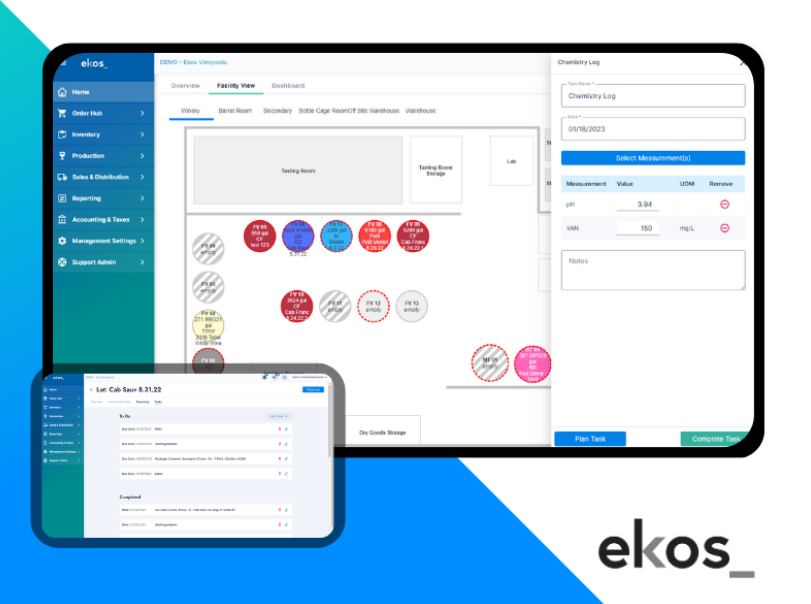
Easy-to-use and intuitive system allows wineries to track production from intake through case goods.
CHARLOTTE, N.C. (Jan. 19, 2023) – Ekos, the only end-to-end business management software for wineries, has launched an all-new wine production experience. The improved features give wineries unprecedented insights into production and the ability to track data from production through sales. By digitally tracking wine production, winemakers can spend less time on administrative tasks and have more time to perfect their wine.
Ekos is the only software on the market that empowers wineries to manage their entire businesses from harvest to the bottom line. Beyond production data, Ekos provides a centralized hub for inventory management, accounting, and sales channel management. Ekos’s winery software helps wineries solve essential business problems like setting the right prices based on COGS; optimizing DTC, wholesale, and on-premise sales; and forecasting based on market demand.
Now, with the revamped wine production experience, tracking winemaking data is easier than ever. With Ekos, winemakers can:
- Keep track of each wine lot in one place
- Manage intakes of grapes, juice, or wine for each lot
- Automatically view wine composition
- Monitor chemistry to make sure lots are progressing as expected
- Manage and assign tasks to improve communication and keep winemaking teams up to date
- Track lot volume and vessel locations
- Visualize production at every stage within the software
- Easily see the entire history of the lot through all stages and blends
“With the full release of our new wine production experience, Ekos now provides a software unlike any other in the wine industry,” said Josh McKinney, CEO of Ekos. “We know that making great wine is the heart of your business. Now, your winemaking team can track every step in Ekos. But we don’t just stop there — with Ekos, you get full visibility into your business so you can make data-driven decisions to build a brand that lasts.”
To learn more about Ekos and the wineries who love the software, visit goekos.com/wine.
About Ekos
Founded in 2014 and headquartered in Charlotte, N.C., Ekos is the leading business management technology platform powering — and empowering — craft beverage businesses. With more than 18,000 users on six continents, Ekos helps beer, wine, and cider makers drive efficiencies, power growth, streamline communication, and improve visibility across their businesses. As a digital hub for all critical business information, Ekos makes it easy to manage day-to-day operations in inventory, production, sales, and accounting. Ekos was named to the Inc. 5000 list in 2022 and 2021 and is backed by Catalyst Investors and Noro-Moseley Partners. To learn more, visit goekos.com.

Customers are the lifeblood of every business. To make your winery successful, you need to cultivate repeat customers and serve them effectively.
If you sell directly to consumers online or self-distribute your wine to local restaurants, retailers, and bottle shops, then your customers go beyond the people drinking in your tasting room. In this piece, we’re talking about how you can streamline and organize customer information and set up processes that will help you sell more.
Customer relationship management systems (CRMs) are software tools built to help you capture data and monitor your customers from initial contact through the transaction and back again. Here’s a quick introduction to whether a CRM is right for you.
Get more info about all the categories of winery software »
What Can a Winery CRM Do?
CRMs provide visibility where you need it most: customer interactions. CRMs are essentially heavy-duty internal databases where you can store all your insights on customers, leads, and prospects and analyze them. Data can include basic information, such as addresses and contact information, or more nuanced notes like a buyer’s hobbies or when you should deliver to a loading dock.
Popular, “big” CRM names include Salesforce and Oracle, but there are niche products specifically geared toward the alcohol industry and even wineries specifically.
CRMs Keep You Organized
Organization is fundamental to providing excellent service. Storing account information in a convenient, secure location helps a wine business create continuity across sales and marketing teams and grow over time. For this reason, established businesses tend to use CRMs as their single source of truth for sales activities.
Today, most well-regarded CRMs have some form of cloud-based functionality, which means you can access customer information on the go, an instant upgrade over storing information in paper files or, worse, in your head. Accessibility is crucial if you have sales representatives on the road or want the ability to do work on some DTC-related tasks from home.
This level of organization gets even better with integration. There are many CRMs that are designed to work with your email provider to help you collect and organize messaging, schedule meetings, and track your overall cadence of correspondence. Employees can be observed in these systems as well, so you can see the complete picture of customer service.
Together, these systems can help you make decisions with hard facts rather than guesstimates — an important step in maintaining or improving business success.
Reporting Is Where It’s At
The true power of CRMs lies in reporting. Once a winery has used a CRM for long enough, it can use the collected data to generate custom reports for deeper analysis. It can use these reports to determine which customers generate the most volume, which markets are doing well, and which employees are providing customers with white-glove service.
This visibility allows you to monitor trends, create sales forecasts, and judge the effectiveness of marketing campaigns. CRMs provide many strategic insights you can’t garner any other way. In many cases, the right CRM can empower a sales team to spot and land new opportunities because of easy-to-access reports.
CRMs Cost Time & Money
CRMs do require a significant investment, and when it comes to standalone systems, you get what you pay for. Some have free or modest pricing tiers, while more robust enterprise-level systems can cost upwards of thousands of dollars a year. Often, CRMs are priced as a yearly subscription and per individual license.
Before you take the plunge on a CRM, take a moment to reflect on how it will fit within your business and who truly needs to use the software on a consistent basis. Onboarding employees to a new system requires a lot of manhours, sometimes entire days, depending on how deep their engagement will be.
Like much of sales and marketing, CRMs are about playing the long game, so it can sometimes take a while to recoup that investment. They also require you to stay diligent about documentation to prove worthwhile, so think of CRM as a continuous discipline that gets better with practice.
Consider All Your Options
Because CRMs are high-ticket items, small businesses don’t always spring for standalone systems right away. In fact, 44% of wineries report using no CRM solution according to our research. But these businesses are still paying attention to customer data.
Many producers prefer to use winery management software to capture this information. Business management software is a simple solution that allows you to keep all your customer interactions, production, accounting, and inventory data in one convenient place with much of the same reporting functions. Using a single system, you can track each customer and their order flow from end-to-end to generate a true snapshot of your business. With time, you can spot patterns and forecast sales for different varietals, blends, or specialty wines. This visibility and control can help your winery transform into a smooth, predictable operation.
Overall, business management software can act as a helpful starting point for establishing a base layer of customer insights and standard processes until a standalone CRM makes sense. This approach tends to be a good fit for lean teams where employees wear many hats, and it’s an approach that lends itself to cross-training. And in the meantime, you can expect customers to appreciate the extra attention.
Learn more about the different types of winery software »

Most of the wine you drink likely comes from a glass bottle. Heavily rooted in tradition, wine packaging is pretty standard across the wine industry because of the stricter packing options. Compared to beer, which can be sold in any size, the Alcohol and Tobacco Tax and Trade Bureau (TTB) only allows wine to be sold in specific sizes.
Historically, you’d be able to package wine in any of the following sizes:
- 50 ml
- 100 ml
- 187 ml
- 375 ml
- 500 ml
- 1 liter
- 1.5 liter
- 3 liter
This list did not include a few sizes that are popular among consumers. Luckily, as of December 29, 2020, the TTB introduced three more sizes: 200 ml, 250 ml, and 355 ml.
Why Do New Wine Packaging Sizes Matter?
With the new sizes, winemakers can package their products in ways consumers prefer. According to WICresearch’s consumer preference surveys, 250 ml is the most popular single-serving size. It allows consumers to drink responsibly and have better portion control.
The new 355 ml size corresponds to a traditional 12 oz beer can. If winemakers use this packaging type, it will provide consumers with a glass-free option that makes wine more portable and accessible. Not only are aluminum cans well received by consumers, but they’re also easier for winemakers to source (recent supply-chain issues notwithstanding) and typically cost less than their glass counterparts.
By adding new packaging sizes for the wine industry, the TTB is helping to drive economic growth and increase the reach of the wine industry.
Wine Packaging Alternatives
With new options available, many wineries are looking for new, innovative ways to package wine for consumers. While glass bottles aren’t going anywhere, winemakers can meet the growing need for convenience and portability that a corked glass bottle can’t provide. If you’re looking for a way to increase penetration in the market, here are a few alternative wine packaging methods to consider.
Aluminum Cans
Cans have been a popular packing option in the alcohol industry for many years — but mainly for beer. With the updated packaging sizes, wine lovers can now enjoy straight from the can. Aluminum cans make a great packing option for winemakers for a few reasons:
- Convenience – Glass bottles can be tricky. When transporting a glass wine bottle, consumers must be mindful of how they pack it to avoid breakage. At the pool or beach, they’re probably surrounded by signs that say no glass allowed. Packaging wine in aluminum cans makes transporting it much more convenient. Plus, wine drinkers don’t need to worry about bringing along a corkscrew!
- Smaller portions – Some consumers don’t want to commit to a full bottle from a new brand. Without smaller sizes, they may opt for one they’ve had before because they know they enjoy it. Cans allow consumers to taste more wine options and find new favorites.
- Eco-friendly – Environmentally friendly packaging is a must nowadays. Aluminum cans are more eco-friendly than a traditional glass bottle, mainly because aluminum is more likely to be recycled than glass. The lower weight of aluminum also makes them easier to transport, reducing carbon emissions and carbon footprints.
- Demographic – Wine drinkers tend to skew upwards in age, and the industry has struggled to appeal to younger consumers. Aluminum cans can help you reach a younger demographic that has been slower to adapt to wine. Younger drinkers are accustomed to drinking beer, ciders, and seltzers from cans. Putting wine in cans makes it easier to bring to a party, beach day, or road trip.
Boxed Wine
Although boxed wine used to get a bad rap, it has become more popular in recent years. A wine box features an air-tight bladder inside a cardboard container that dispenses wine. This makes it easy to use the same box across multiple drinking occasions. Along with its ease of use, boxed wine offers:
- Extended shelf life – Once a bottle of wine is opened, any remaining wine will only last a few days before it goes bad. Because a wine box prevents light and air from reaching the wine, it can last for up to four weeks in the refrigerator. That’s nearly three times longer than a traditional bottle!
- Affordability – Bottling wine can be a costly process. Packaging wine in boxes can save you money during production. As a result, you can pass those cost savings onto the consumer or enjoy a higher profit margin on those items.
- Portability – Boxed wine offers convenience and portability that glass bottles can’t. Whether your consumers take wine on a picnic or an outdoor adventure, a box makes that much easier.
Plastic Bottles
If you’re not quite ready to give up the look of a traditional wine bottle just yet but are looking for alternative packaging options, you may want to try plastic bottles. While they won’t have the same elegance that a glass wine bottle offers, they achieve the same appearance without the hassle of glass. Plastic wine bottles provide consumers:
- Convenience – Similar to aluminum cans and wine boxes, plastic wine bottles make transporting wine easier. Whether heading down to the pool or beach where glass isn’t allowed or bringing a few bottles to bookclub, your consumers don’t have to worry about accidentally shattering a bottle on the way.
- Refrigeration – Because plastic is thinner than glass, white and sparkling wines will cool more quickly in the fridge. This allows consumers to enjoy your product at an ideal temperature more quickly than if they needed to wait for a traditional bottle to chill.
- Weight – Glass is relatively heavy, especially when the bottle is full of wine. Transporting cases of wine in traditional glass bottles increases carbon emissions, thus increasing your carbon footprint. Instead, plastic bottles weigh approximately one-eighth the weight of a glass bottle, making the transport of your product a new environmentally friendly endeavor.
While aluminum cans, bag-in-a-box wine, and plastic bottles are the most popular forms of alternative packaging for wine, there are other non-traditional packaging methods you can opt for as well, such as paper bottles, flax bottles, and flat bottles. But in most instances, these three innovative packing methods will make your product more accessible for consumers, expanding your brand’s reach in the market.
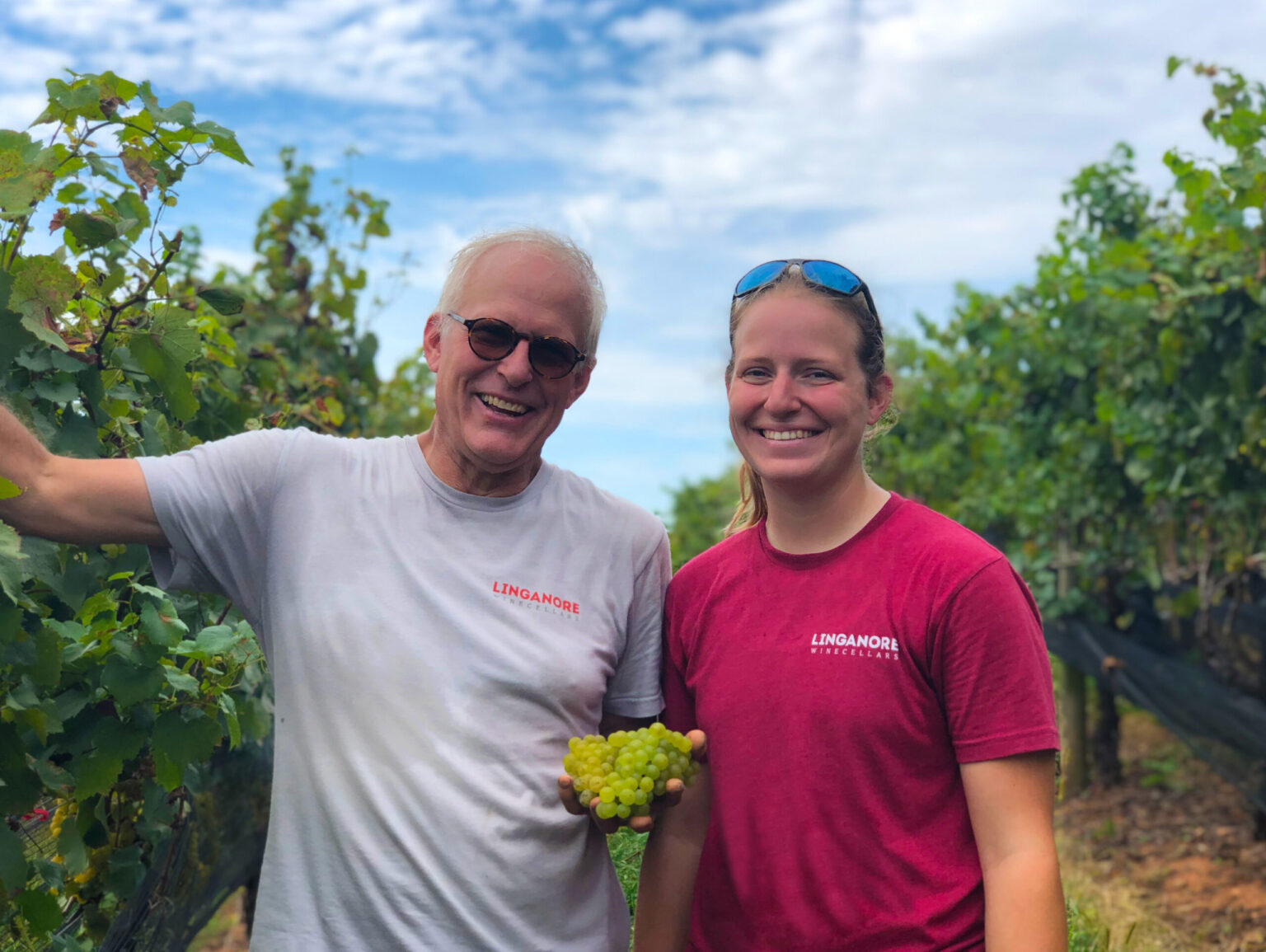
Maryland’s largest winery is using Ekos to oversee production, monitor inventory, and connect POS and accounting systems
MT. AIRY, Md. — (October 14, 2022) — Linganore Winecellars, a family-owned and operated winery since 1971, is using Ekos winery management software to further build its extensive brand.
Founded in 1971 by Jack and Lucille Aellen, Linganore Winecellars is Maryland’s largest winery with 80 acres of vineyards and a 160,000-gallon production capacity. The winery produces 32 varieties of wine and places sustainability at the forefront of their winery, earning Linganore a Sustainability Leadership Award from the Maryland Green Registry in 2021. The winery is still managed by the Aellen family today.
Linganore Winecellars started using Ekos in 2022 to simplify its production process, organize inventory, and track sales at the winery. “We use the production side daily — specifically the facility view,” said Melissa Aellen, winemaker and director of operational changes. “The navigation to different batches is seamless and we have a rough layout of where all of our wine is at any given point.”
Ekos is the only fully connected winery management platform helping wineries manage their inventory, production, sales, and accounting data in one centralized location. The software also integrates with point-of-sale, ecommerce, and accounting softwares like Commerce7, Shopify and QuickBooks.
The Linganore team chose Ekos for its integrations with their point-of-sale and accounting software and to gain more visibility into the business’s costing and other data. “We are excited to finally be able to track costs for each wine made from fruit receival through bottling,” Melissa said. “The excise tax reporting also reduces monthly time spent to create these reports.”
In addition to the technical capabilities of Ekos, Linganore was drawn to the responsiveness and energy of Ekos’s team. “We chose Ekos for the culture and drive of the employees to assist and continue to improve the program,” Melissa said. “Everyone so far has been extremely receptive to ideas we have and are quick to implement new features.”
“Ekos is on a mission to empower wineries to manage their businesses and stand out in a competitive marketplace,” said Ekos CEO Josh McKinney. “I’m thrilled Linganore has selected our team as a partner as they look to continue their tradition of great wine, culture, and success.”
To learn more about how Ekos can help your winery, click here.
About Ekos
Founded in 2014 and headquartered in Charlotte, N.C., Ekos is the leading business management technology platform powering — and empowering — craft beverage businesses. With more than 18,000 users on six continents, Ekos helps beer, wine, and cider makers drive efficiencies, power growth, streamline communication, and improve visibility across their businesses. As a digital hub for all critical business information, Ekos makes it easy to manage day-to-day operations in inventory, production, sales, and accounting. Ekos was named to the Inc. 5000 list in 2022 and 2021 and is backed by Catalyst Investors and Noro-Moseley Partners. To learn more, visit goekos.com.