
The challenge of attracting and retaining a diverse, productive, and engaged workforce has grown. Workers seek quality jobs, and companies that prioritize job quality become employers of choice.
Job quality is not just about the job; it is a combination of key drivers that are important to each worker’s overall employment experience. Pay and benefits matter, and so do many other factors like workplace safety and health, a voice, scheduling predictability, skills building, and advancement. Together, these distinguish an employer of choice from the rest.
The Job Quality Toolkit is an actionable tool that organizations can use to improve the quality of the jobs they offer. Identifying and improving the drivers most valued by workers can significantly increase their satisfaction and engagement and, in turn, benefit the organization’s ability to compete for talent and achieve success in the marketplace.
Given the clear nexus between job quality and performance excellence, the Job Quality Toolkit is rooted in the U.S. Department of Commerce’s Baldrige Excellence Framework. For more than 34 years, the Baldrige Performance Excellence Program has provided the globally recognized and emulated Criteria for Performance Excellence.
Manex, a part of the California Manufacturing Network, and the NIST MEP program are also a part of the U.S. Department of Commerce’s focus on manufacturing excellence, growth, and expansion.
Download the 24-page Job Quality Toolkit from commerce.gov.
Pricing a line of products in a complex and competitive market is not simple. It represents one of the most difficult jobs in manufacturing. If set too low, the business will not remain solvent. (See my previous blog, Gross Margin Drives Your Business Model). If set too high, the product may be priced out of its markets, producing sales volume below the breakeven point.
Many owners and general managers are unhappy with their pricing efforts. They feel they may be leaving money on the table and in some cases missing larger volume orders in others. James Naut in a Conference Board Report said, “Pricing is a subtle art. Too often it has consisted of one-third facts, one-third myths and delusions, and one-third academic economic theories that are out of touch with reality.”
Rather than dwell on the complexities and the theories, let’s go to a great resource, the out-of-print book, Dartnell’s The Sales Manager’s Handbook. The book is full of excellent facts, advice, formulas, and so forth. In this case, a pricing checklist of 10 questions.
- Are prices falling in real terms, yet the share is constant or declining?
- Do you have the feeling that you are leaving money on the table but cannot substantiate it with hard data?
- Are your salespeople, or estimators always claiming your prices are 3 to 8 percent high, yet your share is holding steady or rising?
- Are pricing approval levels acting more as a volume discount mechanism than a control mechanism?
- Do pricing approvals reflect real profit levels?
- Do your prices reflect customer-specific costs (e.g., transportation, set-up, or design costs)?
- Do margins (after customer-specific costs) vary widely by the customer?
- Can you define/describe your competitor’s pricing strategies/rules?
- Can you predict how and when competitors will react to your price moves?
- Do you have a planned method of communicating moves to 1.) Customers 2.) Competitors (legally of course) 3.) to your sales team?
Answering these questions requires a detailed understanding of your company’s pricing system. By this, I mean how pricing starts, how they are administered, price and cost relationships by customers, and more.
In my experience, strategic pricing is much easier than tactical day-to-day pricing. Strategic pricing means your stated goal and supporting business acumen. You might tell yourself, “We are the best and we will charge for the best!” Tactical pricing is the day-to-day management of pricing in a warfare style of protecting your business or growing your business against a host of competitors. It may or may not support your strategic pricing plan if that plan is simply a set of goals rather than a well-thought-out and realistic strategy.
When I managed a team of 15 national account managers calling on every retail chain in the Americas, I experienced one form of very bad pricing intelligence. That being the “last buyer talked to”. You need more than the intelligence gathered from the last customer/buyer your team or even you spoke to. That’s often just a negotiation tactic or a low-ball version of a market shift.
Your criteria for pricing includes:
- Gross margin objectives
- ROI goals
- Buyer/market reaction to proposed price or prices
- Expected volumes at price levels
- Possible and probable competitive reaction
- Newness, innovation, and degree of competition on the product or products
Reasons for changing pricing include:
- Changes in costs
- Competitive review
- Periodic review
- Pressure from customers
- Increased competition as the product loses its innovation advantage
Reasons for pricing variations in your company:
- Quantity ordered for delivery at one time
- Channel of distribution
- Quantity ordered over a period of time (longer horizon)
- Type of customer (direct, wholesale, chain store)
- Location of customer
- Services required
- New tooling
- New or existing production line
- Investment required
- Level of difficulty
Inflation/changes in the general price index. Establish a pattern flexible enough to meet any condition, and yet rigid enough to meet an adequate profit at varying levels of sales productions.
Alertness and flexibility should be the keynote of your pricing activity. Things are moving fast, and predictions of the economic future may not pan out. Therefore, policies must be continually reviewed and revised. A normal lifetime setting of price-setting decisions is being concentrated in a few months. A philosophy of pricing is not indispensable today. A patchwork of price decisions cannot successfully meet a continuously changing situation. You should formulate a pricing strategy to the sales/marketing effort required to move a given volume with a certain / specific time into the market. -Dr. Joel Dean, Former Business professor at Columbia University
- Conduct price research
- Adjust your costs to current and prospective price levels
- Adjust your P&L to reflect economic realities.
- Align your prices with the competition in order to achieve buyer reaction and market share
- Put your pricing house in order. Many companies have let their geographical, quantity, functional, key account, and product line differentials get out of control.
All the factors bearing on pricing decisions are seemingly endless: costs, product, product life cycle, services, distribution channels, industry segments served, credit, demand, market share, competition, local, regional, national, and global economic environment, government support within industries, public policies, and the law. Mathematical models, or simply running “what if’s” on an Excel version of your budget / P&L are very helpful.
However, in the end, price is the result of your discretionary value judgment after considering and evaluating all factors. Just remember, it’s easy to give and very difficult to take away a discount or a lower price. How much will you need to sell in order to earn the same gross profit if your gross margin is 40% and you cut your price or prices by 10%? 33.3% more.
Model your pricing changes carefully and communicate to your key team members the financial literacy around pricing, gross margin, net margin and staying in business or not. Pricing is not a tool to get an order at all costs. It can be, and I’ve certainly witnessed too many cases where the implications are not modeled or ignored to the company’s detriment.
About the Author
As Manex President and CEO, Gene Russell is a driving force behind the firm’s successful track record in helping California manufacturing companies grow and thrive. He has held three successful CEO positions over a 20-year period for businesses that included early-stage, private equity, and non-profit. He has served as senior leadership for global Fortune 100 and iconic consumer-branded companies. Prior to Manex, Russell led a turnaround at a California midsized manufacturer. His experience in global sourcing and manufacturing over several decades led him to Manex where he brings real-world experiences, and as a result, a personal passion to restore and invigorate domestic USA-based manufacturing. He can be reached at grussell@manexconsulting.com.
By Gene Russell, Manex President and CEO
I’ve been writing strategy and financial plans for forty years. From the big one, AT&T, down to my various start-ups and turnarounds. In this blog, I want to talk about my favorite metric from those years of experience and fun.
The business model is the most fundamental element that owners and C-levels must understand comfortably and deeply. Describing your product, who you sell to, why they buy, and how you maintain market share is illustrative of what you do. However, the true business model is the financial underpinnings of that description. One of the first and most important items is at the top of your P&L statement and its gross margin or gross profit margin. It’s foundational to what you can and cannot do in your business. In manufacturing, if you can increase the gross margin through operational excellence and have the products that sell at a maximum market price – you probably are golden and pretty darn happy.
Gross Profit Margin Explained
Gross profit margin is a good metric for measuring how effective a company is at converting goods, materials and direct labor into profit, because it includes only the variable and fixed costs associated with producing or acquiring products and services. It also provides a measure of profitability that is independent of sales volume: if sales increase by a factor of two and cost of sales increases at the same rate, gross profit margin will remain the same.
Organizations can also use the gross profit margin formula to assess the margin of individual products or lines of business by performing the same calculation but inputting the revenue and costs specifically related to those products or business units.
What Does Gross Profit Margin Tell You & Why Is It Important?
Gross profit margin is a good yardstick for measuring how efficiently companies make money from products and services, because it measures profit as a percentage of sales revenue. It can therefore be used to more easily compare companies with different sales revenues.
Gross profit margin is sometimes used as an indicator of how well a company is managed. High gross profit margins suggest that management is effective at generating revenue based on the labor and other costs involved in generating its products and services. Big changes in gross profit margin quarter-over-quarter or year-over-year can sometimes indicate poor management. Other problems that could cause fluctuations in gross profit margin include temporary manufacturing issues that result in lower product quality and a higher level of product returns, reducing net sales revenue.
When gross profit margin declines steadily over time, the company may need to make adjustments to facilitate growth. For example, it may need to look for ways to sell a greater volume of products to compensate for declining profitability. Or this could be a sign that it should consider changing its business model, improving its manufacturing processes to make products more efficiently, or cutting costs in other ways. Alternatively, it may be undervaluing its products and may need to carefully raise prices. In many cases, it rode the product too long in the market without changes, improvements or a completely new version.
What Is a “Good” Gross Profit Margin? Should It Be High or Low?
A company should target as high gross profit margin as the market will support. Besides driving more profit to the bottom line (net income), a high gross profit margin leaves more money to invest in R&D and other activities that support long-term growth.
The Definition of a “Good” Gross Profit Margin Depends on the Industry in Which a Company Operates.
We use multiple industry studies to benchmark companies and provide background on all financial ratios, labor costs, revenue per employee, and other interesting metrics related to the business model. IBIS World Reports for example, produces studies only related to U.S. manufacturing companies, so the comparisons are very valid. These reports are provided to Manex through the NIST MEP program. One more advantage of dealing with Manex.
Advantages and Disadvantages of Using Gross Profit Margin
- It’s a quick method for showing the margin on the company’s products and lines of business.
- It can also serve as a barometer of a business’s management or sales organization.
- It provides a benchmark for comparing a company’s performance with competitors.
- It can highlight areas with opportunities for improvement—for example, if one product or service has higher gross profit margins than others, that could point to an opportunity to reduce COGS or shift the sales strategy for other product lines.
- It can be used to help set pricing at a competitive level while ensuring products are still profitable.
However, gross profit margin does have some limitations:
- It doesn’t show a company’s overall profitability because it doesn’t include all costs.
- Without proper context, it may present an inaccurate view of profitability. For example, a company may need to pay more for raw materials temporarily if several suppliers in a certain region close after a flood, or it may discount heavily in order to capture market share.
- It is less valuable for comparing companies across different industries. Average gross profit margin varies by industry sector, largely because of differences in COGS.
Gross Profit vs. Net Profit Margin
While gross profit margin is a useful financial metric, net profit margin is the true measure of a company’s overall profitability.
Net profit margin differs from gross profit margin in that it includes all the company’s expenses and costs, while the latter only includes COGS. However, I always start at what I consider the source of most pain and misunderstanding and that is the gross margin. If you think about it – there’s no positive net income unless your gross margin is driving that down to the rest of the P&L. In manufacturing, the difficult fix is not in admin and overhead or sales. It is on the floor in costs, and in the market in pricing.
To put it simply; If you don’t review your gross margin on a regular basis: On orders, during deal discussions, on contracts, and then on your P&L, you’re not paying attention to the most important business model financial ratio you have in terms of daily, weekly, monthly and yearly success. EBTIDA? Sure, that’s important – but first things first.
About the Author
As Manex President and CEO, Gene Russell is a driving force behind the firm’s successful track record in helping California manufacturing companies grow and thrive. He has held three successful CEO positions over a 20-year period for businesses that included early-stage, private equity, and non-profit. He has served as senior leadership for global Fortune 100 and iconic consumer-branded companies. Prior to Manex, Russell led a turnaround at a California midsized manufacturer. His experience in global sourcing and manufacturing over several decades led him to Manex where he brings real-world experiences, and as a result, a personal passion to restore and invigorate domestic USA-based manufacturing. He can be reached at grussell@manexconsulting.com.

California winemaking is massive as one might expect. The business is complex requiring many skill sets including farming, science, production, marketing, and finance.
During the pandemic, wineries struggled with non-essential business closures, limited tasting rooms, and reduced sales to restaurants. Growth has returned post-pandemic to a U.S. total of $26.1 billion. California generates 64% of that total and employs 53% of the total U.S. winery workforce.
Competition is stiff. New wineries are always opening, and breweries and distilleries offer ample substitutes. Some wineries like those owned by EJ Gallo, Bronco, The Wine Group, and Constellation brands compete on national recognition and value pricing. These are the exceptions. Most wineries, particularly here in Northern California must gain customer loyalty from a local base and build out a healthy wine club with both tourists and locals. International imports totaled $10.9 billion – some from famous or newly famous wine-growing regions and are strong competitors to all U.S. wineries.
Key Success Factors
- Viticulture and farming in general
- Enology skills and application
- Branding
- Supply contracts
- Economies at any scale
- Expanding scope of product to meet shifting consumer tastes
- Capitalization
- Financial management
- Workforce
Economies at any scale, is the application of lean production techniques to increase the gross margin and net margins in any winery – not just EJ Gallo. The point being lean works at the small-scale facilities as well as the large ones. As sales grow either organically or through the acquisition of other wineries, Lean production allows the winery to scale perhaps into one production facility with a more automated and skilled workforce. It’s much more difficult to instill lean techniques and principles down the road when all the inefficient work layouts, procedures, and workforce are deeply embedded in the process and culture. Lean should be fully in place prior to any automation. Automating bad processes is a bad idea. The increased efficiencies and larger resulting margin can then fund capital equipment, more branding, and perhaps even some forays into export.
I’ve included a case study from a Scheid Vineyards, Inc. (“SVI”) Lean project as one example where Manex can be very helpful:
“We enjoyed working with the Manex team. It was a success, especially giving us a new perspective and analytical tools to further evaluate our processes.” Kurt Gollnick, COO, Scheid Vineyards
Situation
During harvest, Manex provided Lean consulting services to SVI to help improve harvest operational efficiencies.
Approach
Manex led a process team with the following steps:
- Identified goals, measures, and activities taught core Lean problem-solving skills
- Analyzed process and sources of problematic issues, observed process in action
- Developed solutions and verified effectiveness
- Quantified improved process gains and cost savings
Manex assisted SVI in achieving two primary goals in this project:
- Calculate efficiencies gained through deployment of a new mobile harvest inventory tracking system
- Define further opportunities to increase efficiencies, enhance communication, and drive costs down in the harvest operation
Manex consultants interviewed personnel and shadowed harvest operations. Original harvest procedures were studied to determine current manpower demands, find additional improvement opportunities, and forecast future harvest manning needs after making improvements.
Manex identified specific, realistic improvements, which were then mapped and compared to the current state map to calculate gained efficiencies.
Results
The streamlined process combined with mobile harvest inventory tracking allows SVI to reduce waste, resulting in significant cost savings.
Specific results include:
- 11% reduction in manpower at harvest. The implementation of harvest inventory tracking reduced $30,000 of time per harvest season, and
- Biggest opportunity was in additional process flow improvements, reducing manpower needs an additional 10%, and saving $400,000 per harvest.
Reducing and eliminating waste across the manufacturing flow of a company’s operation — from core to shipping – results in better ROI and improved profit. At Manex, our Lean consultants work closely with you to optimize your processes and operation by bringing Lean manufacturing into your business. Contact Manex info@manexconsulting.com to schedule a complimentary consultation.
*Industry Data: 2023 IBIS World Report on US Wineries.
By Sarah Burlingame
Reposted with permission from nist.gov
There is more to lean manufacturing than improving a few processes. Sustainable lean success requires a companywide culture of continuous daily improvement. Companies that develop their people to think scientifically, using facts and data to drive their decisions, are often the ones that most successfully achieve their goals. Practicing Toyota Kata, or kata, promotes this way of thinking, which can help companies become nimbler and more competitive so that they are able to not just survive but thrive during an adverse event such as a pandemic.
Kata is a Japanese word that refers to a structured way of doing things or pattern of behavior. As Senior Project Manager for TDO (Train Develop Optimize), part of the New York Manufacturing Extension Partnership and the MEP National NetworkTM, I work with small and medium-sized manufacturers to practice kata, or behaviors, and apply additional lean manufacturing tools and techniques to solve business challenges. This gives them a competitive advantage.
During stressful situations such as a pandemic, it is human nature to become overwhelmed and lose focus. But kata coaching can keep management and employees on track. The Toyota Kata framework can be a stabilizing force to guide manufacturers through rough terrain and uncertainty while helping them become agile enough to respond to changes in their environment.
The improvement kata
The improvement kata model, based on Mike Rother’s book, Toyota Kata, helps manufacturers develop essential scientific-thinking skills in their people. The model is based on four steps that are driven by coaching questions to guide management and employees during their continuous improvement journey.
The improvement kata serves as a foundation for manufacturers that are navigating a crisis. Building this foundation begins with focusing relentlessly on direction. Use the model questions below to assess your progress at every step.
1. Set the challenge
Through practicing kata and applying scientific thinking, companies can think about their challenge not only through quantitative metrics such as numbers and routine ways of operating, but also in terms of where they need to be as a company.
Ask yourself: Where does your business need to be in the next 12 to 18 months? Establish a clear goal, which may include desired performance metrics, specific operating patterns, or other business-related outcomes that need to be achieved.
2. Grasp the current condition
Once a challenge has been identified, the next step is to get clarity on where you are now, where you need to be, and what obstacles are in your way.
This can be accomplished through various approaches. A detailed process map is a tool sometimes used to collect and visualize data and observed operating patterns. Physically going to the gemba — the place where the action happens like the shop floor — will ensure that the most current and accurate information is collected.
To get to your current condition, describe the way your business is operating today. How are you performing? What do your processes and work environment look like? How are you using resources?
A thorough understanding of the current condition will be helpful in setting the first target condition. Think of the target condition as what needs to happen in the future that is not happening now, or conversely, what should not be happening in the future that is happening now. When determining a relevant target condition, it is important to consider a goal that would likely need to be achieved to get you closer to meeting the overall challenge.
Once a target condition is established and you have a clear destination, the fun part begins. Figuring out how to get to a destination can be riddled with unknowns, and that is okay. If everything was already known, then you would be there already.
3. Set the next target condition
Set a goal for yourself that is one to two weeks out. The goal (target condition) should be something that, if achieved, will help you get closer to reaching your ultimate goal.
When setting your next target condition, consider things that are happening today that cannot be happening in the future, or things that aren’t happening today that need to be happening in the future.
Ask yourself: Why am I not at my goal yet? The answers to this question will uncover obstacles that are preventing you from already being at your desired target condition.
4. Experiment toward the target condition
Pick one of the obstacles that is preventing you from already being at your target condition. Determine an action to try that will allow you to learn something new about the obstacle you have chosen — and give it a go!
Once you have completed an experiment, you will have either learned something new to help you remove the obstacle, or you will have uncovered additional obstacles that may need to be addressed. Either way, you will be moving closer to achieving your target condition.
Continue to repeat this cycle until you have removed all the obstacles that were previously in your way. Be sure to reflect on your target condition and assess your current condition in between experiments to help keep you focused on the right obstacles at the right time.
The kata mindset
Practicing kata encourages a structured approach where one obstacle is removed at a time through experimentation. In a game of golf, the golfer must move the ball closer to the hole, one stroke at a time. Every time the golfer hits the ball, they will learn a little bit more about what works and what doesn’t and will likely get closer to the hole with each stroke. At times the golfer may end up in a worse position than before (have you ever tried getting out of a sand trap?), but still learns through experiments and will eventually work past each obstacle until arriving at the hole.
Practicing kata is most effective when a coach is there to provide gentle guidance to a learner to ensure the right patterns are practiced and to stay on track. The learner is the person who is striving to reach a challenge and is performing the experiments along the way. Rather than directing a learner toward which steps to take next, a coach guides the learner to apply scientific thinking through experimentation and data-based decision-making. This enables each person to focus on the destination rather than trying to address every small obstacle encountered along the way. And the best part is that it also develops a person’s capability to think scientifically about every future challenge they encounter.
Sustaining this mindset is particularly challenging in today’s turbulent environment. Supply chain disruptions, production demand changes, employee turnover — kata can serve as the manufacturer’s safety handle on the pandemic roller coaster. When emotions are running high, scientific thinking can keep everyone focused on the task at hand.
Kata in action
I previously worked with a metal manufacturer that had to shut down due to the coronavirus crisis. The first step was setting the challenge, including three accomplishments in the first week. To reopen, the manufacturer had to invent new ways to keep employees safe — such as moving workstations for social distancing — while meeting its production quotas. The manufacturer had to overcome obstacles, such as fearful employees who were reluctant to return to work during a pandemic.
Using a kata approach, I helped the manufacturer storyboard the steps for overcoming these obstacles, including:
- Ensure a safe environment for all employees.
- Assess the obstacles to reopening.
- Determine how to ensure social distancing.
- Create a safe, socially distanced environment by moving workstations.
- Develop a communication plan for all employees to help them understand the short-term and long-term necessities of returning to work.
- Ensure all government mandates are followed, even as regulations change.
The result? The metal manufacturer reopened its facility successfully. It now uses kata to ensure it stays in compliance while sustaining its continuous improvement culture.
Kata helps you stay focused for successful outcomes
Kata-based scientific thinking can help you stay focused and calm during a crisis. Some companies fail at kata because they are unable to adapt their operational timelines during a crisis. During a pandemic, you’re looking at implementing changes a couple of weeks out, as opposed to a typical 12- to 18-month timeline.
When you are calm and focused, you are ready to set goals. I encourage manufacturers to limit their goals to three per week. If you start looking everywhere to bail water, you will lose focus on your key ingredients for business survival: your people, resources, and finances. Include achievable goals that can be accomplished daily. Even if your timeline must be expedited, set an experimentation pattern and stick to it.
When your employees feel overwhelmed, kata can remind them to take a deep breath and look at every challenge using a systematic, structured approach. Where do we need to be? Where are we now? And what is in our way? You will not have all the answers at once, because we are all human. Let the kata patterns take you where you need to go. They work.
Looking for kata support in your organization’s lean journey? Contact Manex, your local MEP Center, to talk to a lean expert or other manufacturing specialists who understand the needs and challenges of smaller manufacturers. Call 877.33.MANEX or email info@manexconsulting.com.
About the Author
Sarah Burlingame is a consultant at the Central NY MEP (TDO) and a contributor to nist.gov.
I see a lot of predictions out there on inflation and recession. How about stagflation? Did you live through that one? Given current workforce shortages, no one can imagine that one. However, structural unemployment could occur – look what’s happening in tech. In economics, stagflation or recession-inflation is a situation in which the inflation rate is high or increasing, the economic growth rate slows, and unemployment remains steadily high. It presents a dilemma for economic policy, since actions intended to lower inflation may exacerbate unemployment.
There are several reasons to expect inflation to continue even with rising Federal rates seemingly crushing demand in consumer and housing sectors. That is the rise of the global population and the rapid acceleration of a new middle class with high consumption rates. The global population has risen from under 3 billion 65 years ago to 8 billion in 2022. This population growth has recently been accompanied by a rise in the middle class in several countries. China now has a middle-class population of 707 million – which is larger than the entire population of the United States. The stressors on the environment have been clear, and resources continue to become scarcer and scarcer. Water, fertilizer, petroleum, and rare earth minerals are being chased by more and more economies. Populations previously on bicycles are now driving automobiles and flying all over the world.
Demand-pull inflation arises when the total demand for goods and services (i.e., aggregate demand) increases to exceed the supply of raw inputs, finished goods, and services (i.e., aggregate supply) that can be sustainably produced. The excess demand puts upward pressure on prices across a broad range of goods and services and ultimately leads to an increase in inflation – that is, it ‘pulls’ inflation higher. In other words, even with the Fed’s intervention, large swaths of the economy may continue to have inflation due to supply shortages/too much demand from too many people.
A recent Harvard Business Review article, “Six Strategies to Help Your Company Weather Inflation” by Jason Heinrich, Simon Henderson, Tom Holland, and Megan Portanova, aligns well with the types of Manex projects we see accelerating in demand:
- Get spending visibility.
- Differentiate between strategic and nonstrategic spending. *Be very careful of the strategic costs.
- Unpack the drivers of spending. *After visibility, develop granular price and quantity views on spending.
- Reduce consumption. *Reduce consumption particularly when you have no ability to move your supply chain.
- Eliminate work. *Eliminating unnecessary work is Lean.
- *The authors cite companies that automated prior to Covid having weathered the economic challenges better.
*Manex comments on the authors’ strategies.
We do not typically hear about Lean manufacturing being an inflation hedge, but we have seen a sizeable uptick for all the elements of Lean and Lean training recently at Manex. Anything that lowers costs through efficiencies is going to be led by Lean. Being able to have a pricing advantage through quality that includes delivery to your client’s dock is an advantage of having ISO quality management in place and we see a strong demand for quality management systems (QMS) as well. One of the first areas of competitive cost advantage is in the layout of your plant.
Lean Factory Layout
Factory layout drives operational costs. Lean principles applied to layout are fundamental for today’s industrial factory. Manex frequently provides before and after recommended value stream maps (VSM) and analysis to drive a more efficient layout. In the face of shorter product life cycles, higher product variety, unpredictable demand, and shorter delivery times, having manufacturing facilities with poor flows can’t remain competitive. Poor factory flow also increases breakage, scrap, rework, handling errors, setups, and other operational inefficiencies. Legacy layouts that “happened” over time, like poor street layouts and messy intersections will jam traffic in cramped cities, existing poor layouts result in imbedded additional cost to your products.
However, these challenges can be countered for your existing resources through plant layout optimization. Applying principles of Lean manufacturing flow leads to increased industrial productivity through reducing waste. Lean consultants, through their rich experience, will appropriately plan and position processes, materials, machines, equipment, people, manufacturing support functions and facilities to create the most effective factory layout to deliver your products. Expansions and relocation will also benefit from a Lean factory layout analysis before your decisions.
The economy is on a unique and uncertain path as all cycles tend to be. Each downturn and each recovery are unique. What I’ve seen from leading a turnaround at a home décor manufacturer during the housing financial crisis and just over a decade of serving manufacturing clients at Manex is that intelligently planned decisive action wins.
About the Author
As Manex President and CEO, Gene Russell is a driving force behind the firm’s successful track record in helping California manufacturing companies grow and thrive. He has held three successful CEO positions over a 20-year period for businesses that included early-stage, private equity, and non-profit. He has served as senior leadership for global Fortune 100 and iconic consumer-branded companies. Prior to Manex, Russell led a turnaround at a California midsized manufacturer. His experience in global sourcing and manufacturing over several decades led him to Manex where he brings real-world experiences, and as a result, a personal passion to restore and invigorate domestic USA-based manufacturing.
By: Megean Blum and Nico Thomas
Reposted with permission by nist.gov
When Nico asked me if I wanted to collaborate on this year’s challenges blog, my second thought after agreeing to the idea was a scene from the 2007 film “Music and Lyrics,” which I likely have not seen since approximately 2008. Why this popped into my head is unknown but ha! POP! I had forgotten that was the name of Hugh Grant’s singing group and part of the title of their hit song. The hip move! I may have been over-caffeinated or under-caffeinated — the line can be so fine — but as Nico and I started talking about our findings and plotting our structure, that’s what came to mind. Music and lyrics! Peanut butter and jelly! Cinnamon and raisins! We’ve got this!
For those who may lack encyclopedic recall of rom coms from the aughts, “Music and Lyrics” is a romantic comedy starring Hugh Grant and Drew Barrymore. The pair are presented as something of an odd couple attempting to bring their respective strengths together — his for composition, hers for lyric writing — and create between them a mega-hit for their movie world’s reigning pop superstar. First, however, they have to argue their way toward understanding that both music and lyrics are important; it’s not just the melody or the words — it’s how you bring them together. Writing a hit requires collaboration and bringing together a number of moving pieces into a coherent whole; a whole that was, pardon the cliché, more than the sum of its parts, and one where each piece comes to the front in its time.
NIST MEP Survey Provides Important Insights
As long-time fans of the MEP National Network™ (and our blog) know, the “challenges” blog is an annual tradition. As part of the annual National Institute of Standards and Technology (NIST) Manufacturing Extension Partnership (MEP) Survey, we ask MEP Center clients to identify the top three challenges their companies face over the next three years from a pre-determined list. In the past, we’ve received responses from thousands of clients, providing us with insights into not only where manufacturing is, but also where it has been and, hopefully, where we’re going, along with all the moving pieces that keep the symphony of industry going. (Yeah, yeah, are you not entertained? It’s a good line! Everyone’s a critic …) This knowledge can help guide our focus — in fact, the challenges that have grown the most during the past 10 years align with MEP’s current programmatic focuses on workforce, supply chain and technology.
Fiscal Year 2021’s responses had a new frontrunner, a new top challenge reported by MEP clients — employee recruitment and retention. In fact, employee recruitment and retention has grown 29.8% as an MEP client challenge during the past 10 years, the highest increase for any reported challenge in the MEP survey. This aligns with the workforce challenge we are seeing nationally, and not only because of the COVID-19 pandemic impacts. Back in April, Reuters reported on the state of U.S. manufacturing according to the Institute for Supply Management’s (ISM) Manufacturing Business Survey. That poll found concerns about employee quit rates and the ability to meet headcount targets, as well as an upward trend in difficulty filling positions and a near-record number of job openings. Economists in that story cite a general lack of available labor as a driver. MEP Centers provide a robust slate of workforce services and, if you’d like more information on connecting with one in your state, contact information is available on the NIST MEP website.
Managing partners and suppliers has grown the second most as a client challenge during the past 10 years and the global pandemic has only brought the U.S. dependence on global supply chains for industrial and consumer goods into a brighter spotlight. Significant U.S. domestic manufacturing base gaps exist, highlighting lack of resilience in manufacturing supply chains and undermining U.S. economic and national security and public health. On the upside, insofar as there is an upside to a problem this large, people are aware and working on it already.
NIST MEP’s Supplier Scouting service identifies domestic manufacturers to produce hard-to-source and critically needed supply chain items (including personal protective equipment (PPE) and medical supplies). By leveraging our extensive relationships and knowledge of U.S. manufacturer capabilities, we are able to identify manufacturers’ production and technical capabilities and connect them with supply chains of larger companies and government agencies. Supplier Scouting can be applied on a national, regional or local scale and provides a viable means by which U.S. manufacturing can be catalyzed to produce needed items domestically.
Technology has grown the third most as a client challenge during the past 10 years. Small and medium-sized manufacturers (SMMs) need assistance bridging the gap between their state of practice and the state-of-the-art options available to U.S. manufacturers. Nearly 99% of all U.S. manufacturing establishments have fewer than 500 employees (the definition of an SMM) and around 91% have fewer than 100. All told, these establishments employ approximately 71% of the domestic manufacturing workforce.
The technology adoption gap represents an opportunity for the country, for these companies, for their workers and for the MEP program. Industry 4.0 technologies, for example, can raise productivity by up to 40% and transform some scale-based activity into flexible production. Technology may, as discussed in this US Census Bureau paper, “Advanced Technologies Adoption and Use by U.S. Firms: Evidence from the Annual Business Survey,” be a “great equalizer” for smaller/younger firms … but it could also prove to be another gulf to cross if only larger firms adopt.
It can sound a bit pat to talk about opportunities when someone is just trying to survive in a newly extra-complex environment with a novel virus floating around, but we’re also talking about strategy, about how to help build U.S. manufacturing and the U.S. economy. McKinsey & Company’s “Building a More Competitive US Manufacturing Sector” recently found that the U.S. has opportunities to improve its competitiveness, but U.S. companies will need to catch up with global leaders in technology adoption and process improvements to truly make the most of these prospects. However, if we can, the potential could be enormous — a more than 15% boost to the sector’s annual Gross Domestic Product (GDP) and up to 1.5 million new jobs. And MEP Centers stand ready to help SMMs adopt and implement new, advanced technologies. Learn more about MEP’s Advanced Manufacturing Technology Services.
All other client challenges have decreased as a percentage of reported challenges during the past 10 years. For comparisons across the decade, see the list and chart below.
Top 3 client challenges in 2012: Top 3 client challenges in 2021: 1. Cost reduction strategies – 73% 1. Employee recruitment/retention – 63% 2. Identifying growth opportunities – 54% 2. Cost reduction strategies – 60% 3. Product innovation/development – 49% 3. Identifying growth opportunities – 46%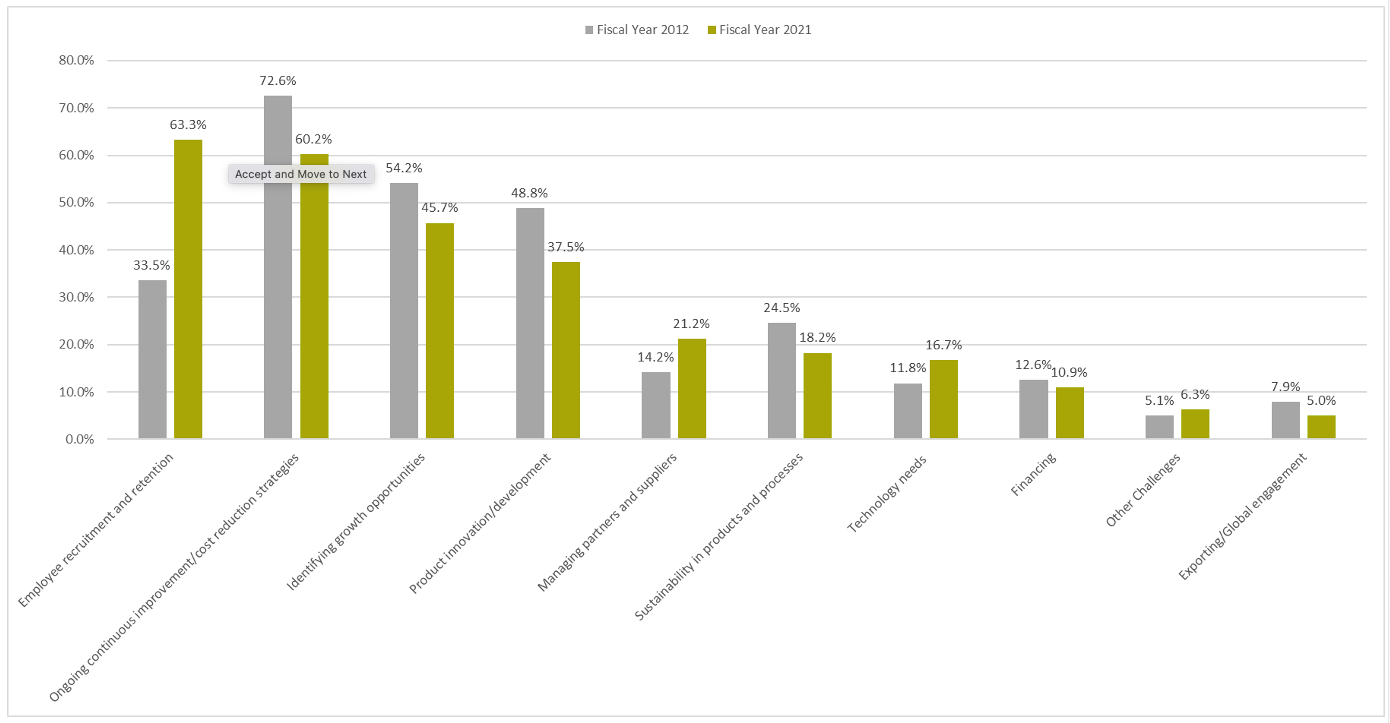
The data shows that building a solid workforce is a vital, foundational step. A 2021 study published by Deloitte and The Manufacturing Institute found that as many as 2.1 million manufacturing jobs will be unfilled through 2030 without strong action, a worker shortage that could cost the U.S. economy up to $1 trillion by 2030. Success in all things, like in writing a popstars mega-hit, takes music and lyrics — but if we can find the path forward and get the mix right, amazing things could happen. We’ll leave the reader to decide where each piece fits in their own metaphorical songwriting attempts. (Or literal, everyone has to have a dream. Live your best life.) If you’d like help with living your best manufacturing life, the MEP National Network is here to help.
Manex, your local MEP Center, offers services to manufacturing companies in Northern California, always customized to meet specific markets and needs. Call 877.33.MANEX or email info@manexconsulting.com.
MFG Day is manufacturing’s biggest annual opportunity to inspire the next generation to start careers in modern manufacturing through a series of focused events to promote manufacturing to students, parents, and educators on the first Friday of October. However, for the last decade, industry leaders have chosen to focus on manufacturing and in particular the manufacturing workforce for the entire month of October.
MFG Day is an initiative of The Manufacturing Institute, with the Fabricators & Manufacturers Association as a founding partner. The Institute grows and supports the manufacturing industry’s skilled workers for the advancement of modern manufacturing. The Institute’s diverse initiatives support women, veterans, students, and workers through skills training programs, community building, and supporting the advancement of their careers in manufacturing. As the workforce development and education partner of the National Association of Manufacturers, the Institute is a trusted adviser to manufacturers, equipping them with the resources necessary to solve the industry’s toughest challenges.
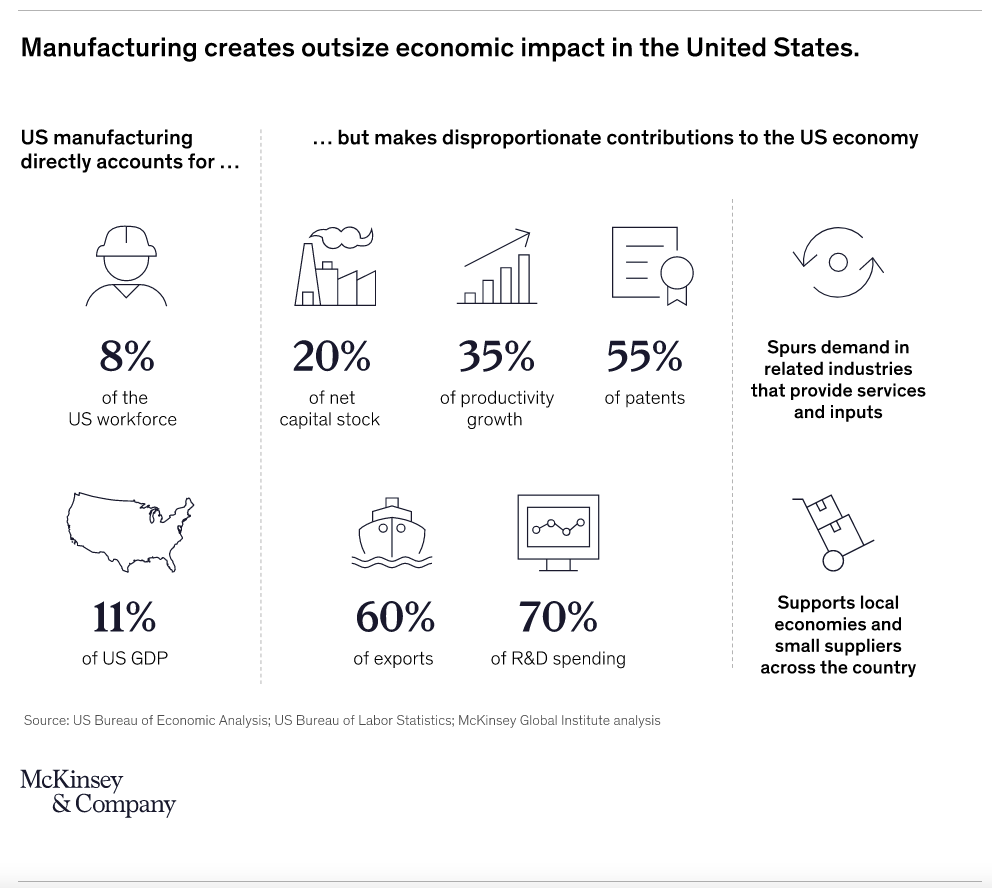
Is manufacturing relevant to the California economy? It’s not only relevant to California but hugely important to the United States.
Top Counties and Industries
According to MNI, one of our database suppliers, Los Angeles County is California’s largest in terms of industrial jobs, home to 453,116 workers. This is followed by Santa Clara (215,748), Orange (210,771), San Diego (140,209), and Alameda (89,187).
Taking a look at the state’s top industries, electronics manufacturing is the state’s top industry, accounting for 17% of California’s manufacturing employment. This is followed by food & kindred products with 13% of the state’s industrial workers and industrial machinery with 12%.
Instruments and related products ranks as California’s fourth-largest industry in terms of employment, with 9% of the state’s industrial workforce and transportation equipment ranks fifth with 8%.
National Rankings
California ranks number one in medical device manufacturing with 72,000 employees and 2,131 establishments with concentrations in the Bay Area and San Diego. California is also number one in electric vehicle (EV) production with Tesla.
California accounts for 46% of the U.S. fruit and nut production and 62% of the national value of fruit and nut crops. California leads in fresh market vegetable production, accounting for 44% of the U.S. harvested area and 49% of the national production. These are not only harvested but packaged and shipped across the country and the world. A great example is the Blue Diamond Almond Cooperative which ships to over 200 different ports worldwide. The technology behind fresh bagged salads showing up in New York City in January is a testament to companies like Emerald Packaging’s science and can do attitude.
Other facts to know about California manufacturers, based on MNI’s advanced criteria available to subscribers, include ownership, distribution, and other trends:
- 2% are women-owned
• 2% are minority-owned
• 9% are publicly-owned companies
• 12% import raw materials
• 31% distribute their products internationally
There are several factors that keep California at the top of the manufacturing world:
- Top universities drive relevant education in science, technology, and innovation
- Companies are started and located close to these educational institutions
- Leading venture capitalists fund new and exciting ideas such as plant-based foods, new types of EV batteries, materials, and more
- Top federal labs and manufacturing institutes spin out new technologies into an educated workforce
- Agricultural powerhouse fuels local packaging, production, and shipping of food globally. (Amy’s, Ramar Foods, Blue Diamond, and many more)
- Strong interest in advanced manufacturing
Challenges to California Manufacturing
- Housing costs
- Shortage of advanced manufacturing programs in high schools and community colleges
- Tax and environmental poaching from other states
- Water
- Energy costs
- Import logistics competing for industrial Land
To learn more about Manex’s efforts to support and grow California manufacturing, check out our Community Impact.
At Manex, Manufacturing Day is every day!
About the Author
As Manex President and CEO, Gene Russell is a driving force behind the firm’s successful track record in helping California manufacturing companies grow and thrive. He has held three successful CEO positions over a 20-year period for businesses that included early-stage, private equity, and non-profit. He has served as senior leadership for global Fortune 100 and iconic consumer-branded companies. Prior to Manex, Russell led a turnaround at a California midsized manufacturer. His experience in global sourcing and manufacturing over several decades led him to Manex where he brings real-world experiences, and as a result, a personal passion to restore and invigorate domestic USA-based manufacturing.

By Matthew Inniger
Reposted with permission from nist.gov
The inability to gather good data has challenged many food manufacturers for decades. But not anymore. As sensor technology has improved, and technology platforms have become more accessible and affordable to small and medium-sized manufacturers, the food industry is poised for transformation. Food companies can now better understand their ingredients, products and operations.
The Center for Innovative Food Technology (CIFT) and JobsOhio recently commissioned a business intelligence group, TEConomy Partners, to conduct a study on the current and future state of the food industry. The findings identified five large-scale trends, or themes, that are having a significant impact on the industry, whether you are in craft beer or dairy. The disruptive technologies span the entire value chain and will have impacts for many years. It’s not just high-demand areas such as supply chain and cold storage where innovation is occurring, it’s also happening in traditional unit operations found in legacy manufacturers and product categories.
Let’s look at the five long-term, impactful trends in the food industry.

1. Supply Chain Adaptability
Disruptions in the supply chain have forced food processors to make rapid adjustments, better manage their exposure, and develop new avenues for distribution from suppliers and to customers. But food companies were facing significant challenges in the supply chain prior to the COVID-19 pandemic. This was primarily from the expansion of stock-keeping units, or SKUs, as consumers demand more flavors and options.
It is not unusual for a food processor to handle 200 ingredients for 60 SKUs even though a significant portion of their revenue comes from a handful of core products. Higher SKU counts and additional specialty ingredients have added to exposure in the current environment. When an ingredient is not available, the manufacturer faces additional challenges as a substitute ingredient may result in changes ranging from supply storage to processing requirements and even cleaning and traceability policies.
Willingness to invest in this area has led to solutions that allow for rapid adjustments to new supply constraints, real-time location tracking, and alternative input sourcing using artificial intelligence (AI) powered algorithms. In any case, you should be looking at what solutions for adaptable and flexible systems are within your budget and return on investment (ROI) expectations.

2. Digitalization of Food
It’s important for even the smallest food manufacturers to become familiar with and invest in digital technologies to be able to meet new industry standards for increased transparency and safety. These changes have been driven not only by compliance concerns, but also by retailers requiring their vendors to be capable of participating in digital supply networks.
The more you invest in ways to measure your raw materials and finished products, the easier it will be to improve your performance. For example, you might be able to optimize shelf life of a product if you can better understand its water content by using accurate, real-time measurement.
The ability to capture data from your operation will also help standardize work and reduce the reliance on key individuals’ tribal knowledge. In this case, that’s not a bad thing. Augmenting human decision making with data-driven science is good for business.
Harnessing big data will also inform food science, such as cold-chain management and associated R&D.

3. Automation, Robotics and Industry 4.0
Autonomous systems will have a profound impact on the food industry. In fact, with improvements in sensor performance, AI is being implemented by some food manufacturers. Data acquisition systems are capable of accurately characterizing complex biological ingredients and products, which allows manufacturers to automate processes and derive the same value out of predictive data analysis that other segments have been doing for years.
Many smaller domestic manufacturers have struggled to adopt automation, especially for high-mix, low-volume work. Industry 4.0 requires significant capital investments and new workforce skills in analytics and programming, which are in high demand across all industries. But the benefits of automation are extensive, including:
- Enhanced production efficiency.
- Potential for 24/7 operations.
- Reduced labor demands.
- Increased uptime and extended machine lifecycles.
- Improved quality and repeatability.

4. Consumer Empowerment
Consumers who understand their food are demanding more choices that are healthier and processes that are more transparent. They are looking for brands to demonstrate a commitment to reducing their impact on the environment. And they are looking for higher levels of customization and convenience for shopping, purchasing and delivery.
The implications for food companies are many, including:
- Providing more avenues for product sales, including direct to consumer.
- Improving order fulfillment, shipping and packaging.
- Expanding ways to connect with customers.
- Increasing customization options and SKUs.
Savvy brands have increased transparency, both in their products and their environmental impact, and are driving consumer engagement. Tactics include messaging such as:
- “Scan this QR code to see how much water it took to make this bottle of salsa, then tell us how you feel about it.”
- “Use code INFLUENCER10 to get a discount and support your favorite social media personality sponsored by our brand.”
- “Your meat crate just arrived, click this link to learn more about how we raise our animals and get grilling tips from our resident pitmaster.”
These touchpoints can have a big impact with customers. Even if you think you are far removed from consumer preferences, such as a flavor house, customer empowerment will trickle down to your operation.

5. Resource Optimization (Sustainability)
The food industry is likely to face increases in regulations pertaining to emissions, resource use and waste. The good news is that advanced technologies are enabling resources to be managed more efficiently.
Many food companies can make significant improvements in this area by learning how to quantify their waste streams and measure improvements. For instance, there’s a big difference between a goal of “use more recycled resin in our HDPE tubs” and “increasing the recycled resin in our tubs from 10% to 20% will reduce the net carbon footprint of our product by 15% and only lose 3% in rigidity.”
The companies that are most successful in optimizing their resources conduct resource-use audits, whether internal or external, to pick out the lowest-hanging fruit that can be addressed with minimal costs. For example, do you know how much aluminum or water your company uses? Can any of that be reduced or reused?
Manex Can Help You Transform Your Food Company
The food industry continues to be a driver of national economic competitiveness that sustains our high quality of life. Food manufacturers face many choices in how to evolve their engineering, food safety, and product development. Experts at Manex, your local MEP Center, can help you address the disruptive technologies that are transforming the food industry. Call 877.33.MANEX or email info@manexconsulting.com.
About the Author
Matthew Inniger has been with CIFT, which is part of Ohio MEP, for three years, and in that time has worked with hundreds of companies providing various engineering solutions needed to fit unique situations. He manages CIFT’s Advanced Technology Program in the areas of automation and robotics. Matt also supports the Product Development team on certain projects, both in benchtop work and production scale-up.