
Winemakers often use their sense of sight, smell and taste to evaluate wine’s color, flavor and mouthfeel and confirm it with scientific lab data. Unfortunately, cloudy samples can often prevent accurate readings when using a spectrophotometer because the haziness scatters light rather than letting it shine straight through.
“Color and phenolics have been notoriously difficult wine parameters for winemakers to measure,” says Marco Wilkins. “As a result, they aren’t as easy to control, and winemakers can’t maximize their full value.”
Wilkins is Head of Growth at Marama Labs, a New Zealand start-up that has developed a revolutionary solution to sample turbidity. CloudSpec is the world’s first UV-Vis spectrophotometer to clarify these high-level, hard-to-control color and phenolic parameters while eliminating the need for a centrifuge and making it easily accessible on a winery’s lab countertop.
Traditionally, winemakers have used filters or a centrifuge to remove sample turbidity. Marama Labs allows a lab technician to insert a standard cuvette into CloudSpec’s integrating sphere. Light enters the hollow sphere through a port, and the cavity’s highly reflective walls repeatedly bounce the sample’s scattered light around the sphere. As a result, a sample's “true absorbance” can be measured as easily as with standard UV-Vis while simultaneously measuring absorption, extinction and scattering spectra of turbid and clear liquids.
Marama Labs also simplifies the interpretation of results with CloudSpec Insights software, which summarizes and visualizes the parameters, such as color, phenolics and AWRI tannin and anthocyanin measures. It also provides the CIELAB visual perception of wine, which uses three axes—green to red, blue to yellow and lightness to darkness to quantify how differences in wine hue and color appear to the human eye. It also calculates the difference between the colors of two wines as the Delta E metric.
“If a winery is looking to ensure consistency or meet a specific target, it can measure color differences using this Delta E,” explains Dr. Brendan Darby, the CEO of Marama Labs. “A Delta E of less than two gives a realistic, real-world way of assessing whether consumers would perceive two wines as the same. That's very important from the point of view of hitting a target style.”
Several large US wineries have used this new invention to optimize winemaking.
Tracking Progress During Harvest
Measurement is so easy with CloudSpec that one winery used it to track its 2023 harvest progress. Although CloudSpec can measure grapes, this winery began with samples from juice at intake and, in the first three months, pulled 400 samples and evaluated nearly 1300 color, phenolics and AWRI measurements. Half were during and just after primary fermentation, but the winery also ran results at press cuts for white wines, before, during and after soaking, post-press, in barrels, during fining and from the final bottled product.
Evaluating the Value of Cold Soaks
Several wineries used CloudSpec to evaluate whether eliminating the time needed to cold soak red wine before fermentation adds enough value to the wine quality to warrant the extra time. CloudSpec results from a trial comparing Cabernet Sauvignon with a cold soak to a same batch control with no cold soak confirmed the slower color and phenolic development in the cold soak batch.
However, in the end, the two ferments were almost identical with a Delta E between the two wines falling well below 2.0, which means they would be indistinguishable in color to a consumer. Parameters for free anthocyanin, tannin and pigments also showed minimal difference.
The winery can now confidently eliminate cold soak and reduce fermentation time by five to six days—enough to potentially process another batch of wine, a critical benefit during harvest when tank space is limited. It would also gain significant energy usage reductions by removing the need to hold wine at a lower temperature.
Assessing Open vs. Closed Top Fermenters
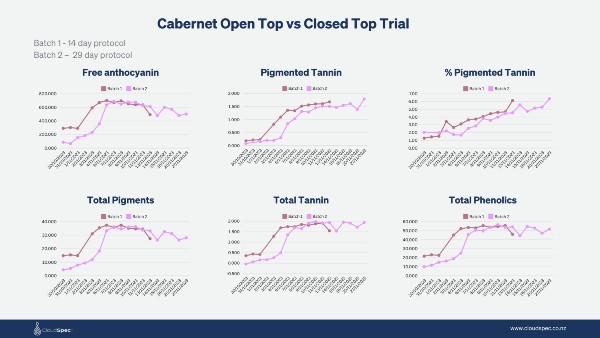
Another winery compared two fermentation protocols—one using an open-top fermenter to a closed-top fermenter. The latter offers more control but takes twice as long since phenolic extraction and color develop more slowly, and the protocol adds extra days on the back end to allow further flavor development and mouthfeel enhancement. CloudSpec confirmed that the open-top fermenter develops color and phenolics more quickly and revealed that it may have higher phenolic development. However, the two protocols reached a similar endpoint in color and other parameters, and the Delta E of 1.97 indicated no significant difference between the wines.
“And 15 extra days can have a big impact on a very busy winery,” notes Brendan, emphasizing, "What you're seeing with all of these results is the use of data and objectivity to optimize processes, freeing winemakers to explore whether optimizing a process will achieve the same quality.”
For more information about the CloudSpec technology and how it could be applied in your winery and business, please contact marco.wilkins@maramalabs.com.
Now that we have the crush of harvest behind us and the grapes are all nestled happily in their proper tanks and barrels perhaps we can consider the management of color and phenolics as the wines develop and blends are assembled.
As we all know, you can't manage what you can't measure. Wine chemistry measurement has become a critical part of wine production decision making in both the vineyard and cellar as well as in market targeting. While many chemical analyses have been simplified and their data application made routine, the measurement of color and phenolics has proven to be vague or difficult and expensive... until now!
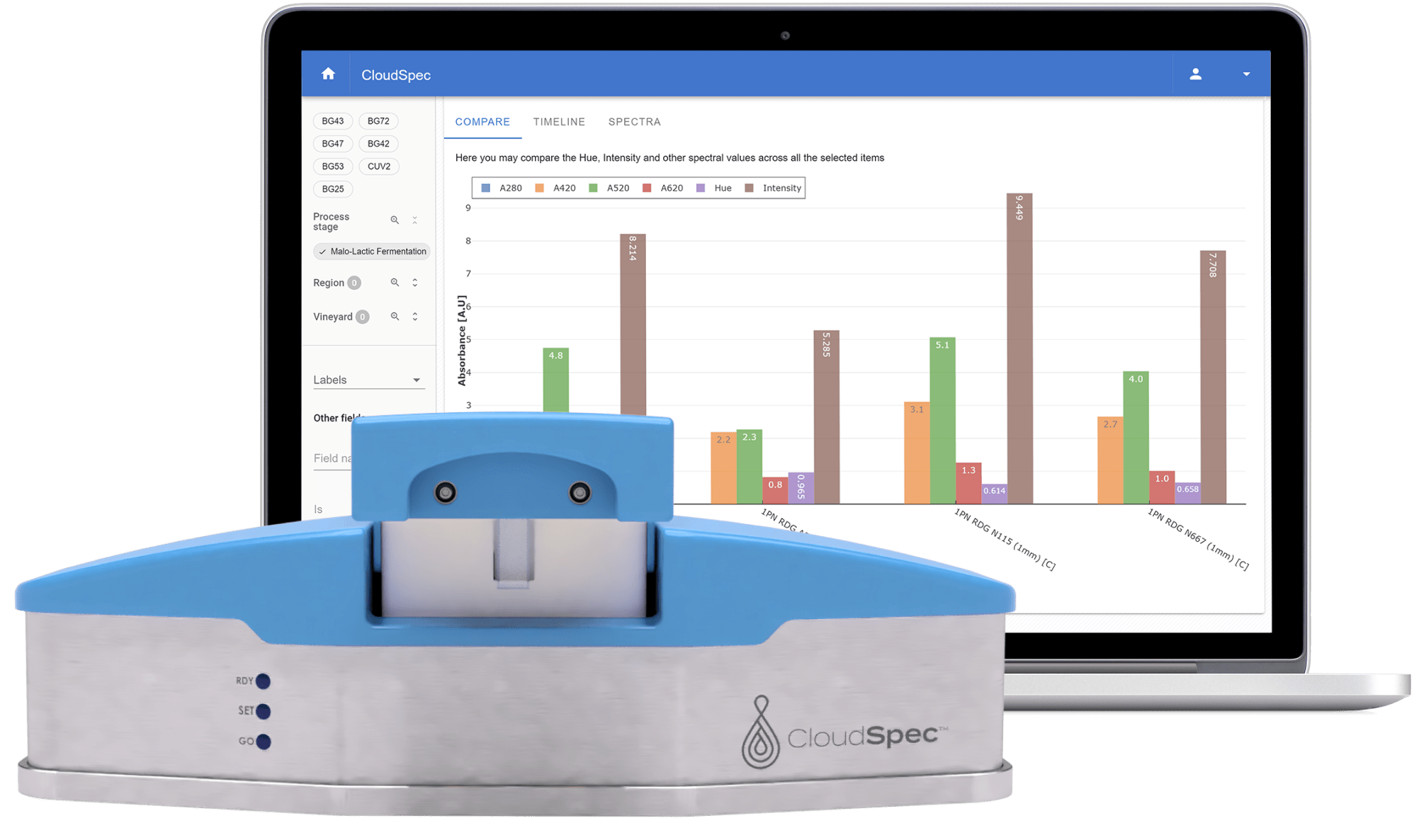
Allow me to introduce you to CloudSpec from Marama Labs. The CloudSpec and Insights web app platform is a revolution in the measurement, data storage and presentation of color and phenolic data from grapes and wines throughout all stages of production through bottling and aging.
From the game-changing patented "Integrated Sphere" photocell that allows accurate spectral determination of cloudy or turbid solutions to the intuitive on-board CloudSpec software through the cloud based Insights web app database which fronts the powerful AWRI developed WineCloud tannin and phenolic algorithms to the multiple presentation options including CIELab data, grape and wine color and phenolics just moved into the "I can do this!" stage.
Marama Labs' CloudSpec instrument and platform makes color and phenolic analytical data easy, understandable and affordable. Let me reveal to you the power of the CloudSpec, I will be happy to schedule an on-site visit or a ZOOM meeting at your convenience.
Questions? Contact Pete Salamone at pete.salamone@maramalabs.com, (707) 595-9506, or click here to learn more!

CloudSpecTM Is The World's Most Advanced Wine Color and Phenolics Platform
CloudSpecTM unlocks a new world of opportunities for wine style optimization through spectrophotometric color and phenolics analysis of grape, fermentation, in-process or finished wine samples
With the combination of a revolutionary ability to measure both clear and hazy samples, the power of the AWRI-developed WineCloud algorithms and seamless integration into the cloud-based InsightsTM database, the CloudSpecTM winery integrated technology enables you to rapidly analyze, predict, control and compare color and phenolics of white, rosé and red wine batches at each stage throughout the grape growing, winemaking and wine market analysis processes.
Overlaid with powerful Market Wine comparison tools and designed for wineries of all sizes, CloudSpecTM allows you to seamlessly target or maintain your unique style, ensuring you stand out in the market.