

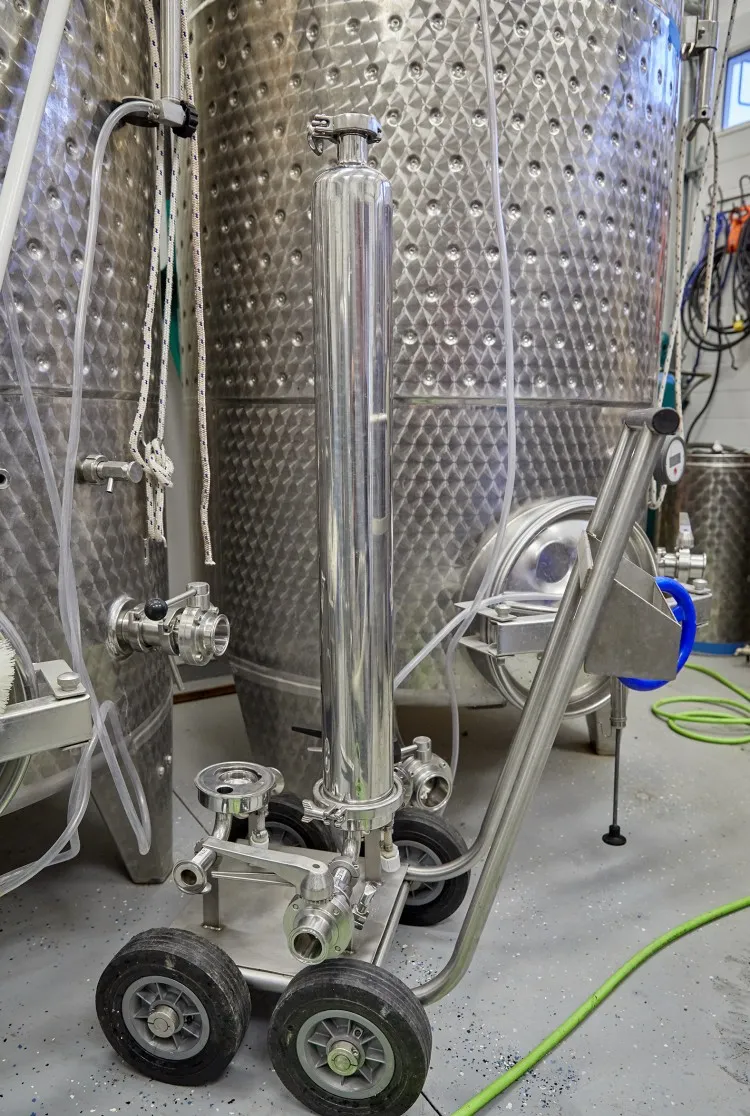
 Problem: Without a careful double-filtering process, a series of bacteria can negatively affect the quality, flavor, character, and aroma of the bottled wine.
Solution: Donaldson's LifeTec™ filter elements have 20% more media than comparable filters and have a sturdy triangular design to withstand twisting and to stay intact under high flow rates.
Wineries Advised to Use Two-Step Process
In the art of winemaking, it’s not only what’s in the bottle that matters. It’s what isn’t. Winemaking consultants say the wrong micro-organisms can be disastrous if they sneak into final bottling. For example, acetobacter will convert wine to vinegar, and any residual yeast that remains after fermentation can cause re-fermentation in wines with residual sugar, producing unintended carbonation.
“If a volume of wine has any residual sugar—and you’re not very diligent about removing all of the bacteria, and more importantly, the yeast cells—the wine can re-ferment in the bottle,” says Drew Horton, Enology Specialist at the University of Minnesota, and a consultant to wineries across the Upper Midwest. “It’s a disaster because it causes the wine to get bubbly or cloudy, or the cork pushes up, or in the worst scenario, the bottles start exploding in the bottle shop.”
Horton strongly recommends vintners learn proper filtration techniques. Unless a wine contains no residual sugar and the winery is absolutely sterile, he advocates a double-filtering process. The wineries that don’t conduct this practice, he says, are very rare.
“If a wine label says it’s unfiltered, the winery is guaranteeing they’re using the best clean fruit, their processing standards are extremely high, there’s no residual sugar in the wine, and most of the malic acid has been converted to lactic acid,” says Horton. “Then the winemaker may choose to bottle the wine without any filtration.”
Established wineries are veterans in filtering. But in regions where the industry is younger, the learning curve for small operators with less experience can be steep. Horton says many vintners use only “nominal” filtering, and are unaware of the need for the second “absolute” step.
“If the wine is not properly prepared and filtered when it goes into the bottle,” he says, “there are a series of bacteria that can negatively affect the quality, the flavor, the character, the aroma of the bottled wine.”
Dry or off-dry white varietals of most respected wineries have less than two percent residual sugar— many have less than one percent, the industry’s definition of “dry.” By contrast, wines with three to five percent residual sugar are common in many northern states with large rural populations, where people tend to prefer sweeter wines, and where vintners need to compensate for high acid in shortseason grapes.
"That's why wineries tend to be sticklers about filtration."
The residual sugar is a very important blend component, but any yeast that lingers after it’s done its job will have a chance of interacting with the product even after six or nine months after bottling.
That’s why wineries need to be sticklers about filtration. Periodically throughout the production year—after the wine has been oak-aged and cold stabilized—many vintners practice the two-step method Horton recommends. First, they batchfilter the wine through a nominal “depth” filter to remove 95 to 98 percent of all yeast and other target organisms, which range between 0.6 and 0.8 microns in size. Then, if they add balancing sugar, they batchfilter the wine once more through a final absolute “membrane” filter. Its pores are also 0.45 micron, but its thin, PES (polyethersulfone) membrane captures the last two to five percent of any remaining contaminant that a nominal filter sheet can miss.