

The later-than-usual release of the Grape Crush Report had everyone doing what this industry does best: guessing. And when the number finally dropped, it landed somewhere between “not great” and “not nearly low enough to matter.”
At approximately 2.6 million tons, the 2025 crush came in higher than most had hoped, and, more importantly, higher than many believe the market actually needs.
The Facts: What the Crush Report Tells Us
Data released by the California Department of Food and Agriculture shows that the 2025 grape crush totaled approximately 2.6 million tons. That represents a decline of just over 8% from the prior year and marks the smallest crop since the late 1990s.
On the surface, that’s a meaningful shift. After several years where production consistently exceeded 3 million tons, supply is clearly beginning to respond.
But the details matter.
Key premium varieties such as Cabernet Sauvignon, Chardonnay, and Pinot Noir all declined, while certain white varieties, most notably Sauvignon Blanc, continued to grow. Regionally, the contraction was uneven, with larger bulk-producing areas seeing sharper reductions than some premium regions.
And then there is what the report does not fully capture: unharvested fruit.
Grapes left on the vine are not just a footnote; they are a signal. They indicate that the final crush number reflects not only what was grown, but what the market was willing, or unwilling, to take.
So while the number is down, it is important to recognize what is driving that decline. This is not purely a supply-side correction. It is also a demand-driven constraint.
What It Means
Market commentary from Ciatti Company helps clarify the implications.
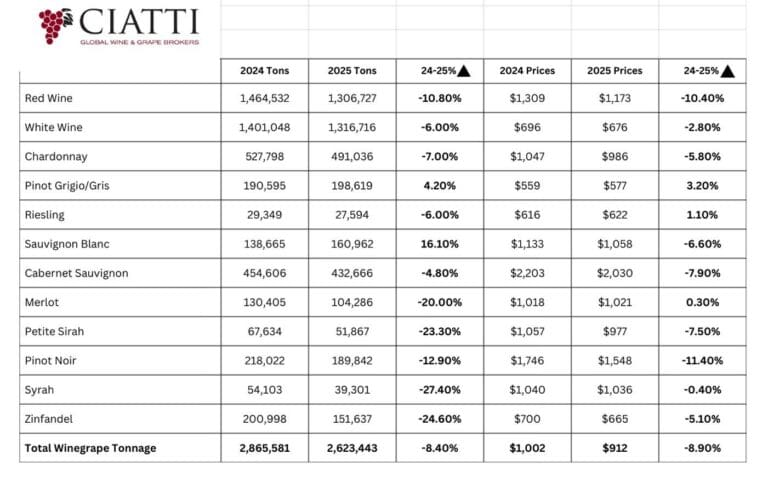 Image source - Ciatti
The smaller crop is a step in the right direction, but it does not resolve the underlying imbalance. The presence of unharvested fruit reinforces that demand remains constrained and that supply, in many segments, continues to exceed what buyers are prepared to absorb.
This distinction is critical.
A lower crush driven by reduced yields would suggest a tightening market. A lower crush influenced by demand limitations tells a different story. It suggests the system is still working through excess supply.
From a practical standpoint, the market remains soft. Bulk wine is still available, buyers remain selective, and pricing, particularly outside the premium segment, continues to face pressure.
For wineries, this means the window for opportunistic buying is not closing anytime soon. If anything, it may widen if supply does not contract more aggressively.
The Bigger Picture
To understand why this is happening, it is necessary to step back from a single vintage. Insights from the Silicon Valley Bank Wine Division consistently point to a structural issue rather than a short-term cycle.
U.S. wine consumption has plateaued and is likely declining in key segments. At the same time, the industry expanded production capacity during stronger demand years. The result is a system capable of producing more wine than the market now requires.
This imbalance takes time to correct.
Inventory built over multiple vintages must be worked through, and supply must remain below demand for a sustained period to restore balance. A single smaller crop, even one that is historically low, is not sufficient to achieve that on its own.
The tone coming out of the Unified Wine & Grape Symposium reinforces this reality. Vineyard removals are increasing, and there is growing recognition that the industry must adapt to a different demand environment. This is not a short-term adjustment; it is an ongoing realignment.
Why It’s Still Not Enough
Despite the progress reflected in the 2025 crush, several factors suggest it is not yet enough to bring the market into balance.
Inventories remain elevated, particularly in bulk wine, and continue to weigh on pricing and purchasing behavior. Demand has not stabilized, meaning supply reductions are working against a moving target. If consumption continues to soften, the level of production required for balance moves lower as well.
At the same time, supply adjustments are slow. Vineyard removals, replanting decisions, and contractual obligations all limit how quickly production can respond. There is also a degree of structural “stickiness”; once vineyards are farmed, the incremental decision to harvest becomes more justifiable, particularly if there is an opportunity to offset costs.
Finally, expectations themselves highlight the gap. Pre-harvest estimates across the industry generally pointed to a lower number, reflecting a broad understanding that deeper cuts were likely needed. The fact that the final crush came in higher suggests that, despite awareness of the issue, the system has not yet adjusted sufficiently.
Bottom Line
The 2025 crush is a step in the right direction.
But it is not a solution.
Production is declining, but supply still exceeds what current demand can sustainably absorb. The industry is in the middle of a multi-year correction, not at the end of one.
Until supply aligns more closely with demand and remains there for a sustained period, the market will continue to feel the effects of imbalance.