
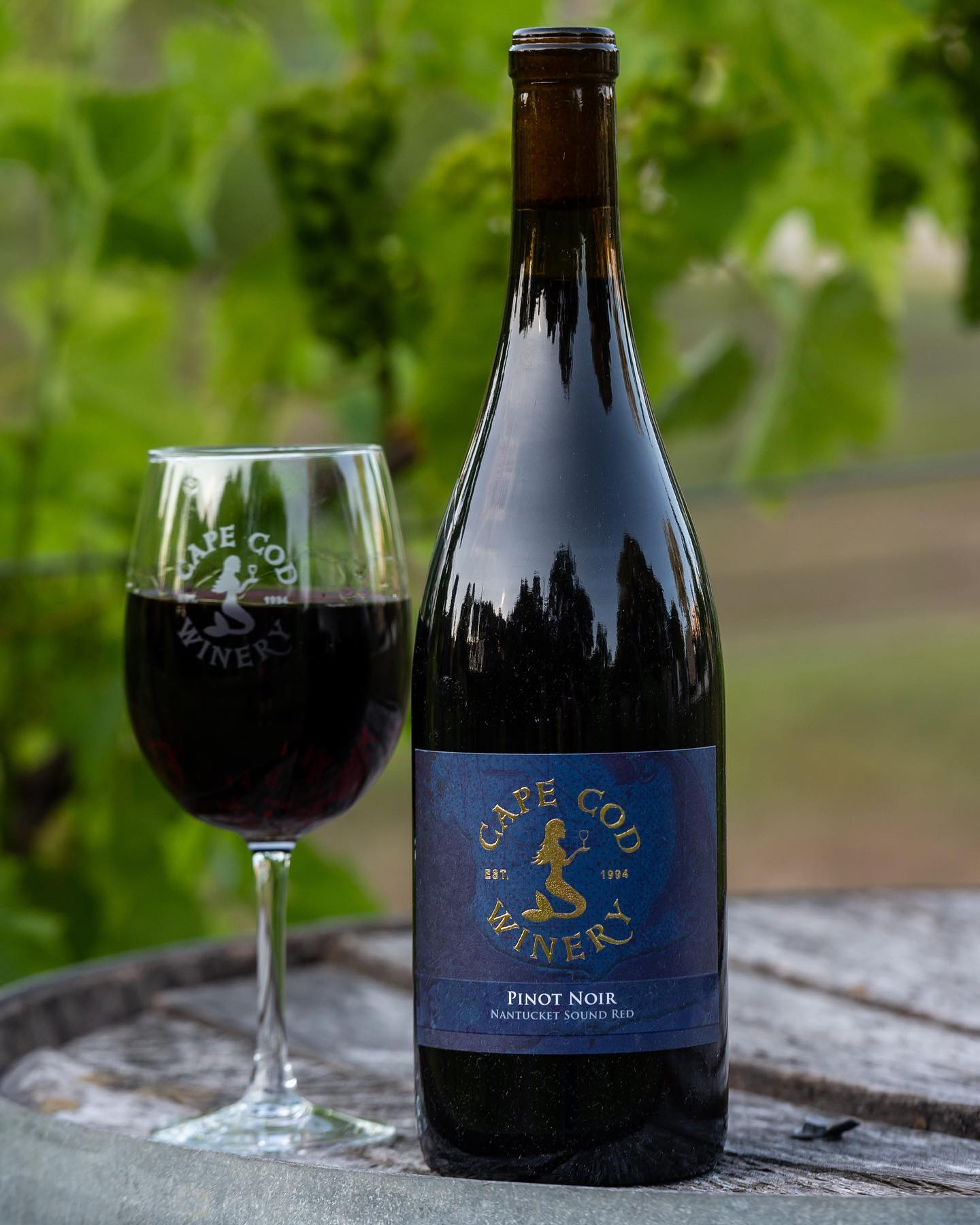
The Resource Label Group delivered a facelift for this family-owned winery’s labels that helped lift its bottom line.
The problem: Inconsistent labels that were incongruous with the winery’s quality and the owners’ ambitions
The solution: An elegant redesign featuring strategic embellishments, resulting in templatized labels that were easy for the client to use going forward
The owners settled on a few touches that elevated their product and made interacting with their wines a premium experience. These included:
- Elevated facestock
- Hot foil stamping
- Tactile varnish
Cape Cod Winery released their new label in time for summer, and the response was swift. In their tasting room, visitors lingered over the winery’s new eye-catching labels. And not long after customers began sharing photos of the new-look product, Cape Cod.
The winery gained thousands of new social media followers and received comments raving about the revamped labels.
Ready to revolutionize your labels?
Reach out to our skilled team at Resource Label Group to find out how we can help your branding reach the next level. Together, we can create a beautiful label that helps tell your company’s story to the world.
Find the best solution that makes the most sense for your brand.
When ordering labels, three questions always get asked:
- Will they exactly match my brand vision?
- Will it perform in my product’s end-use environment?
- How much are my labels going to cost?
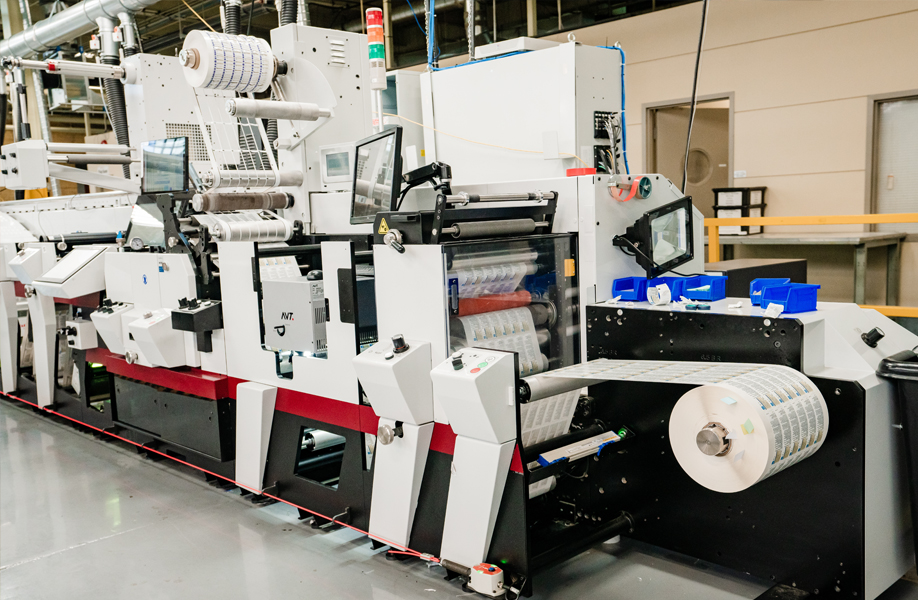
And while many factors affect the price, appearance and performance of your labels, press technology is chief among them.
The press dictates production speed, make-ready waste and tooling costs — all of which impact your overall label spend. And, of course, the way your label is printed will impact the way it displays on the shelf and performs in its end-use environment.
The traditional label press technology debate has had two players: Flexographic vs. digital. Now, a third player has entered the stage: Hybrid printing technology.
Here, we’ll expand on the “digital-versus-flexo” debate to include hybrid printing, exploring when hybrid does and doesn’t provide the best value for your labels.
First of all, what is hybrid label printing technology?
Hybrid presses are like the Prius of label printing, combining the best features of digital and flexographic printing technology.
So, in order to understand hybrid, you need a basic understanding of digital and flexo.
Flexographic printing presses have multiple stations which can be used to mount plates for CMYK printing, spot color printing, applying cold foil, screen printing, laminating or applying varnishes. The in-line finishing capabilities are a key benefit — allowing you to produce finished labels in a single pass on the press. But because flexo presses rely on analog processes, there’s a fixed tooling cost associated with every graphics variation (plates) and custom embellishment (dies for screen printing, tactile varnishes, etc.). Still, flexo presses offer unparalleled throughput speeds — and for long runs, the speed gains greatly outweigh the initial investment in tooling.
Plate-free digital printing eliminates plate costs and allows you to vary your graphics label by label with variable data printing. This makes digital printing a great fit for product lines with many SKUs, or for promotional campaigns requiring personalization. As long as the labels share the same dimensions (as with flavor variations of the same product), you can group many different orders into one long run and achieve cost efficiencies.
Hybrid printing presses have flexographic printing stations — which can be used for CMYK printing, spot colors, varnishes and more — as well as a digital printing module which can be used for variable data printing. Our proprietary hybrid printing offering, Digital Impact, boasts a high level of ink coverage and density that offers a die-free alternative to screen printing for producing opaque whites. And eliminating dies eliminates tooling costs.
Value crossover: Hybrid vs. digital vs. flexo
The value crossover point between the three press technologies looks like this:
Very generally speaking:
- Digital makes the most sense for small runs. This is because digital printing does not require an upfront investment in plates. But because it doesn’t run as quickly as a flexo press, it becomes less cost-effective as the order size goes up.
- Flexo offers unparalleled value for long runs with little variation. The tooling investment associated with flexo printing is easily neutralized by speed gains for large label orders.
- Hybrid offers the best value for medium runs. With the in-line finishing capabilities of flexo, hybrid is competitive for medium to large orders. With the variable data printing capabilities of digital printing, hybrid minimizes changeover time and allows for the grouping of different SKUs and flavor variations within one order. Perfect for small to medium orders with a high level of variation.
But the chart is an oversimplification. It neglects to consider the many, many factors beyond run length and cost that impact label value, appearance and performance.
To see what the chart doesn’t tell you about the value difference between digital, flexo and hybrid technologies, keep reading.
Determining if hybrid printing is the right fit for your labels
None of the three press technologies we’ve discussed are better than the other. Of course, there are certain scenarios in which each will deliver superior value — but none of them, not even hybrid, is a catch-all.
It’s best to work with a label converter that provides all three.
If all you have is a digital press, every label order looks like a perfect-fit for digital. But converters that have flexographic, digital and hybrid presses will guide you toward the best technology for every order.
And selecting the right press technology isn’t a matter of either/or. Many brands would benefit from using a mix of all three across their product portfolio.
For your flagship product — where you’ll print millions of labels with the same exact graphics — flexo is likely the best fit. Perhaps you’re running a promotional campaign for one of your product lines that requires label-by label variation. Then digital is probably the best fit.
Below, we’ll narrow in on a few examples where hybrid is the best fit.
Hybrid vs. digital
There are three primary advantages of hybrid over digital:
- Production speed — When using pure digital presses, the printed labels must be removed and placed on a finishing press for any embellishments. On hybrid presses, many embellishments (screen printing, cold foil, varnish) can be done in a single pass on the press. This saves production time, and those savings are passed on to the brand owner.
- Abrasion resistance — Our inkjet hybrid presses use UV-cured inks rather than the heat-cured inks of pure digital presses. UV-cured inks offer enhanced abrasion resistance.
- Opacity — The digital module on our hybrid presses rivals the opacity of screen printing, even for whites. The ink is applied heavily, even to the point it appears raised and glossy. This allows you to get the effect of a screen-printed, super-opaque white without the cost of screen-printing dies.
Even with the myriad benefits of hybrid, digital still provides the best value in many situations. For very short runs with a lot of variability (SKUs, flavors, personalization), digital is often the best bet as long as high ink opacity isn’t required.
Hybrid vs. flexo
Because of its throughput speeds, pure flexo printing will always be the most cost-effective option for long runs with no variation.
But hybrid presses allow you to group multiple SKUs together into one order, printing common art elements with flexo, printing variable art elements (e.g., product or flavor name) with the digital module and finishing the labels in-line. With fewer plates and fewer changeovers, you’ll save significantly.
As it pertains to label appearance, hybrid printing offers tighter traps, better registration and infinite color combinations for cold foils, replacing the need for costly hot stamp dies.
The more complex your label graphics, and the greater variation required, the better suited it will be for hybrid printing.
Hybrid printing might be the right choice if …
- You need a medium to large order of labels for a product with many flavors or varieties. Hybrid printing would reduce (if not eliminate) your plate costs and significantly reduce production time. All of this translates to more cost-effective labels for your brand.
- Your label embellishments are limited to varnishes, cold foil, screen printing and laminates. If so, printing and finishing your labels in one pass may present significant cost savings.
- Ink opacity is a key concern. Hybrid presses give you screen-print level opacity without investing in screen-printing dies.
- Your product will be exposed to moisture or abrasion. Compared with pure digital presses, the UV-cured inks used in hybrid presses offer superior performance for products that will be stored in wet or abrasive environments.
Hybrid printing isn’t a silver bullet. It’s another tool in the brand owner’s toolbox.
There isn’t a simple conclusion to the “digital-vs-flexo-vs-hybrid” debate. And when you do see black-and-white statements — “Digital is the best option! Here’s why!” — it, unsurprisingly, usually comes from a label supplier that only has digital presses.
Presses are simply tools. There’s a place for each of the three technologies we discussed — just as sometimes you need a wrench, and other times you need a saw.
So what label technology is best for your brand?
The one that saves your brand money while delivering on your packaging vision.
With a large coast-to-coast footprint of digital, hybrid and flexo presses, we have the redundant capacity to produce your labels in the most cost-effective way for your product. And the experience of our press operators is what ensures we will deliver on your brand vision on every label — regardless of which technology you use.
See which press technologies will provide the best value for your product mix

Track orders, compile communications and get labels faster with one online portal
You can order a pizza online and track it all the way from the prep table to your doorstep. Why not product labels, too?
Traditional label ordering often involves phone and email exchanges that delay processing. With DIRECT TRACK™, customers receive their labels at least 72 hours sooner. You also get added efficiency, convenience and certainty in your label ordering.
This online application offers Resource Label Group customers a 24/7 interface with their label producer. All orders, schedules and internal communications are readily available with one login. Send messages anytime, anyplace, and get a response ASAP.
The potential of EASESENTIALS
DIRECT TRACK is among our EASESENTIALS™ suite of applications that simplify our customers’ working lives. Alongside our ARTWORKS™ system, DIRECT TRACK automatically documents every aspect of the label production process, from first draft to last reorder.
It’s easily implemented by anyone. If you can use Facebook, you can work in DIRECT TRACK.
However, DIRECT TRACK is a tool, not a requirement. If a customer prefers to do things another way, we are happy to oblige.
Fearlessly paperless
The progress of order-by-mail systems is reliant on the pace of the postal service. Online ordering systems aren’t much better unless highly organized and easily accessible. Cross-communication between teams becomes a hassle when you’re manually sharing disparate email chains.
Online efficiencies are an absolute business necessity, especially after the pandemic. Operations still using traditional systems risk falling behind and losing out to competitors taking advantage of the new marketplace.
DIRECT TRACK helps keep you on pace to stay ahead of the competition. Customers large and small, from wine bottling operations to meatpacking plants, have made it an integral part of their operations due to the range of solutions it offers.
One stop for label specs, order updates and approval discussions
Put your record keepers at ease with our searchable, sortable system. DIRECT TRACK can:
- House an overview of your label orders at all phases, from the artboard to production and finishing rooms.
- Keep complicated artistic discussions simple by connecting with ARTWORKS to store design drafts and critiques in one readily accessible place.
- Provide production notifications like when your labels are printed.
- Track labels from the loading dock to your doorstep.
- Keep stock of all your labels with a product history that allows you to easily reorder prior products.
- Include internal message boards to quickly keep everyone up to date, in your teams to ours.
- Maintain an updated overview of all our product offerings so you’re always ready to make the next order.
Remote-work ready
In today’s online world, business hours extend around the clock. Customers want the freedom to work just as well in the early morning as late at night, in their homes or offices.
Work when and where you like. DIRECT TRACK is readily available anywhere there’s a computer and internet connection.
Easy transition
Transitioning to DIRECT TRACK is simple and intuitive. But if there are issues, you won’t waste resources on them. Our service and sales teams help customers get acquainted with the new technology and remain available for day-to-day help and advice.
Want certainty in your label procurement?
Focus on your long-term vision and company goals. Leave daily documentation to the software.
Take a look at the DIRECT TRACK Quickstart Guide to see if it can help your operation succeed.
We are the label experts. It’s what we do, every day, and we’ve gotten pretty good at it. So contact us to help put the perfect wrap on your product design.
Americans look at their phone as much as 96 times a day. Spaced out evenly over the course of a day, that amounts to once every 10 minutes.
At this very second, there’s a good chance your target consumers’ have their smartphones on-hand, and that device has the power to transform how your brand engages with them.
So, what is your brand doing to harness that power?
For many, the answer is simple: “Nothing.”
But for those willing to invest in near-field communication (NFC) labels to reshape customer journeys, there is a blue ocean of opportunity to drive purchases, retention and loyalty with today’s mobile-first consumer.
And many organizations across industries — retailers, breweries, vineyards, brand owners hosting virtual events and more — are already seizing it.
In this article, we’ll show you what’s possible with NFC technology by:
- Giving a quick primer on how NFC labels can transform customer experiences
- Highlighting five examples of how brands are leveraging NFC labels to transform the consumer experience, detailing the experience from the customer’s perspective and the benefit to the brand
The technology behind digital customer experiences
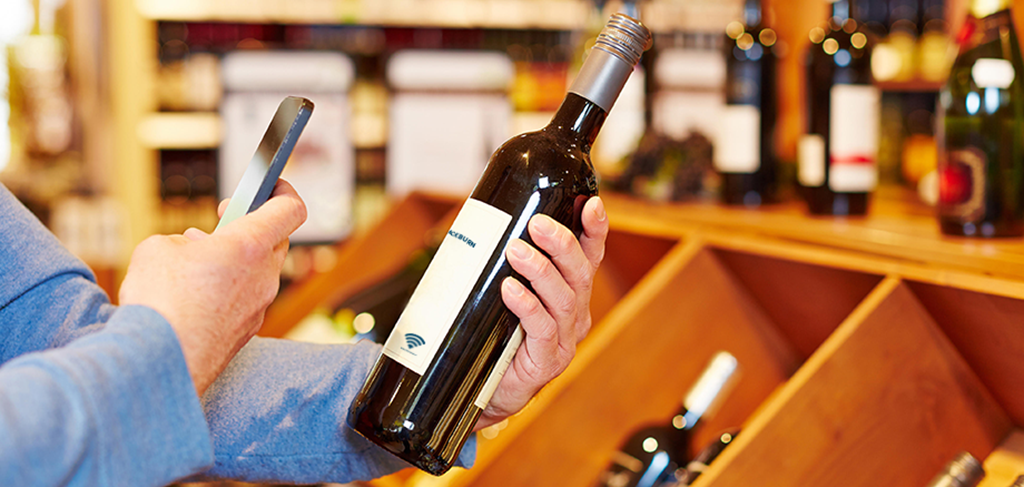
NFC labels are labels equipped with an NFC chip, enabling secure, two-way communication between the label and an NFC-ready smartphone. (For a full explanation of what NFC labels are, check out this guide to smart labeling).
Essentially, NFC smart labels turn any physical product into a uniquely identifiable asset in the cloud. When a consumer taps their smartphone to an NFC label, you know exactly which surface or product they tapped. And you can also use the customer’s unique device ID to track their engagement with a label over time or understand how many unique taps are made on a particular NFC-enabled package per day.
When paired with robust cloud infrastructure to guide the rules of the digital experience, NFC labels transform any surface into a smart, interactive experience:
- Tap the label on a luxury product to authenticate it
- Tap a drink coaster in a restaurant to order food or request your server
- Tap the label on an empty hand sanitizer dispenser to notify staff that it needs to be replaced
- Tap the label on a consumable product (like wine or high-end cosmetics) to reorder via e-commerce channels
- Tap the menu at a bar to retrieve the digital drink menu
To show you what’s possible — and the tangible value NFC smart labels promise to your brand — let’s dive into a few real-world use cases. As we do, keep in mind that these are but a few examples of the limitless possibilities for your brand to apply this technology. Quite literally, anything is possible.
Example 1: Virtual tastings for VIP club members
From the consumer’s perspective
You pick up a six-pack of your favorite beer and, as you take your first sip, you notice a callout on the label to tap your phone to access more information about their brand. After spending a few minutes watching videos and reading about the ingredients they use, you sign up for their club membership.
They send you a welcome package with NFC-enabled swag. You tap your phone against the NFC chip and notice that a virtual happy hour is happening the following Thursday, so you sign up.
During the happy hour, you learn more about a sour you’ve never tried. The other members are singing its praises, so you decide to tap on the NFC label on the last beer in your fridge and order a case of it for delivery.
The benefits for your brand
- Build customer loyalty from far away — On-premise consumption is no longer an option in many places, which can spell disaster for breweries, wineries and distilleries that rely on tasting room traffic to survive. At the same time, direct-to-consumer delivery of alcohol (including wine, spirits and beer) is on the rise. Play into this trend — and develop a smart, mobile VIP membership experience and host virtual events. These virtual experiences could be the key to driving engagement and building loyalty during this time.
- Drive remote product sales — Remove friction from the purchasing process by allowing consumers to easily order or re-order your products by simply tapping on the smart label.
Example 2: Contactless ordering
From the consumer’s perspective
You enter a coffee shop, find an empty table and sit down. You tap your phone to the NFC chip on the tabletop and the digital menu appears. You order coffee with two creams and wait. A few short minutes later, an employee walks directly to you, hands you your coffee in a reusable cup and you’re on your merry way.
The benefits for your brand
- Contactless ordering and payment — With consumers more aware of keeping their distance than ever, no one wants to wait in lines or exchange cash directly with a clerk. Contactless ordering offers a safe alternative as the world returns to its new normal. You can check out this 2021 product labeling trends guide to learn more about how NFC and RFID fill the gap in consumer engagement in a socially distant world.
- Easily re-order by tapping your phone to your cup — If your cup is reusable, and has an NFC-enabled label, next time the guest comes, they can tap their phone against the cup to order without waiting in line.
Example 3: Gamified virtual tours and tap-to-book reservations
From the consumer’s perspective
You arrive at a department store in one of New York City’s hottest shopping destinations. And this isn’t a normal department store. It has enough to keep you and your family occupied all day — multiple stories of salons, restaurants and shopping displays.
Upon entry, you’re given a temporary tattoo decal that’s NFC-enabled. You tap your phone to your arm and unlock virtual tours, real-time cocktail delivery service (no waiting at the bar!) and games you can play to earn points and win prizes.
You tap your tattoo to schedule a blowout at the salon, while your husband takes your children on a virtual tour of the facility. You reunite for a dinner reservation you made by tapping your tattoo. The restaurant tables are NFC-enabled, too, so you tap the tabletop anytime you need your server’s attention.
And as you’re on your way out, your husband mentions that he and the kids won a free dinner by playing the mobile game — and you begin planning your next visit.
The benefits for your brand
- Increasing the number of services purchased — After one luxury retail brand deployed a digitized customer experience strategy relying on wearable NFC decals, 20% of visitors were purchasing services.
- Creating a seamless guest experience — From shopping to dining to indulging, every real-life experience is seamlessly augmented by the mobile-first experience. Guests can simply tap the wearable sticker on their arm to access any info or service — and by making their experience easier, it’s also much more enjoyable.
- Encouraging repeat visits — By gamifying the experience, and offering rewards like free meals, customers are encouraged to return and redeem their prizes.
Example 4: A more enjoyable Napa Valley vineyard experience
From the consumer’s perspective
Imagine for a moment you’ve taken a weekend getaway to Napa Valley. It’s September and the tasting bar is flooded with tourists, sipping the day away.
You tap your phone to an NFC-enabled coaster on the bar to access the digitized tasting menu — which educates you on the grapes in the wines, allows you to meet the winemakers and enables you to vote for your favorite wines. You purchase a glass of wine and, to get away from the noise, wander out to the garden.
Before you know it, you’re ready for a refill. So, you tap your phone to the NFC chip on the armrest of your lounge chair and are able to request a bottle without leaving the company of your friends.
Sitting in your hotel room later, you can’t remember the name of your favorite wine. So you tap the NFC label on the coaster you left with, pull up your notes from the tasting and order a case to be delivered to your home.
Months after your delivery arrives, you crack open your last bottle. Thinking fondly back on the experience, you tap your phone to its NFC-enabled label and order another case.
The benefits for your brand
- Driving post-visit purchases and club memberships — Since each “tap” with an NFC-enabled label is tied to a particular device, each time your customers tap a physical asset — like a digital tasting menu or NFC-enabled package — you can serve them customer-specific information. After tapping, they can access their unique tasting menu notes and ratings and re-order their favorite wines.
- Telling their unique brand story — By tapping smart coasters and labels, guests access videos and stories, allowing them to “meet” the award-winning winemakers behind the wines they’re tasting and learn more about what sets this vineyard apart.
- Analytics on consumer behavior — With paper menus, it’s impossible to get insight on which wines visitors enjoy the most. You can “digitize” the menu by encouraging guests to tap their coasters, allowing you to access rich, real-time insights on the patrons of the vineyard — which wines they like most, how watching videos of the winemakers influences purchase decisions, how many people venture out to the garden and how many stay in the bar. This information can be used in the future to fine-tune the vineyard experience to make it more enjoyable for the guests and profitable for the brand.
- Brand protection — Counterfeit wine is a pervasive problem affecting luxury brands, and each fraudulent bottle sold is a huge safety and image risk for the brand. NFC allows you to authenticate the wine is real, down to the unique identification code for that particular bottle.
Example 5: Instant product customization and ordering
From the consumer’s perspective
You enter a shoe store, and eye the hundreds of sneakers lining the walls. None of them are quite what you’re looking for and, as you begin to turn around, you notice a display in the back. It says that you can customize your own, one-of-a-kind shoe.
A store employee approaches you as you walk toward the display and says that all you have to do is tap the shoe you like most to begin customizing it. You grab your favorite pair, tap your phone against the NFC-enabled tag hanging from the laces and a landing page pops up. As you click through your color choices on your phone, you settle on a colorful, illustrated pattern. Then you place your order.
The benefits for your brand
- Accurately attribute e-commerce sales to brick-and-mortar stores — Each NFC tag is assigned not only to the shoe (so the right page populates when a consumer taps it), but also to the store. This means all e-commerce sales from this campaign can be accurately attributed to the right store.
- Differentiate your brand by offering personalized experiences and products — This NFC application plays perfectly into the mass personalization consumer trend. 41% of consumers are interested in buying completely unique products and 32% reported they find designing custom products themselves fun, according to a survey from Deloitte.
Go from thinking about “what’s always been done” to “what’s possible”
And the answer to that question — what is possible with NFC labels? — can be summed up with one word: Anything.
The above examples only begin to scratch the surface of the near-infinite applications for your brand to drive efficiencies, consumer engagement and sales with NFC labels.
If you want to learn what’s possible for your brand, then reach out to our team. With 20 years of experience manufacturing smart labels for some of the largest consumer goods brands, we have the expertise and industry connections to make any idea a reality.
Or, if you’d like to learn more about smart labeling technology, download this guide. It will walk you through the types of RFID and NFC labels, as well as other use cases for deploying this technology.
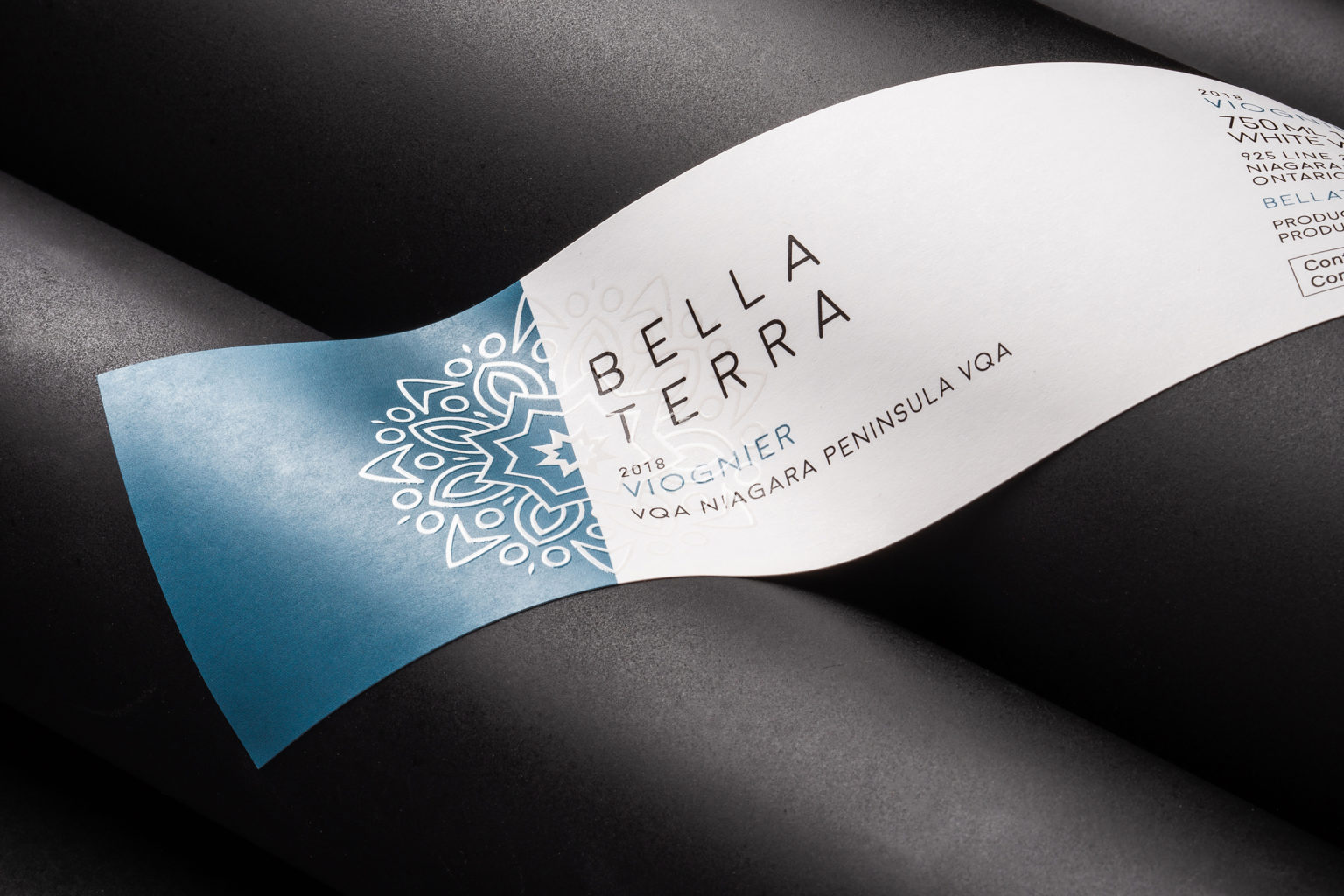
Rebranding your wine or spirit product doesn’t stop with the finished label design. You also need to consider how your design will translate from pixels on a screen to a physical label on your bottle. And that comes down to production — materials, embellishments, printing.
But it’s impossible to visualize exactly how different materials and embellishments will look with your unique pressure-sensitive label graphics.
That’s why we’ll often send wineries fully embellished samples of different production concepts — so you can test each out on your bottle and decide which best represents your new brand.
With physical samples, you’ll know exactly what you’re getting when you place your first order. No surprises.
Here, we’ll walk through how we helped one Niagara Valley wineries achieve the right look, by walking them through the design process, and giving them full-production samples to make them confident in their embellishment and material selections.
PondView Estate Winery: Building a brand from the ground up
PondView Estate Winery has a rich, three-generation history of growing grapes and making wines in Niagara Valley. And while they’d built quite a bit of brand equity over the decades, they decided it was time for a change — and enlisted our help in rebranding their line of premium wines.
As part of the rebrand, they renamed the wine. What was once sold under the “PondView” brand would now be marketed under “Bella Terra,” meaning beautiful land. It’s the perfect name for their finest wines, grown and made on the “bella terra” of their Niagara vineyard.
This was a complete, 180-degree rebrand — and the labels needed to be updated in order to elevate the appearance of the Bella Terra bottles on the shelf, complement the wine in the bottle and justify the premium price point. It was a massive undertaking, so we rolled up our sleeves and got to work.
A quick overview of PondView Estate Winery
- Location — Niagara Valley
- Primary problem — Creating a more elevated packaging look for their premium line of fine wines
- The solution — Completely rebranding their label design, and using full-production label samples to select the right embellishments
- Added benefits — Baking label cost savings into the redesign through smart production planning
Labels that look the part
Our design partner began by brainstorming multiple concepts with the PondView team, and finally refining it down to one, completed design– a minimalist design that elegantly projected the sophistication and quality of their wine.
Production-focused design conversations
With the final design in hand, our team was looped in to discuss production, deliberating questions like:
- How will we carry this design across multiple SKUs, while still ensuring they can all be produced in one print run?
- How can we leverage our production technologies (varnishes, embosses, stamping, etc.) to elevate this design, and take it up a notch?
- What printing technology presents the best value for these labels?
This type of production-focused conversation not only helps you take your design to the next level with the right embellishments, but it also builds in production, cost and turnaround efficiencies. It ensures everyone (your team, designer, printer) is considering production constraints and possibilities from the outset of the rebrand.
- The line used just two shapes, die lines — one for their varietals that would be placed in a Burgundy bottle, and another for those that would be placed in a Bordeaux bottle. Colors would be used to distinguish between varietals. The simplicity of the shape and design across this line of wines will build brand recognition, and also allow their label orders for all varietals to be grouped together on the press, streamlining production.
- Fully embellished samples were sent to the PondView team to review. They got to see how embellishments (varnishes, hot stamping, micro-etching, embossing) actually looked on different stocks (felts, flat papers, welds, etc.) printed with their label design. Ultimately, they ended up going with micro-etching and hot stamping on a flat matte weld — which they were absolutely sure they would like before they ordered even one label, because they’d been able to compare it to a range of other options.
- Plate-free digital printing ended up being the best fit — especially since the color and information needed to be varied within one print run to distinguish varietals.
Our production-focused guidance added value and helped build efficiencies into their rebrand from the start.
Price-sensitive label solutions for their entry-level line of wines
After the success of the first redesign, PondView wanted to introduce an entry-level line extension to the Bella Terra brand. These wines would come in at a much lower price point, and the PondView team needed more cost-effective labels that still capitalized on Bella Terra’s brand equity.
The first thing we did was update the label shape, optimizing it to cut material and production costs. And the sleek, simple label anchors low, allowing the bottle to breathe, and gives a much more approachable look for this economical line of house wines.
They kept the same material — the flat matte weld — but switched to more cost-conscious embellishments. While the high-end Bella Terra wines used a hot stamp over the medallion, we recommended they switch to a cost-effective raised varnish for these entry-level wines. Embellished labels are within reach at many different price points, both high and low. It’s about aligning the right embellishments for the right brand.
A seamless rebrand
The entire design process took a week, if that. And because they were able to select the exact samples that best represented their brand, there were absolutely no surprises when their first order came in.
Seeing is believing
If you’re planning a rebrand, and need help designing new labels from the ground up, or would just like embellishment selection advice, let us know. With the capability to give fully embellished labels — not from a swatch book, but samples printed with your exact graphics — you’ll know exactly what your labels will look like before ever placing your first order.
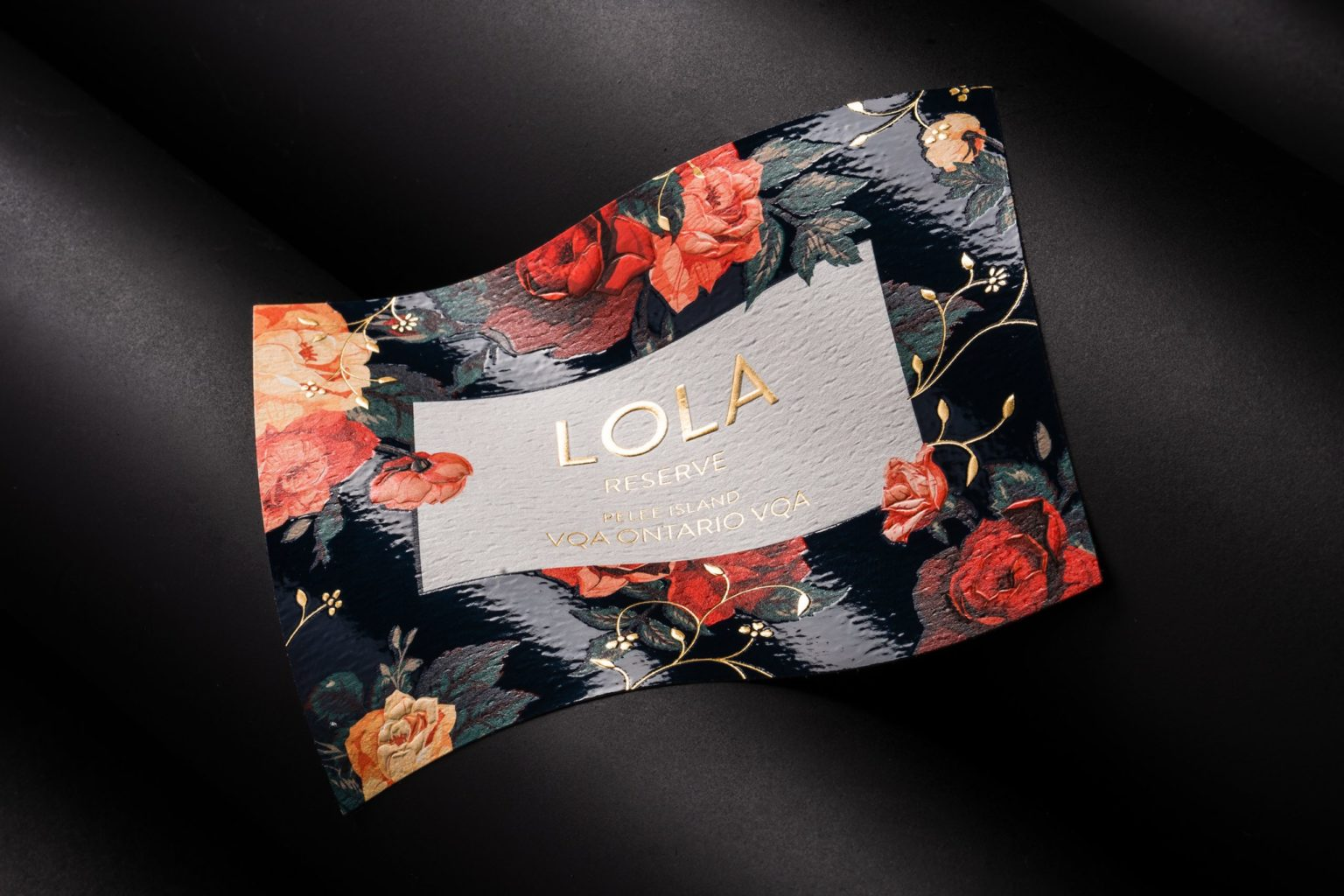
Rosé wines, either still or effervescent, are now a staple on store shelves and in wine coolers across the country. But before the recent trend in North America exploded, an Ontario winery prepared for their launch of LOLA, a sparkling rosé wine.
The blush colored wine from Pelee Island Winery was ready. But it needed a show-stopping label to go along with it.
Enter A1 Label, a Resource Label Group company. As their trusted label converter, we coordinated with their design agency and played an essential consulting role in the label production process. We recommended finishes, embellishments and stock to take the agency’s floral concept to the next level. In addition, we provided holistic packaging advice and supply chain cost efficiencies for the winery, too.
The result? A best-selling product, label spend reduced by 20% and an iconic brand look that has since been expanded to eleven different wines.
A quick overview
- Location — Ontario
- The problem — Create a best-selling label for a sparkling rosé product launch
- The solution — Bold recommendations on finishes, embellishments and stock
- Results — #1 selling VQA wine, nomination for Best New Product Launch
- Added benefits — 20% cost reduction, guidance on quality package design
Collaborating on a modern design with striking embellishments
For the launch of LOLA, Pelee Island Winery needed a label that would catch the attention of young millennial women (the target demographic) amongst other rosé varietals. Their design firm landed on inspiration from the interior design and fashion industries: A sophisticated floral pattern that was already resonating with young millennial women.
But to take the design off the mood board and onto the label, a consultative label manufacturer was needed.
We worked closely with the design agency from the beginning. With our deep understanding of labeling technology, we were not only able to execute the client’s vision, but also recommend eye-catching embellishments that may have never come up otherwise.
First, we proposed different types of embosses, varnishes and hot stamping in an array of colors. Without any embellishments, the label would appear flat on the shelf and not be nearly as attention grabbing as the design agency intended. After presenting Pelee Island Winery with samples of our ideas, we agreed upon the most impactful combination of techniques.
The hot stamp was a natural choice for the typography, creating a lustrous, shining quality and catching the eye immediately. Additionally, our team added the gold foil to sections of the flowers for an additional pop, and included a varnish for the navy background. This final element creates a striking contrast between the high sheen gloss of the background and the textured, more natural-feeling flowers.
The achieved effect of the label is romantic, feminine and decidedly modern — an exact right fit for Pelee Island Winery’s target customer and an expert execution of the design concept.
Guaranteeing consistency across packaging components
The label is one piece of the entire packaging puzzle. We often see wineries keep conversations amongst packaging components siloed off, preventing design consistency.
For example, just a “standard white” cap can end up being many different shades, from a cool off-white to a warm cream color.
To guarantee design coordination, we looped in Pelee Island Winery’s cap provider from the start. We made sure the cap color matched the exact shade of the background, and even carried over similar embellishment techniques from the label.
This forward-thinking process ensures more cohesive packaging and an overall elevated look.
Reducing label spend by 20%
Our role as Pelee Island Winery’s label manufacturer didn’t stop at expertise-driven design insights. We also shared supply chain guidance to streamline their label spend where possible.
We talked about their label ordering process, showing how looking ahead and ordering multiple SKUs at once (i.e. a rosé label and a white wine label) can benefit them from a costing standpoint.
In addition, we advised the winery to choose a more cost-effective stock for their back label. The front label is a beautiful felt material and includes the embellishments discussed above and must draw in the customer.
The back label, however, is information only and serves a more utilitarian purpose — so a cost-effective stock makes the most sense. This approach encourages investment where the impact matters most (i.e. the front label) and streamlining costs where possible (i.e. on the less visible back label).
This decision alone helped Pelee Island Winery save about 20% on their LOLA label spend.
The bottom line
Since its launch, Pelee Island Winery received a nomination from the Liquor Control Board of Ontario for Best New Product Launch. The sparkling rosé is also the number one selling VQA wine.
LOLA has now been expanded into eleven other varietals, ranging from a classic Pinot Grigio to a unique, Lambrusco-style sparkling red. Each wine showcases a different floral pattern, but is unified in the same recognizable design. Pelee Island Winery has even added a 250-mL slim can of the sparkling rosé, a completely new package for them.
These expansions wouldn’t be possible without successfully engineering the first LOLA label — and we’re proud to have helped lay the foundation for a successful brand for Pelee Island Winery.
Launching a new varietal soon?
You want a bold label design that will resonate with your customers. A consultative labeling partner can help you achieve that.
At Resource Label Group, we are experienced in collaborating with designers, providing design-related guidance and engineering labels that reflect your vision. And we help streamline ordering costs along the way, too.
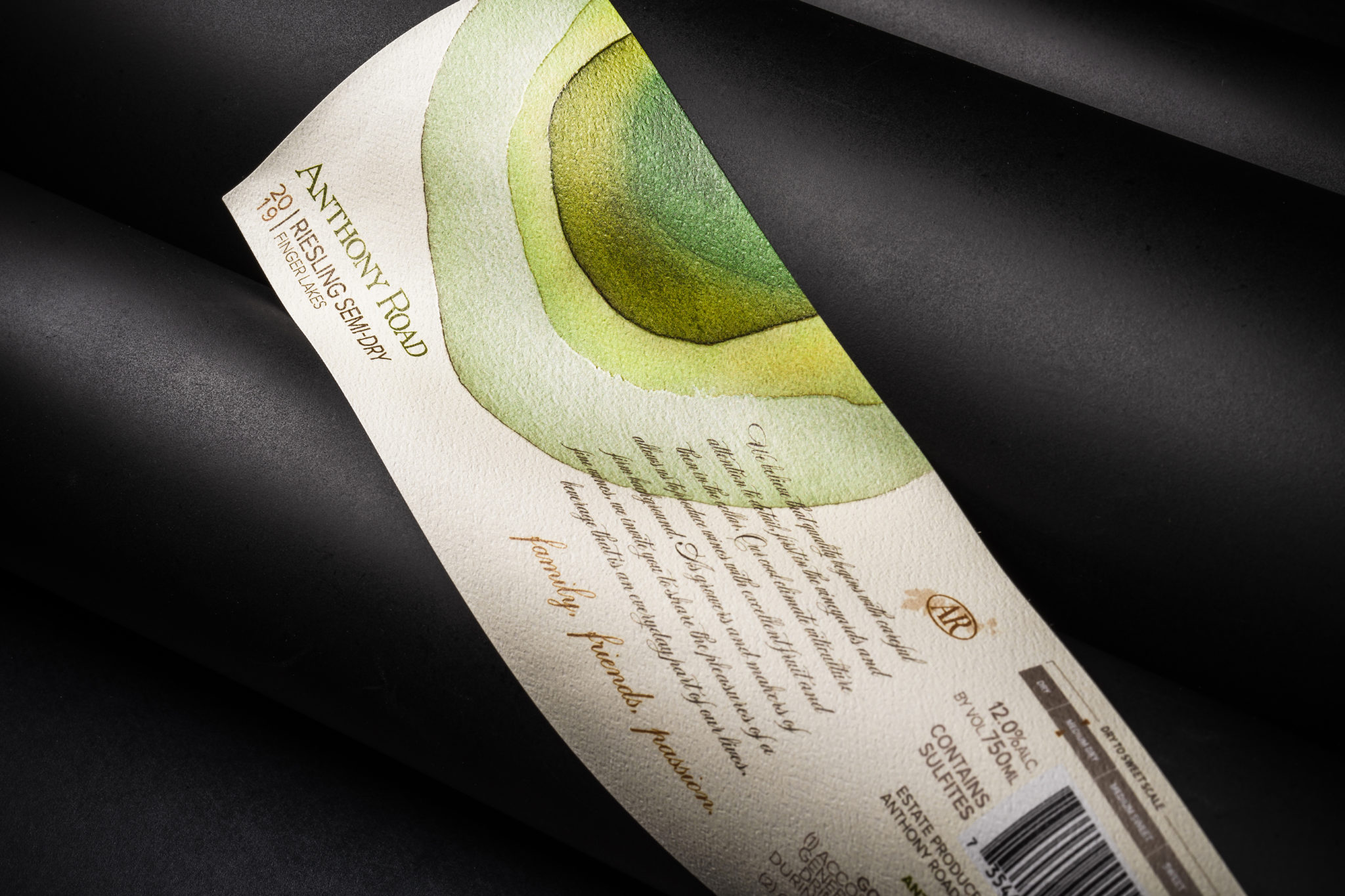
Regulations make for dry reading, so you might want to have a cup of coffee before tackling this topic. Nine primary requirements for wine labels are covered here, with a reading time of about 12 minutes– depending on how many times you nod off in the process.
The Federal Alcohol Administration (FAA) Act articulates the labeling rules for wine containing at least 7% alcohol by volume (ABV). According to the Alcohol and Tobacco Tax and Trade Bureau:
“TTB’s regulations exist to prevent the deception of the consumer and provide them with ‘adequate information’ as to the identity and quality of the product, to prohibit false or misleading statements, and to provide information as to the alcohol content of the product.”
The FAA Act provides three primary objectives:
- To ensure the integrity of the industry
- To protect consumers
- To preclude unfair trade practices
The sample label below is meant to serve as a simple guide for wine bottled and labeled in the United States, with a brief summary for each indicated section. Refer to the TTB website for complete regulations. This is general information intended to assist winemakers with successful Certificate of Label Applications (COLAs, TTB form 5100.3) submitted to TTB. The relevant Code of Federal Regulations (CFR) is noted when applicable, most of which are found in Title 27/Chapter I/Subchapter A/Part 4.
Additional information added to wine label designs beyond TTB requirements has to meet the following guidelines:
- It must be truthful, accurate, and specific, and not misleading
- It may not conflict with or qualify any other mandatory information
- It must comply with the corresponding sections of the regulations
1. Brand name or producer identification
The brand name used by the winery or the winemaker itself. Per TTB, in the absence of a brand name, the name of the wine producer may serve as the brand name for the label. (27 CFR 4.33(a)).
Brand Name Type Size Requirement:
- At least 1 mm for containers 187 ml or less.
- At least 2 mm for containers larger than 187 ml.
(27 CFR 4.38(b,c))
2. Bottler’s name and address
Every wine bottle label must contain the name of the bottler, city and state, exactly as indicated on the basic permit. This information must be preceded by either the phrase “Bottled by” or “Packed by
Optional terms: In addition to the required info above, there are extensive options for additional information, for example, wine produced at one location and bottled or packed at another. “Vinted by”, “Produced by”, “Blended by” and “Made by” are optional terms, depending on the specific production arrangement of each winery. Be sure to read the specific regulations to see which situation best fits your winery. (27 CFR 4.35(a2))
Bottler’s name and address type size requirement:
- At least 1 mm for containers 187 ml or less.
- At least 2 mm for containers larger than 187 ml.
(27 CFR 4.38(b,c))
3. Varietal designation, class/type, American viticultural area
Simply put, this would be the type of wine in the bottle. Use of a varietal designation (Merlot), requires the Appellation of Origin also be included. (27 CFR 4.23(b)). The word ‘Wine’ is typically required– for example, the label may not simply say ‘Rose’ to meet the Varietal Designation requirement, it must read ‘Rose Wine’ to serve as the type. (27 CFR 4.21 (a)(1)(iv))
Type requirements: Varietal references (50% Merlot and 50% Cabernet Sauvignon for example) take precedence as the class/type designation (American Red Wine), whether the wine is a single grape variety or two or more grape varieties as the type designation. Varietals and their percentages (if shown) have to be typeset at least 2 mm print, and be set apart or displayed more conspicuously than any other surrounding text. Mandatory information must be bold or at least twice the size of any surrounding text in order to meet TTB requirements. (27 CFR 4.38(b)).
Multiple varietals: TTB stipulates that when multiple varietals are used in wine blends, the percentage of each grape must be noted on the label with a total that equals 100%. (27 CFR 4.23(d)).
Fanciful names: Fanciful names are entirely optional and do not meet or replace any required information on a brand label. The use of a ‘Fanciful Name’ such as “Sunset Seeker’s Rose” does not meet the TTB requirement for a class or type designation (a Rose Wine, in the example used in this section). (27 CFR 4.34(a)).
Non-standard wines: Formulated wines, those with added flavors for example, are considered non-standard wines. Formulas must be approved prior to label COLA submission, and TTB will suggest a statement of composition for the label (Rose Wine with natural flavors added, as an example). This formula description will be considered the required class/type designation and must appear on the label for non-standard wines. Note: Vintage date and grape varietals are not permitted on non-standard wine labels. (27 CFR 4.27(a), 4.39(n)).
Varietal, class/type, viticultural area type size requirement:
- At least 1 mm for containers 187 ml or less.
- At least 2 mm for containers larger than 187 ml.
(27 CFR 4.38(b,c))
4. Appellation of Origin, Country of Origin (Where Are The Grapes Grown)
A state, county, or American Viticultural Area (AVA) for geographic wine labels. The grapes used for geographic wine are required to have been grown in the stated area: 85% for AVA and 75% for state or county designations. As an example, labeling a wine “American Merlot” would require 75% of the wine is derived from Merlot grapes grown in the United States. ‘American’ in this example serves as the Appellation of Origin. (27 CFR 4.25(b)). Appellation of origin text is required when a vintage date is used on the label, and both must appear together– so if the appellation of origin is ‘America’ and the class/type is ‘Red Wine’, this text must be on the same label– the front, back, or same label when multiple separate labels are used in your packaging design. (27 CFR 4.34(a))
Two-piece brand labels: If your label design uses a two-piece layout with a varietal designation or a vintage date, the appellation of origin and the class/type designation must appear on the same label. (27 CFR 4.33(a)).
Origin type size requirement:
- At least 1 mm for containers 187 ml or less.
- At least 2 mm for containers larger than 187 ml.
(27 CFR 4.38(b,c))
5. Alcohol content
The alcohol content by volume (ABV) is the percent of the bottled wine that is alcohol. U.S. law permits a 1.5% variance from the ABV printed on the wine label. Note this is not the “proof”– alcohol proof is twice the percent ABV, so 100-proof whiskey would be 50% alcohol. Proof is not used for wine labeling. A specific alcohol content by volume statement is required for any wine with an ABV of 14% or greater. (27 CFR 4.36(a)
Table wine: Alcohol content does not need to be displayed if the words “Table Wine” appear on the label and the alcohol content is between 7% and 14% by volume. (27 CFR 4.36(a)). “Table Wine” also serves as the Class/Type designation. (27 CFR 4.21(a)(2)).
Dessert wine: For wines that contain more than 14% but not more than 24% alcohol content by volume, TTB refers to these as ‘Dessert Wine’. Unlike Table Wine, Dessert Wine is not considered by TTB to be a suitable Class/Type designation– an appropriate designation such as ‘Red Wine’ would be required. (27 CFR 4.21(a)). Note that Dessert wines are not required to be labeled dessert wine on the label simply because they meet the requirement of greater than 14% ABV. (27 CFR 4.21(a)(3)). As stated above, alcohol content must be displayed on any wine with an ABV greater than 14% by volume. (27 CFR 4.36(a))
Alcohol content type size requirement:
- At least 1 mm but not larger than 3 mm for bottles that are 5 L or less.
6. Vintage date
If a wine label displays a Vintage Date, an Appellation of Origin must also be shown on the label. (27 CFR 4.27(a)).
Bottler’s name and address type size requirement:
- At least 1 mm for containers 187 ml or less.
- At least 2 mm for containers larger than 187 ml.
(27 CFR 4.38(b,c))
7. Net volume of contents
This is the content, by volume, of the bottle. Typically measured in milliliters (ie. 750 ml) for a common bottle of wine. The basic guidelines are as follows (27 CFR 4.37(a-c)):
- If the contents are more than one liter, net contents are stated in liters and a decimal portion of a liter accurate to the nearest one-hundredth of a liter. If less than a liter, contents must be stated in milliliters (ml). Equivalent volume of less than 100 fluid ounces must be stated in fluid ounces, accurate to the nearest one-tenth of an ounce. Equivalent volumes of 100 fluid ounces or more will be stated in fluid ounces accurate to nearest whole fluid ounce.
- If contents are stated in metric measure, the equivalent US measure may also be shown, using the following standards: For the metric standards of fill: 3 liters (101 fl. oz.); 1.5 liters (50.7 fl. oz.); 1 liter (33.8 fl. oz.); 750 ml (25.4 fl. oz.); 500 ml (16.9 fl. oz.); 375 ml (12.7 fl. oz.); 187 ml (6.3 fl. oz.); 100 ml (3.4 fl. oz.); and 50 ml (1.7 fl. oz.).
- Net contents may be marked on the bottle itself, through etching, molding, blowing, underglaze, etc. as long as it is clearly visible and not obscured. If the net volume will be branded on the bottle it needs to be indicated in item 19 of the COLA application, or if filing electronically, in the special wording section.
Net volume of contents type size requirement:
- At least 1 mm for containers 187 ml or less.
- At least 2 mm for containers larger than 187 ml.
(27 CFR 4.38(b,c))
8. Sulfite declaration
If the total sulfur dioxide or if a sulfating agent is present at 10 ppm or more, a sulfite declaration such as “Contains Sulfites or “Contains (a) Sulfating Agent(s)” must be present on the wine label. (27 CFR 4.32(e)).
If laboratory analysis determines sulfite content is below 10 ppm no sulfite declaration is required. Lab analysis can be performed by TTB or a TTB-Certified laboratory, in either case, the lab analysis has to be submitted to TTB during COLA application.
Sulfite declaration type size requirement:
- At least 1 mm for containers 187 ml or less.
- At least 2 mm for containers larger than 187 ml.
(27 CFR 4.38(b,c))
9. Health warning statement
Health Warning Statements are required on any alcoholic beverage with an alcohol content of 0.5% or higher. (27 CFR 16.20). All wine containers for sale or distribution must display the Health Warning Statement on any label, with the following rules:
“GOVERNMENT WARNING” must be typeset in bold, capital letters
The remainder of the warning must not be bold (but may be all caps)
Surgeon General must be capitalized (both the ‘S’ and the ‘G’)
Required language for the Health Warning Statement:
GOVERNMENT WARNING:
(1) According to the Surgeon General, women should not drink alcoholic beverages during pregnancy because of the risk of birth defects. (2) Consumption of alcoholic beverages impairs your ability to drive a car or operate machinery and may cause health problems.
Health warning statement type size requirement:
- At least 1 mm for containers that are 237 ml or less.
- At least 2 mm for containers over 237 ml or up to 3 L.
- At least 3 mm for containers that are larger than 3 L.
(27 CFR 16.22(a))
There is a lot more to learn about wine label regulations
Even attempting to simplify the regulations for wine labels is complicated. In order to be in full compliance please refer to the TTB website for a full explanation of the rules for your specific winery.
Find the best solution that makes the most sense for your brand.
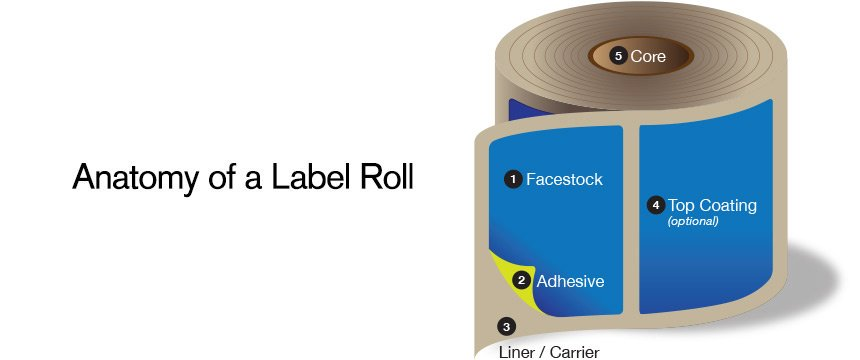
This page is dedicated to label basics, common label terms (many more are defined in our Glossary), and what to know when ordering pressure sensitive labels. A pressure sensitive or self-adhesive label is made up of a few basic parts: a facestock and an adhesive on a liner, produced on a roll.
The simplified reference or “Quick Guide” we are providing here is intended to serve as a primer for the high-level requirements for most food, however you will need to read and follow the specific FDA guidelines for your individual products.
Note: Foods that do not require nutrition labeling are: whole or ground coffee beans, tea leaves, plain instant unsweetened instant coffee and tea, condiment-type dehydrated vegetables (e.g., dried garlic), flavor extracts and food colorings.
1. Facestock
The part of the label we print on, also the part of the label your customers will see. The most common materials used as a facestock for pressure sensitive labels are paper, film, and foil.
2. Adhesive
This is of course the sticky part of a pressure sensitive label. The adhesive will remove easily from the liner for easy application to your product or container. There are a few types of adhesives: all temperature, cold temperature, permanent, and removable. These types of labels are called self adhesive or pressure sentive because the adhesive is a part of the label– they do require the addition of glue for application to your container, just like a sticker.
3. Liner / carrier
Also called the carrier or backing, for pressure sensitive labels it is most commonly a brown kraft color paper, and it has a special coating that allows your labels to be easily removed. Another liner option is polyethylene terephthalate (PET), especially amid global supply chain disruptions in the wake of 2020.
4. Top coating
The top coating is the final protective layer applied to your labels, if desired. Some top coatings are visible, like glossy or matte coatings, and can be used as another element of your label design. Others are not visible and are purely functional, protecting the facestock from damage.
5. Core
The core is the sturdy cardboard center of a label roll. Just like a roll of paper towels, when you reach the end of your label liner only the core will remain. Depending on the label application equipment you use, the core will be either 1-inch or 3-inches in diameter. Unless you are hand applying your labels with no machine assistance of any kind, we will need to know which core size to use. Different label machines have varying requirements for core size.
Understanding “rewind”
When your labels are printed they go on a roll. There are eight possible orientations for the labels related to how they go onto the final roll.
The “Rewind Direction” refers to which way the label printing is “right side up” as you unroll your labels to apply them to your products.
If you are hand applying your labels, rewind #2 or #3 is most common for right handers, and rewind #4 is the favorite for south paws.
Why is this important? Rewind direction is critical for semi-automatic and machine applied labels. The equipment you use will specifiy a rewind direction between 1 and 8, and that’s the number your rolls must be produced with to be compatible with your label applicator.
Just like the core size of 1-inch or 3-inches, your equipment will be set up to handle a specific rewind direction.
It is important to note that rewind direction may also your pricing. If you are hand applying your labels we will automatically select the most cost effective rewind direction. However, if you know you will be machine applying your labels in the future, let us know so we can quote your labels with the appropriate machine application rewind requirement. This will allow you to use existing labels on your new equipment as well as provide you with consistent pricing.
Please continue to read about roll size, as this is relevant to machine application as well.
Efficient roll sizing
The size of each label roll is known as the Outside Diameter, or “O.D.”. This can be crucial information for both hand application and machine application.
For hand application, there are two primary considerations. First, will you physically be able to move the roll around? While it’s true you can save a little on your order by buying a single roll, make sure it’s something you will be able lift, move, and work with.
Second, will you have more than one person applying the labels? Sharing a single roll during hand application will slow you down. Consider breaking your order up across a few smaller rolls or even ordering one for each person applying labels.
For machine application, the O.D. is important because each machine is different and will have a different maximum O.D., as well as core size and necessary rewind direction. Check with your equipment manufacturer for exact specifications.
Find the best solution that makes the most sense for your brand.
More labels for less
With the deep discounts available when ordering a large quantity of labels, some brand owners may be tempted to buy more labels than they need. When the cost per thousand labels drops over 80 percent when ordering 10,000 vs. 2,500, the decision is easy to justify if it is in your packaging budget.
If your labeled products will not be updated in the time it takes to use the labels you have ordered, it makes financial sense to buy in bulk. Of course, it’s important to know for sure that your label info will not change. Ingredients or varietals, contact info or regulatory information often does change for many products, and new labels are often required. Before the decision to save money by buying larger quantities can be made, however, the shelf life of the labels themselves needs to be considered.
Labels have a lifespan
Labels do have a lifespan, and depending on how they were engineered and the specific conditions your labels will be exposed to, labels can deteriorate before you have a chance to apply them. The primary factors that influence a label’s lifespan are Label Construction, Label Adhesive, and Label Storage Environment.
Label construction
Make sure your label supplier provides a label construction that outlasts the life of your product use. This includes facestock, the adhesive, the type of ink used for printing and the protection of the labels, such as varnish or laminate. Each of these elements needs to withstand the actual conditions your labeled product will experience. For example:
- Perishable food labels may only need to last for one month
- Outdoor exposure labels may need to last for five years or longer
- Shampoo labels may need to last for a year or more
Imagine what your label will go through in transport, storage, application, on the shelf and in use by the consumer. Your label supplier should be able to determine all of the components necessary to assure your labels last through their typical useful life.
Label adhesives
Label adhesives are the primary concern when considering the useful lifespan of your labels. Label rolls have a typical adhesive lifespan of 10 to 12 months before the adhesive begins to degrade. This is true strictly when you are storing your labels– not once they are applied to your containers. The FDA also has specific guidelines for adhesives used in food label packaging.
Label storage environment
The environment where your labels are stored and applied will have an effect on the lifespan of your labels. A cool, dry, environment is optimal. Hot and humid or very cold environments will reduce the useful lifespan of your labels.
If you know the specific environment in which your labels will be exposed, let your label printer know. Some adhesives, label facestocks and label protection options can be included in the engineering of your label order to better prepare your labels for their environment. When storing labels, do not lay them flat and keep them as cool as possible.
Open communication with a professional label printer is the best way to ensure you get quality labels in quantities you can use, engineered to meet the requirements of your brand. It is not uncommon for label application problems to be traced back to labels that are too old, when a brand owner is attempting to apply labels ordered two years ago. Order what you need, what you will be applying, before the labels and adhesives start to degrade.
For more label information, including basis, design, application, and marketing, visit our learning center.
Find the best solution that makes the most sense for your brand.
Resource Label Group has extensive experience producing high-quality four-color process labels in countless shapes and sizes for our clients. Utilizing the finest state-of-the-art equipment available in flexographic printing, digital offset printing and digital prepress proofing, We can meet or exceed every expectation for all of your four-color process self-adhesive labels.
Additional spot colors can be printed, up to a maximum of 10 colors. Color accuracy and consistency are key to quality four-color process printing and that’s where Resource Label Group rises above the rest. You can rest assured that we will produce color-accurate, high-quality, full-color labels for you time after time. Accurate color reproduction is critical to representing your brand packaging year after year.
Four-color printing and beyond
We also have the unique ability to expand offset-quality four-color process printing with IndiChrome process, which expands the CMYK color gamut by adding violet, orange and green. Why use just four when you can add three more? Quality, custom, and challenging label projects are our specialty.
Our clients utilize four color process labels for wine and beverage labels, cosmetic labels, health and beauty labels, e-liquid labels, promotional labels, static cling window labels and bumper stickers. Your imagination sets the limit for how many options you can utilize with our four-color process labels.
Resource Label Group can meet all of your four-color process label needs with countless materials, laminates, label treatments and design options. Four color process labels can be delivered on rolls for hand or auto application, or in sheets.
We can produce your labels on nearly any material including paper, foil, vinyl or film with the appropriate adhesive to meet your unique application. We always protect our labels with a clear film over-laminate or a topcoat varnish to protect your graphics and create a water-resistant label that lasts.
You can also take advantage of our short to medium-run HP digital offset printing capabilities for your label packaging with multiple SKUs. Add foil stamping or embossing to your existing label to make a statement or enhance your design. Of course, our knowledgeable customer service staff can guide you through the many options available to set you apart from your competition.
Get started today and contact one of our label specialists for a label quote and samples of our work.