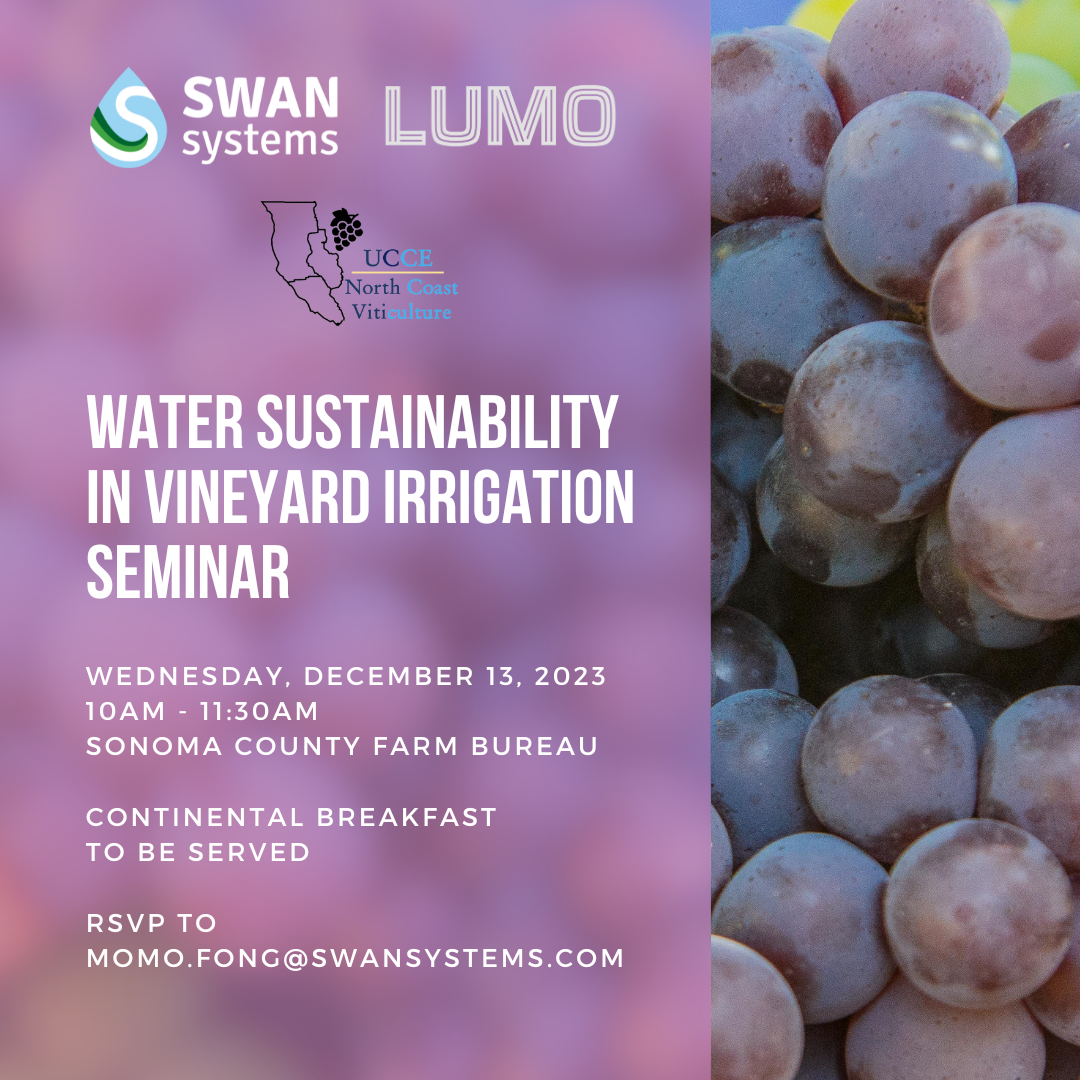
Join us on December 13th at 10am for a seminar on water sustainability in vineyard irrigation where we will cover topics such as measuring and scaling water sustainability in the vineyard, choosing the right rootstocks for water scarcity, and advancements in crop water use monitoring.
We will feature three speakers: Chris Chen from the University of California, Kathy Turner of Lumo Ag, and our own Val King.
The event is free to attend; contact info@swansystems.com for details!
Have you ever tried to piece together a massive, complex jigsaw puzzle without a clear picture to guide you? It's a daunting task and yet, it's a challenge that those of us in agriculture face daily in managing irrigation. We are confronted with a dizzying array of disparate, confusing, and often clunky pieces of technology, from field sensors and software platforms to competing management strategies. At SWAN Systems, we're simplifying this puzzle through a transformative process we call irrigation technology optimization.
This isn't merely a new buzzword or a minor tweak. It's a paradigm shift that transforms the chaos of irrigation management into a streamlined, efficient system. By harnessing the power of data, and employing sophisticated algorithms, we're converting disparate sensor readings, confusing reports, and disconnected systems into a single, powerful source of actionable insights.
The Era of Holistic Water Management
We live in the era of holistic irrigation management. A symphony of scalability, strategic planning, and true insights is set to replace the discord of disjointed data and clunky gadgets. Water data, once an overwhelming deluge, now channels into meaningful business outcomes, ushering in the era of effective hardware-independent irrigation management.
The urgency of this shift cannot be understated. Global water concerns are more pressing than ever. By 2040, we're expected to witness a daunting 40% decrease in our freshwater resources. Rather than succumbing to despair or panic, we view this as an opportunity to innovate, change, and make a significant difference for generations to come.
Optimizing Across the Water Value Chain
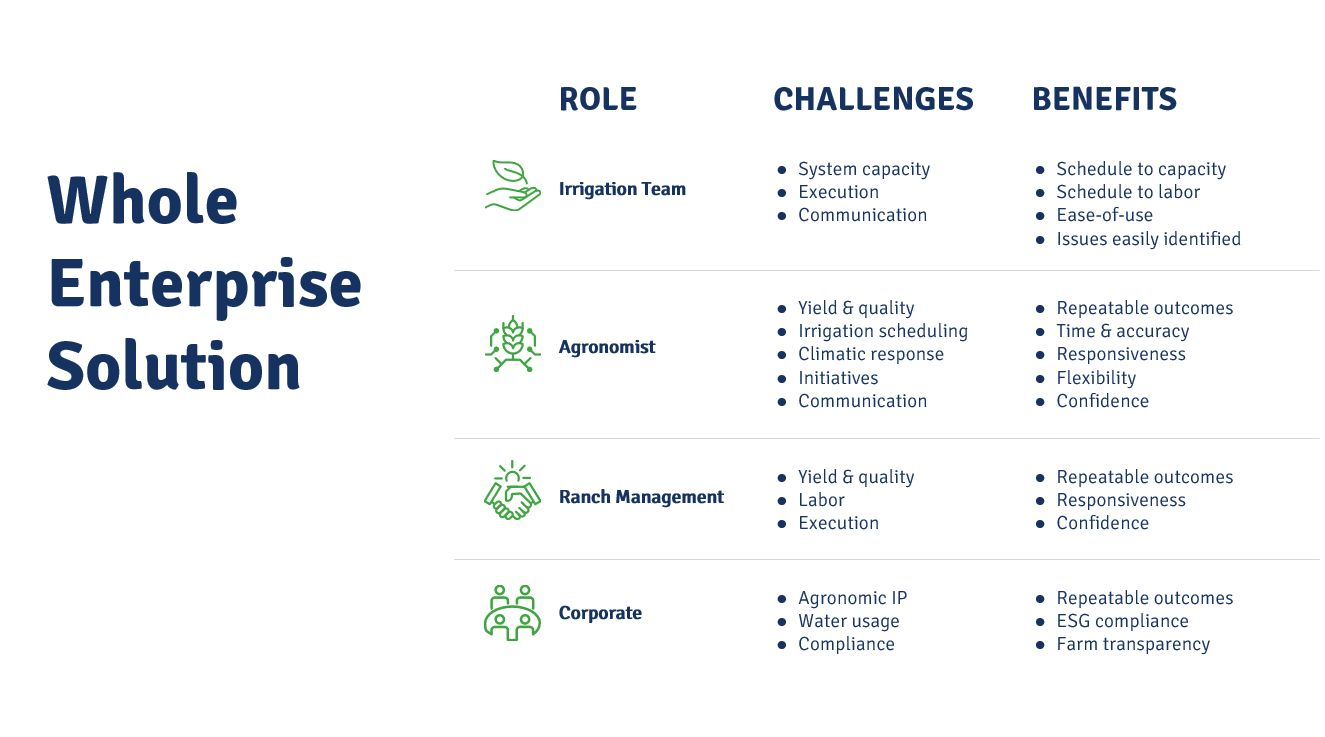
This fresh approach demands an understanding of the various stakeholders in the 'water value chain,' each with their unique challenges:
The irrigation team grapples with system capacity, execution, and communication.
The agronomist strives for balanced yield quality and irrigation scheduling.
Ranch management tackles labor, execution, and accountability.
Corporate entities navigate issues related to agronomic intellectual property, water use, and transparency.
We believe that small changes can lead to substantial differences. By adopting a holistic perspective that caters to all players in the water value chain, we can streamline workflows, synchronize data, optimize water use, and significantly elevate our impact analysis.
The Way Forward
Looking ahead, we foresee a series of critical shifts through the lens of irrigation technology optimization:
From data inundation to data integration, we're transforming measurements into meaningful, actionable insights.
From a reliance on hardware to hardware independence, we're placing the power in the data these devices provide.
From merely selling products to nurturing relationships, we're reshaping the advisor's role to build trust and offer solutions that provide real value.
From a world of guesswork to a world of real returns, we're ensuring every decision is data-informed, bringing measurable returns on investment.
From disjointed, one-off processes to scalable, streamlined systems, we're paving the way for sustainable irrigation management.
From resource depletion to resource efficiency and discipline, we're revolutionizing how we utilize our most precious resource—water.
These are the promises and the power of irrigation technology optimization. A new dawn in irrigation management is upon us, where every piece of the puzzle fits perfectly, crafting a beautiful, sustainable masterpiece. Join us at SWAN Systems as we embark on this exciting journey, transforming chaos into order, silos into synergy, and measurement into management.
The future of irrigation management is here. Are you ready to be a part of it?
Contact us at swansystems.com to learn about how our water co-pilot could benefit your operation.
What does international viticulture expert, James Wright, have to say about how SWAN helps grape growers to achieve their quality and efficiency goals? This report explores various viticulture best practices from the VitiSynth Global Audit© Criteria and how they relate to SWAN Systems features.
James is the author of VitiSynth, an open access website and weekly newsletter that keeps busy wine professionals worldwide up-to-date with the latest in wine industry research.
SWAN Systems is an evolving platform, improving with every new development. Our focus on providing user-friendly and best-in-class water management software keeps us focused on adding value to our customers’ businesses, whether their goals are for production, quality, sustainability, or profitability.
2022 was a big year. We launched further controller integrations ("talkback”), which involves sending the optimised irrigation schedule from SWAN direct to a controller for execution.
The SWAN Systems mobile app was also launched. This user-friendly app has enabled the instant sharing of planned irrigations with irrigators, saving time, and ensuring planned and actual irrigations are recorded in the one system.
We have started work on our new languages feature – soon SWAN Systems will be available in Spanish – buenas noticias!
Looking ahead to 2023 our first major release will be the talkback feature for the Talgil DREAM2 (BERMAD in the USA) and the WiseConn DropControl irrigation controllers. This feature is being tested now and will involve pushing the SWAN-calculated irrigation schedule for the coming week (by valve) back into the controllers for execution. It's been a huge feature upgrade, allowing us to work with pulse irrigations and fertigation control.
This release will be closely followed by our new impact module. This exciting feature will allow customers to calculate water use efficiency (WUE) and water application efficiency (WAE). Tracked and monitored over time, WUE will allow accurate benchmarking on how much water is required to grow a set weight of produce. An example would be how many gallons of water are used to produce a pound of almonds (or for those of us who are metric, how many litres of water are used to produce a kilogram of almonds).
Water application efficiency will allow for easy observation of how well an enterprise schedules, and if they used any rainfall in a beneficial way.
With increasing social licence and reporting requirements, we believe WUE and WAE will become the underlying benchmarks for monitoring water used for irrigation.
We're seeing customers wanting to adopt water technology who have not completed their investment in irrigation control. To remove this barrier, we are working to make the recording of manual irrigation data (run times) easier. This will enable us to partner with growers for their entire digital journey – we will be able to work with them from now through to when they have implemented fully automated irrigation control using the controller talkback features.
Our ability to manage annual water allocations will also get future enhancements in 2023. This will provide multiple benefits, including assisting with reporting for the Californian Sustainable Groundwater Management Act (SGMA).
We look forward to working with our existing and future customers.
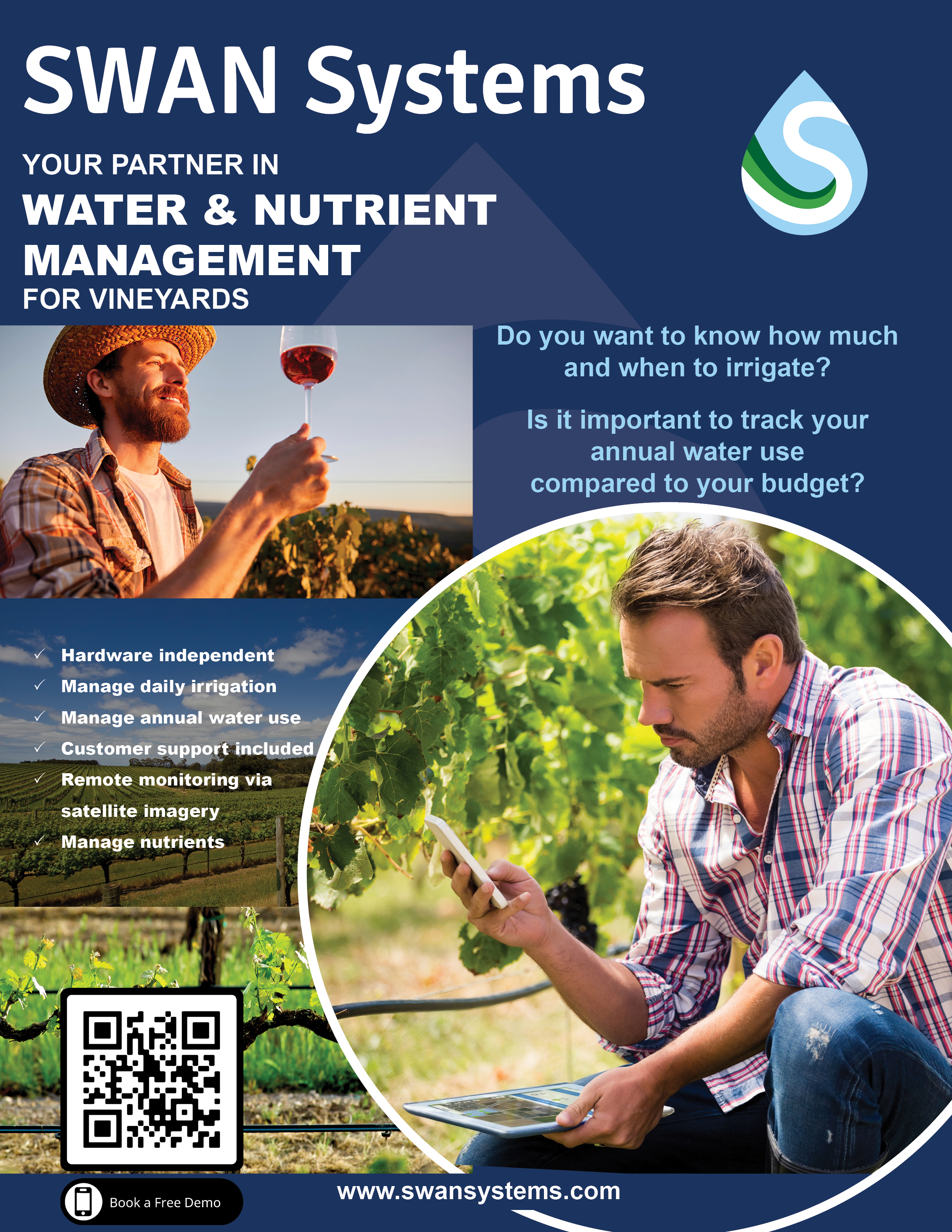
SWAN Systems is the premier software platform that enables a grower to visualize their farming operation from the “driver’s seat” to improve yield, save time and money, and maximize the utility of resources - all from one platform.
Tailored to local geography and irrigation context, SWAN’s technology transforms historical, current, and predictive data from multiple sources into actionable insights, allowing users to decide how much to irrigate and when.
Regardless of the age of your vineyard, SWAN Systems can help you to improve fruit size and quality, optimize resources, lower your input costs, and improve stakeholder satisfaction. SWAN’s ability to integrate data from multiple sources across irrigation operations provides the detail for informed decision-making. No more jumping from app to app to make a business decision that can affect your bottom line - SWAN puts the information you need at your fingertips, from your existing hardware and infrastructure.
SWAN delivers value to growers and is paramount in ensuring that your business will be there for the next generation.
Catch SWAN Systems at WIN Expo Booth #134.
Tom Hatcher takes a quick look at a vineyard in Western Australia, a region where a predominant clone of Chardonnay is grown. The clone is known as the Gingin clone.
The original cuttings came from the University of California in 1957 and were propagated initially in the Swan Research Station.
SWAN Systems is headquartered in Perth Australia and has a North American office at Fresno State. We have experienced viticulturists on both continents ready to help you with sustainable water and nutrient management.
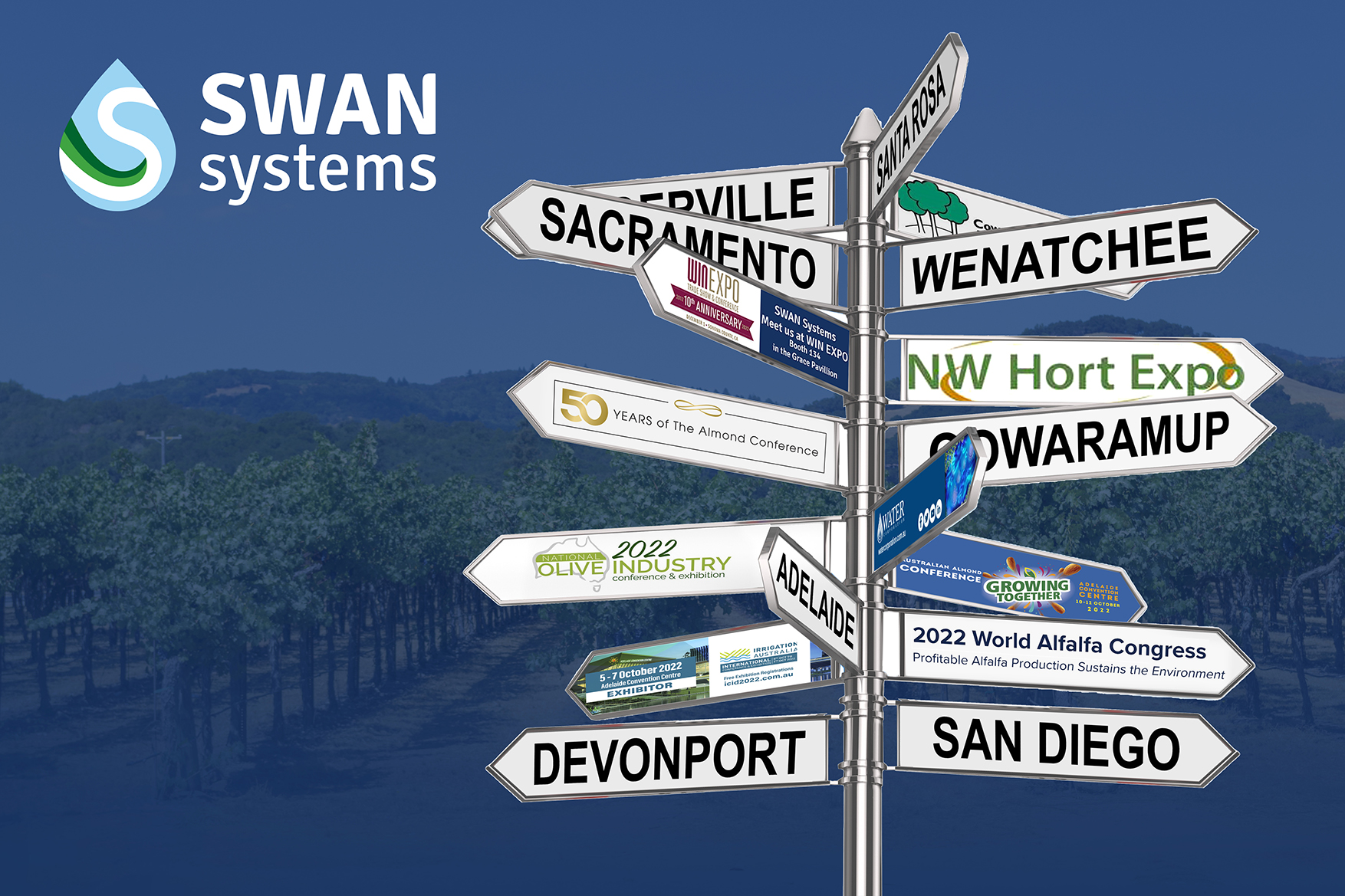
Our team is hitting the road and bringing SWAN to an industry event near you. Over the next few months, you will find us in Sacramento, Santa Rosa, Wenatchee, San Diego, Cowaramup, Leederville, Devonport, and Adelaide a few times!
Catch us this Friday, October 28th at the Innovations in Ag Irrigation Technology Demonstration and Showcase
Hosted by the Center for Irrigation Technology (CIT) in Fresno.
It's never been easier to find out how SWAN will benefit your water and nutrient workflow.
Summary
Farming quality wine grapes in a cool climate provides different challenges to those faced by farming in a hot climate vineyard. Cool climate water needs are more about optimization of the water accumulated in the soil and surface water. SWAN Systems uses tools already in the vineyard, such as soil probes, weather stations, and remote sensing, to enhance the understanding of what’s happening in the soil and within the canopy. Using every drop of water to its full potential and managing the canopy and berry quality, SWAN Systems creates an all-encompassing forecasting tool ideal for use in cool climate growing regions.
Background
California has vast microclimates where wine grapes can thrive. The cool climate regions of California can be found in the coastal areas, parts of Northern California, and areas with elevation changes. Cooler regions in Northern California have wet winters, while coastal areas have cooler winters with less rainfall. Though both areas are within Winkler Index I and II, the rain patterns are different, and the irrigation needs will vary. Cool climate regions have their challenges, but a coordinated irrigation plan can help manage the needs of the vineyard and optimize water use. Using tools like soil probes, weather forecasts, and remote sensing allows for a complete picture of the irrigation needs throughout the year.
Challenges
Regions with longer winters, fog, and rain will have unique challenges and different timings for their vineyard practices. Irrigation planning in cool climate areas can be started by monitoring soil moisture in the soil profile early in the season. Understanding the amount of water in the vineyard’s system can help plan the needs for the rest of the year.
From winter to spring, irrigation needs are likely to be low during a wet winter. With the full soil profiles, reservoirs and waterways flowing, there is no urgency to irrigate. However, understanding what’s in the water bank will allow for educated irrigation choices when spring comes around. By looking at soil moisture readings from probes at the start of the year, insight will be gained as to what’s happening underground and provides an opportunity to set a water budget.
Spring allows for fertigation and early irrigations to occur. As canopies begin to develop, balance in vigor is needed to supply enough energy to the vine but not allow the canopy to grow too big. Canopy growth can be controlled through irrigation practices and leafing. Leafing can help keep mildew levels low in moist vineyards while allowing a suitable amount of sunlight and wind to enter the canopy. It also assists in the proper spray applications of fungicides.
During spring and summer, the focus turns to cluster maturation and Brix accumulation. Both over-irrigating and under-irrigating can be a problem in cool climates. Too much water will result in watery berries, split berries, and excessive foliage. Water-stressed vines can begin to shut down, and berries will shrivel if the permanent wilting point is reached. Further insights into summer irrigations and canopy growth can be gained through an understanding of the crop coefficient of the vines and analysis of data (e.g. NDVI) obtained from spatial imaging.
SWAN Systems
SWAN Systems is a prime instrument used by irrigators in cool climate areas due to its ability to pair with existing hardware in the vineyard. SWAN Systems can read data from most existing devices already sitting in the soil and estimate dry-down periods. These tools, paired with weather forecasting, historical data, water budgets, and spatial imaging, can give a clear view of what’s happening underground and above-ground. The SWAN dashboard allows you to view your vineyard as a whole or as individual sites. The System Suggested Irrigation (SSI) module uses the configured site data, current soil moisture and weather forecasts to provide a week’s worth of forecasted irrigation needs. This tool can be customized to allow the soil to dry while maintaining enough soil moisture for the vines to cope with any forecasted heatwaves that may be approaching. The SSI is ideal for cool climate areas due to its ability to suggest practical and substantiated irrigation plans based on growth goals and quality targets.
The ability to properly irrigate cool climate vineyards will help control vine vigor, berry health, disease, water logging, and overuse of resources and budgets. Cool climate viticulture areas can present challenges different to those experienced in warmer climates. Still, with the right tools, farmers can make the best choices allowing the cool climate viticulture characteristics of higher acidity and unique aromatics associated with these softer-bodied wines to shine in the wine.