

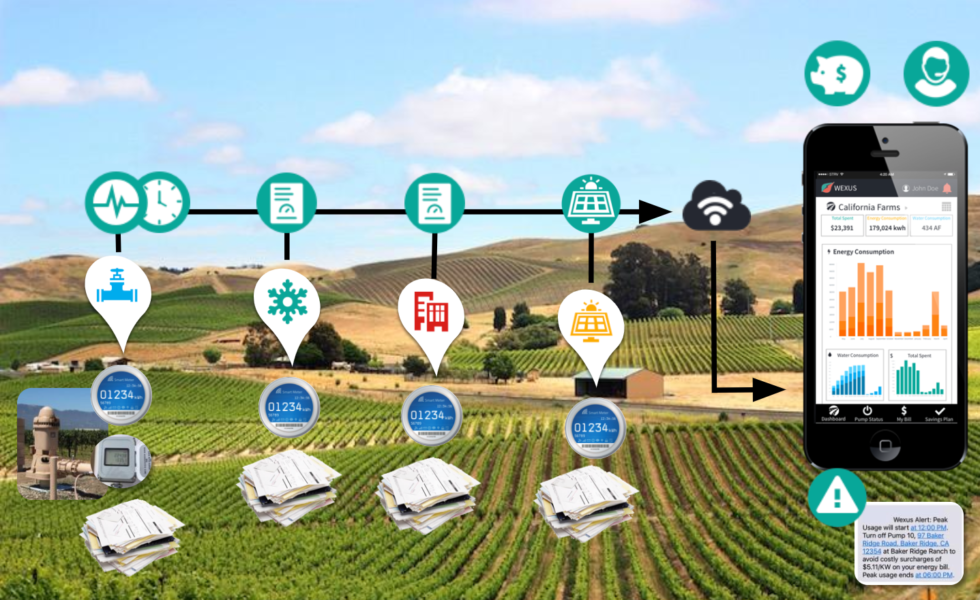
Energy is one of the fastest-rising operating costs for wineries, driven by factors like utility rate hikes, time-of-use pricing, peak demand charges, and aging infrastructure. Running chillers, pumps, lighting, and irrigation around the clock adds up quickly—especially during harvest or hot summer months. But wineries don’t have to be at the mercy of their utility bills. Wexus Technologies offers a smart, software-based solution to mitigate energy costs and improve efficiency without adding hardware.
Wexus connects directly to a winery’s existing utility and solar data, providing real-time visibility into energy usage and costs. By identifying when and where energy is being wasted—such as equipment running during peak pricing hours—wineries can make immediate changes that result in substantial savings. In fact, some users have reduced their utility bills by up to 50%.
Beyond monitoring, Wexus automates energy analytics, tracks solar performance, and even automates irrigation water reporting and energy data to help meet regulatory goals like SGMA and CSWA sustainability certifications. With tools to optimize load shifting and prevent overuse during peak hours, wineries can reduce exposure to high electricity rates and increase ROI from solar investments.
In short, smarter energy management means lower costs, greater resilience, and stronger profitability.
Get a Free Quote to save on your energy bills.
Wexus software remotely connects with your utility data to track buildings, equipment and solar arrays. No equipment needed to get started. Setup and onboarding is fast and easy.
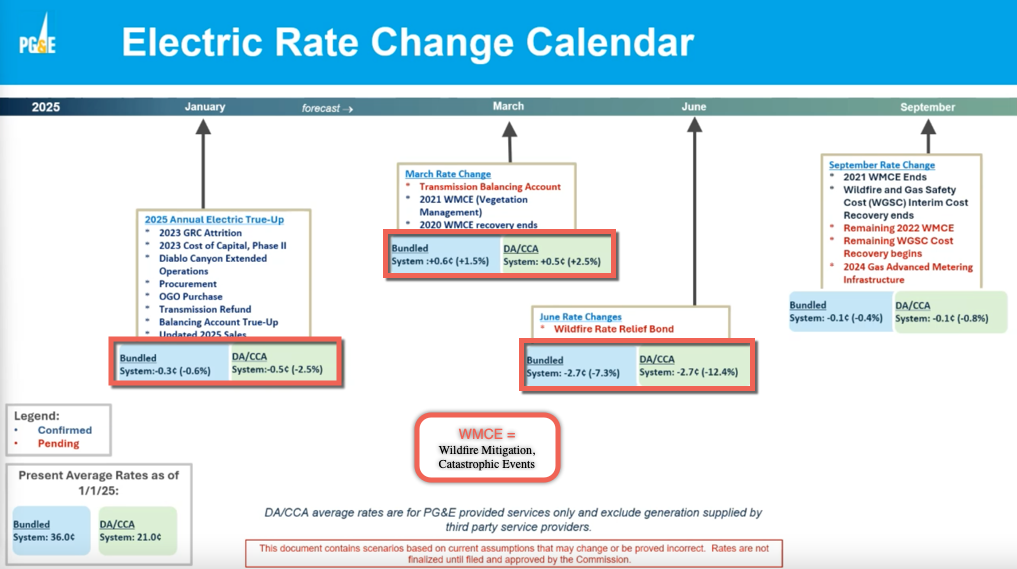
What's the latest with energy costs in California? Here are the top 3 things you need to know for 2025:
1) Californians are still stuck with the highest energy costs in the United States - by far.
- Per the EIA, residential electricity in California averages $0.32 per kilowatt-hour (kWh). This is 88% higher than the national average.
- Commercial electricity in California averages $0.29/kWh. This is 123% higher than the national average.
- And in Northern California where most agricultural companies operate, PG&E commercial electric rates average $0.36/kWh. 177% higher than the national average.
2) We may finally get some cost relief in 2025.
- PG&E commercial electric rates in California have grown steadily for a decade (per this chart from Revel Energy) but this year are finally set to drop about 7%.
- $2.1B in wildfire "mitigation" costs - in the form of undergrounding power lines, trimming trees, and installing fire warning systems/cameras - drove most of this rate growth over the past several years and were passed on to utility customers.
- Ag electric rates will increase in Q1, Q2, and Q4 but will drop in Q3.
- Gas rates will grow ~6% to pay for wildfire "mitigation" and gas "smart meter" infrastructure.
3) New "Flex Pricing" programs - also known as "demand response" - are being offered by utilities.
- Use extreme caution or you could end up paying much higher bills.
- Large incentives $ are being offered to enroll and help pay for automation equipment.
- Peak afternoon/evening prices can double or triple, so if you don't shut off equipment in time - or control equipment breaks - you could get stuck with a massive energy bill.
California Energy Market: The Nation's Largest And Most Expensive "Time of Use" (TOU) Energy Rate Rollout
California rolled out the nation's largest Time of Use (TOU) utility rate changes in 2021. The days of paying a "flat" rate for electricity are no more.
Time of Use: WHEN you use energy is just as important as HOW MUCH you use
Under the new TOU rates, you pay more for electricity during weekday and weekend afternoons between 5pm-8pm, seven days a week. And those costs on your utility bill are broken out between two different types of charges:
- energy consumed (i.e. the odometer) in $/kilowatt-hours ($/kWh)
- power consumed (i.e. the speedometer) in $/kilowatts ($/kW) - also known as "demand."
Confusing? YES. And it's designed to be that way so you just give up and pay your bill without asking too many questions. Hopefully these charts explain it a little more clearly:
So why is all of this changing now?
California has produced so much renewable energy in the form of solar and wind power that there's now a glut of excess power - generally in the afternoons when the sun is shining and the wind is blowing.
And let's be honest, these rate increases also siphon more money out of our pockets to go to monopoly utility companies with horrendous safety records and had to declare bankruptcy in recent years because of massive liability from sparking huge wildfires that burned down entire towns (looking at you, PG&E). Under the guise of investing in "wildfire safety measures," customers are footing the bill with much higher energy rates.
So what's the bottom line for my business?
Any businesses that use electricity during peak hours - whether for pumping irrigation water, processing crops, for office use etc - need to watch these rate increases closely to maximize their investment in on-site solar projects. Without managing "peak demand" usage between 4-9pm (commercial) or 5-8pm (agriculture), they'll likely see their original expected solar savings and ROI dwindle - and get hit with much higher bills.
Our software quickly analyzes these new TOU rates and matches them with your energy bills and consumption, your solar generation, and your irrigation pump loads over the past few years to automatically select the cheapest TOU rates and maximize your cost savings. You can also monitor and manage your peak energy usage on a daily basis, down to the equipment level. Doing this manually is simply impossible and way too time consuming.
All of these changes are clear as mud. I have a business to run. What should I do next?
You're not alone. We're seeing changes in the energy landscape faster than ever before. So leave the heavy-lifting to the energy engineers of Team Wexus.
- For more information about how Wexus can help you drive energy and water efficiency, automation and cost savings check out our home page here where you can schedule a demo of our software platform or sign up for a free proposal.
- For product and news updates, case studies and product tutorials check out our blog page here.
- Be sure to follow us for the latest updates and news on Twitter, LinkedIn and YouTube.
Wineries have been facing rising costs almost across the board for a decade or more. Labor availability and costs are longstanding concerns, and California has seen some of the sharpest increases in energy rates in the nation. Rates are more than triple the national average and have continued to rise just in the last few years due to inflation and wildfire liability costs passed on to utility customers.
Adding to the cost worries of many wineries and vineyards, enforcement of the Sustainable Groundwater Management Act (SGMA) has ramped up in recent years. It’s the first ever attempt to regulate groundwater use in California and was passed in 2014 during a multi-year drought to protect California’s aquifers. The Department of Water Resources (DWR) oversees the law’s implementation and has recently been putting water districts and growers on notice for lack of compliance.
Combining these escalating energy costs, a tight labor market, and potential fines for water regulation non-compliance, California’s agriculture and wine businesses are highly motivated to find cost-cutting solutions to enhance their profitability.
Chris Terrell, Co-founder of Wexus Technologies, says of the dramatic increase in energy rates, “It's hitting the ag industry very hard in terms of profitability—many farmers spend over a million dollars a year on utility bills and over 90 percent of their energy costs are tied to irrigation. They need relief now.”
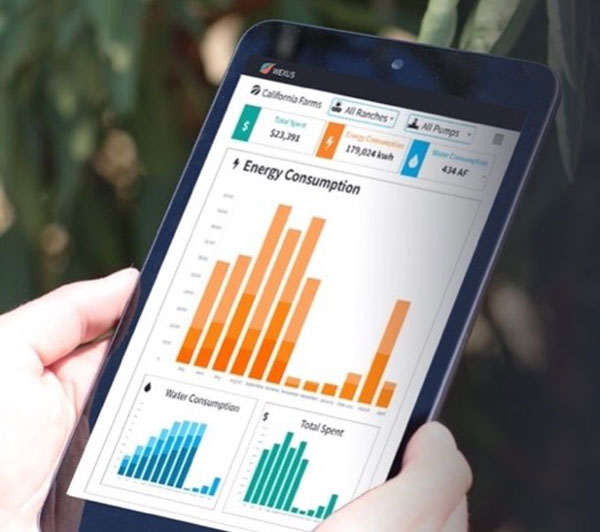
Terrell founded Wexus Technologies with Co-founder Chris Vines to develop an intelligent software solution that would help farmers automate tasks while reducing their energy and water costs. In a project sponsored by the California Energy Commission and UC Davis, his team spent three years developing the technology with farmers in the field based on “boots on the ground” feedback. The resulting software platform provides farmers with a better way to manage their energy costs and water usage in real time and can be accessed from both the office and in the field. And no additional equipment needs to be installed.
Wexus software links directly to a customer’s utility account and takes only a day or two to set up before it begins automatically monitoring a winery or vineyard’s usage. The software immediately reviews a customer’s energy bills and historical usage to identify quick opportunities to reduce electric and water costs. Terrell expands on the process, “We start with the up-front return on investment (ROI). Agricultural users have many options for utility rate plans, and we often find that they’re not on the best one. So the software automates the process, shows them how much money they could save by switching to a better plan, and does it for them without having to change operations or irrigation schedules. It also factors in wet vs dry years because irrigation can change drastically from year to year.”
One Central Coast grower shared that, "With Wexus Technologies' rate analysis service, our operation was able to save 40%—a $40,000 savings in annual energy costs—on just one irrigation pump.”
- Earn upfront energy cost savings. Choose the best utility rates, track energy expenses in real time, and track renewable energy ROI.
- Turn your energy meter into a water meter. Monitor water usage in real time, while promoting conservation, reducing labor expenses and staying in compliance with new regulations (SGMA).
- Achieve California Sustainable Winegrowing Alliance (CSWA) certifications. Easily track and report data needed for the Energy Management Plan (EMP).
In addition, Wexus software tracks the bill savings and ROI of renewable energy systems and provides detailed cost analysis to pinpoint opportunities for improvement. Typically, a solar array may have incorrect billing, equipment problems, or dirty panels that can affect the system’s energy output and cost savings. Wexus’ solar data saw a 20 percent drop in solar energy output during the 2020 California wildfires due hazy skies and ash building up on panels.
For water reporting, the software tracks billions of gallons of irrigation water usage with real-time, automated monitoring of pump activity. It turns an energy meter into a water meter by converting pump test data and energy usage into useful, downloadable reports with information like total gallons or acre-feet used, dollar cost per acre-foot ($/AF) and crop types. This helps growers stay in compliance with new California water regulations like SB88 and SGMA.
Wexus also helps wineries and vineyards achieve California Sustainable Winegrowing Alliance (CSWA) certifications by easily tracking data needed for the Energy Management Plan (EMP). An EMP creates a strategy for managing energy costs, increasing winery efficiency, addressing risks from energy disruptions, and creating a structure for continuous improvement. This is also useful for tracking and reporting greenhouse gas emissions (GHGs) which some financial institutions now require.
Just as critically, the Wexus Technologies program saves winery and vineyard owners time and prevents labor errors that could result in extra costs. Manually compiling energy and water usage information is time-consuming and, if not reported accurately and on time to the state or county water district, can incur a hefty fine. Terrell points out an instance in which a local water district on the Central Coast fined a grower $250,000 for late reporting.
“We make our customers’ lives easier by using software to reduce input costs and automate reporting,” explains Terrell. “For the last ten years, we’ve been working with many leading wineries and vineyards in the industry as well as companies across the ag industry to take the pain out of utility costs.”
In recent years, wine consumption is down and harvests are up. There’s increasing pressure to remove vineyards while still generating income from farmland and not losing access to water rights.
The recent Silicon Valley Bank State of the US Wine Industry report notes that “Publicly, industry experts called for 50,000 acres of vineyard removals net of new planting…While removals are continuing as of this writing, we believe there need to be calls for additional acres removed.”
To redress the associated supply imbalance, some wineries are removing vineyards, and others are considering solar energy to augment their power grid.
“If a customer is looking to add a solar array because a vineyard is coming out of production or the land isn’t farmable,” says Terrell, “we can help them figure out whether the solar array will be profitable for them in the long run and actually make financial sense. And if they already have solar arrays, our real time tracking can help to optimize them, look for areas of improvement, and show the true ROI based on their actual utility bills.”
To see Wexus in action, you can schedule a software webinar demo by going to their website at www.wexusapp.com and clicking the “Demo” button to choose a convenient day and time on your calendar. And to get a free utility analysis and proposal with your data, click the “Join Us” button.
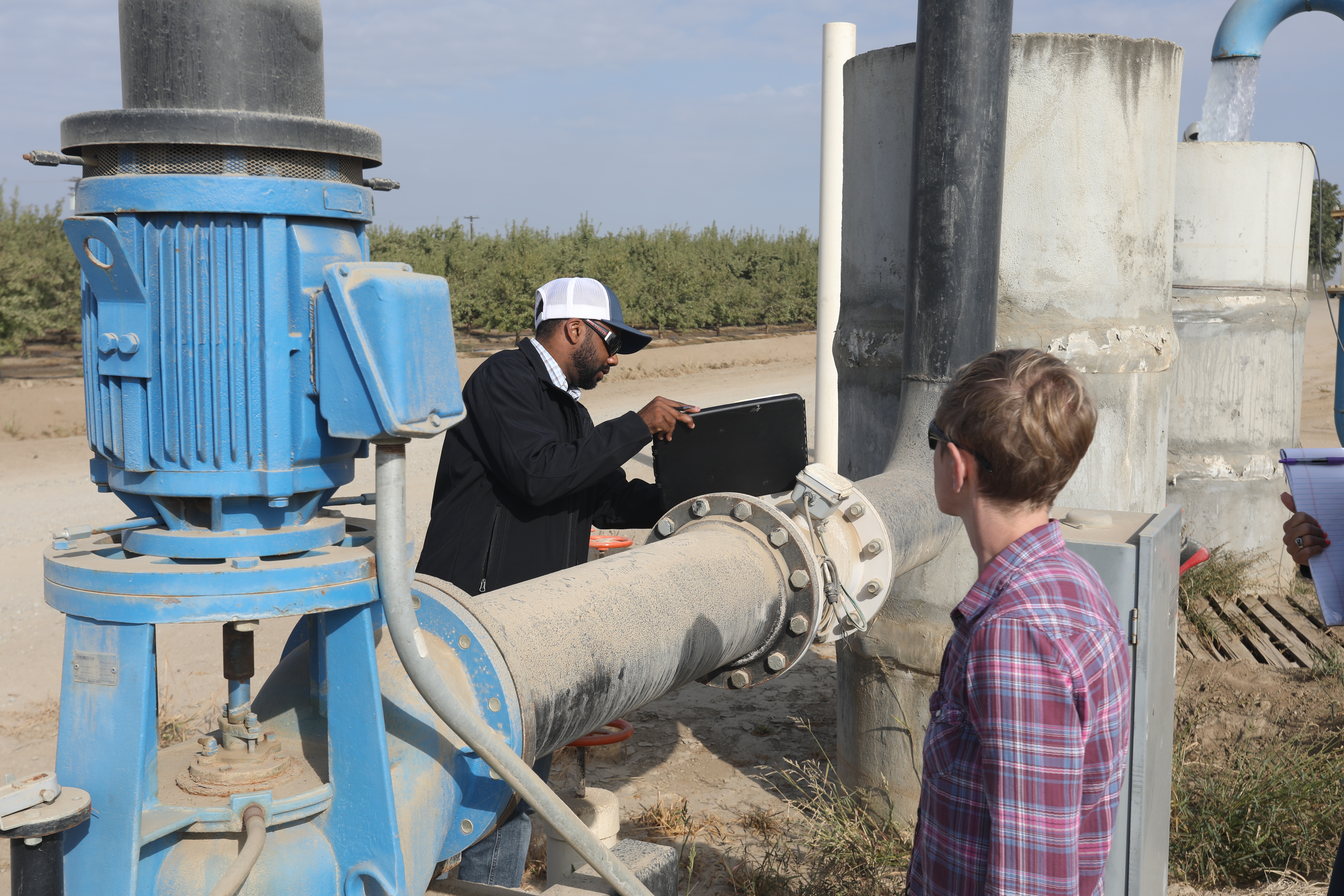
Turn Your Energy Meter into a Water Meter: How to Easily Report Water Usage
Export Info feature easily converts water usage data into reportable formats for SGMA compliance
We're looking forward to catching up with our vineyard/winery customers at @theunified next week! If you'd like help with reducing energy costs, tracking water usage, or emissions reporting book a time with us here: https://calendly.com/wexus/15min?month=2025-01