Our focus on National Forklift Safety Day, and every day, is providing solutions that reinforce operator best practices and training to keep your operators running confidently and efficiently, so your operation stays in perpetual motion.
Our holistic approach to creating secure working environments starts with the lift truck, then it expands out to explore how your entire operation flows to establish the best practices that are specific to your facility.
If you’re interested in our Safety On The Move program and other initiatives, contact us at Raymond West! Because when you secure the rhythm of your facility and operators, you tap in to their full potential.
National Forklift Safety Day is Right Around the Corner!
|
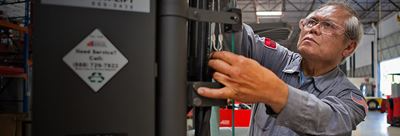
Ongoing use (or misuse) can cause wear, cracks and bends to your lift truck forks. Here's how to conduct a thorough inspection and determine when forks need to be replaced.
Did you know that nearly 30% of all forklift forks FAIL independent safety inspections? Many people assume that the heavy steel forks on their lift truck will never wear out, but daily wear and tear, combined with occasional misuse or accidents can and do make forks fail eventually.
With regular use, the steel on your forks wears away. Forks can also develop cracks or bends when operators collide with walls or columns. Improper chain adjustments can put undue stress on forks, and overloading a fork beyond its rated capacity can compromise its structural integrity. Some forklift attachments can also cause premature wear on forks.
Worn or damaged forks typically break under load, which may result in product damage, rack damage, injury or worse. That’s why routine inspections of your forks are so important. Beyond risk mitigation, there are also requirements from OSHA and ANSI/ITSDF for regular fork inspection. Here are a few tips on inspecting your forks:
- Measure thickness: check the wear on your forks by using calipers. A 10% decrease in thickness reduces your load capacity by 20%. Although forks wear slowly, they need to be checked regularly.
- Look for surface cracks: carefully inspect the entire fork for cracks, paying special attention to the welds and the heel area.
- Look for bends: examine the blade and the shank to make sure they are straight and true. Any bends mean that the fork needs to be replaced.
- Check the angles: if the shank or blade is beyond 93 degrees the fork needs to be replaced. Forks cannot be bent back into place once they are compromised.
- Look for uneven forks: the height of your fork tips needs to be closely aligned. A variance in tip heights can’t be more than 3% of the length of the blade. For example, 48-inch forks can’t go beyond a 1- and 7/16-inches variance.
- Check the positioning lock: make sure that the lock is functioning correctly.
If you have questions about fork safety or need to replace forks, call Raymond West today at 562-944-8067.
Finding the right attachment for your forklift can be confusing. Use this simple formula to determine whether an attachment is appropriate for your lift truck.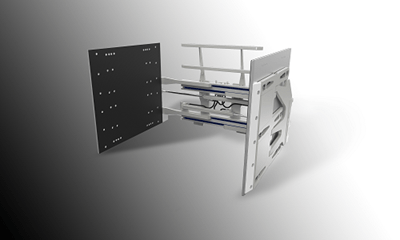
If you’re in the market for forklift attachments, finding the right attachment for your capacity requirements can be a little bit confusing. Your starting point should always be the lift truck’s rating at load center as stated on the data plate. This rating simply tells you the maximum safe weight your truck can lift with a centered load.
As you shift a load from the center point, your capacity reduces accordingly. For example, a 5,000-lb. capacity forklift may be capable of lifting that weight on 48-inch forks with a 24-inch load center. However, if you were to extend the load to 60 inches with a 30-inch load center, your capacity may drop to 4,000 lbs.
In other words, the further you move a load’s center, the more your capacity diminishes. Many forklift attachments change the load center, reducing your truck’s capacity.
Load Moment
The capacity for a forklift attachment can be calculated using something called the Maximum Load Moment, which is simply a formula that accounts for weight distribution based on center load distance and the resulting changes in capacity. From a safety perspective, it’s essential to account for any change in load center, as pushing the center out too far can flip a truck.
You can calculate a Load Moment by multiplying a load’s weight by its center distance from the fulcrum. In the case of a counterbalance sit-down truck, the fulcrum is the axle of the front wheels, which is the pivot point between the load and the weight of the lift truck. Simply stated, the Load Moment measures the overturning force applied to the front of the forklift.
You can determine the Maximum Load Moment for any forklift by multiplying the weight rating by the center load distance state on the data plate. In the example we used above, it would be a 5,000 lb. capacity multiplied by a 24-inch load center (5,000 x 24), which gives you a Maximum Load Moment of 120,000-inch pounds.
Factoring Load Center Modifications
When you add an attachment that shifts the load center, you need to factor in that change. You can do that by dividing the new load center by the Maximum Load Moment.
Continuing the example from above, we went from 48-inch forks to 60-inch forks, which pushed the load center out from 24 inches to 30 inches. To calculate the capacity with these longer forks, you can take the Maximum Load Moment of 120,000-inch pounds as calculated above and divide it by the new load center of 30 inches, giving you a new load capacity of 4,000 lbs.
The formula is simple:
(Truck Capacity x Load Center) / (New Load Center) = Revised Capacity
Load Positioning
Of course, all of these calculations assume that you are handling uniform products with perfectly centered loads. This is frequently not the case. Many products are not uniformly shaped and pallet weights are not always evenly distributed.
If you’re considering a forklift attachment that will change the load center, you must also consider the size and shape of the materials you will be loading. If they are not uniform, be aware that extensions will reduce your load capacity by even more than your calculations projected.
Overloading a forklift is a serious safety risk that can result in injury or death. It can also impact your business through product damage, property damage, OSHA actions and more.
Talk To an Expert
If you have any questions about forklift extensions or other attachments, get in touch with a material handling expert at Raymond West today.
While most warehouse businesses are interested in automation, many think it’s too expensive or risky to implement. When done properly, an ASRS project delivers massive gains in productivity and a rapid return on investment. Here are some common misconceptions about ASRS.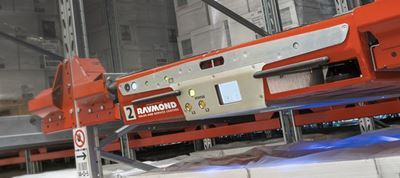 Many businesses believe that ASRS are for the “big guys,” and they can’t afford the initial investment or the potential downtime associated with these complex systems. Nothing could be further from the truth. ASRS implementations can often generate a positive ROI in 18 months or less and when automated storage systems are properly maintained, downtime is practically nonexistent.
Misconception #1: “ASRS is way too expensive for our operation.”
While it’s true that large scale deployment of ASRS can run in the millions of dollars, smaller implementations can be done for a fraction of that cost. Many factors contribute to a system expense such as unit size, environmental considerations (e.g. clean room, climate controlled), integration requirements and so forth.
On the other hand, a standalone vertical carousel can be well under $100k. Quite often, the savings you generate from reduced labor, floor space and pick errors can easily justify this cost in fewer than 18 months. To put that in perspective, for roughly the cost of a high-end automobile you can get something that pays for itself within a year and a half and contributes to your profitability for years to come. How’s that for an investment?
As an example, let’s suppose a manufacturing plant adds a vertical lift module to store parts required on the production line. The VLM immediately frees up 85% of the floor space that was once occupied by racks and shelving to hold the parts by storing them in a densely packed column that almost reaches the ceiling of the building.
That recovered floor space can be repurposed for additional manufacturing capacity that can rapidly justify the cost of the initial investment. Once the VLM equipment has been paid for, the additional capacity the business has gained will pay dividends for years to come.
Misconception #2: “Complex equipment means lots of down-time.”
While it’s true that replacing racks and shelves with machinery is more “complex”, ASRS systems are well built mechanism with decades of proven use in harsh manufacturing environments. The fact is, if these systems are maintained properly there is rarely a situation where you’ll experience an unplanned outage.
Schedules preventive maintenance is often included during the initial warranty period. After the warranty expires a preventative maintenance program can be purchased that will keep your equipment in top shape. When ASRS systems are maintained regularly they can perform flawlessly for 15 or more years.
Although preventative maintenance comes with a price tag, it’s far less than what an extended unplanned outage and emergency repair will cost you. Routine maintenance costs are minimal compared to the cost savings and productivity increases you’ll get from a typical ASRS project.
Misconception #3: “Our software doesn’t integrate with ASRS.”
If your needs are fairly basic, most automated systems can provide fundamental inventory management functions from the onboard controls. For advanced inventory management features such as inventory tracking, FIFO/LIFO picking or batch picking, you’ll need inventory management software. ASRS are often packaged with modular inventory management software that can address your specific needs. These can be directly integrated with your existing WMS or ERP system.
Misconception #4: “Training our people is going to be an expensive hassle.”
In most cases, training is included when you purchase an automated system. The fact is, ASRS equipment is designed from the ground up, with the operator in mind, meaning that the interfaces are intuitive and user-friendly. For high-turnover or seasonal operations, most manufacturers offer a “train the trainer” package so that you can have your own in-house subject matter experts for your ASRS equipment.
Misconception #5: “We’re a small business. We can’t use that type of warehouse automation.”
You don’t have to be Amazon to benefit from warehouse automation technology. ASRS solutions are highly scalable and can offer enormous cost saving opportunities for small and medium businesses.
Although your needs might be much smaller than the Amazons of the world, the ROI models still work, only at a smaller scale. Maximizing warehouse space and reducing labor costs are good for any kind of business.
Misconception #6: “We don’t have enough volume to justify ASRS.”
High volume is not necessarily a requirement for building an ROI model for an ASRS solution. For instance, you may store specialty items that aren’t used often and take up space in your warehouse. You can store those in a system that uses only 15% of the footprint of your existing racking or shelving, freeing up space to put to other revenue generating uses. It also give you a paper trail of exactly who picked which items and when, which can help minimize expenses and losses. Furthermore, you’ll have inventory numbers at your fingertips, which can be particularly helpful with items that don’t get used often.
Would You Like More Information? Talk to an automation expert at Raymond West. Give us a call at 562-944-8067.
Are you thinking about making the jump to Automated Guided Vehicle (AGV) systems in your warehouse or distribution center? Here are a few things you should consider before engaging an AGV consultant or vendor. Raymond West is here to help.
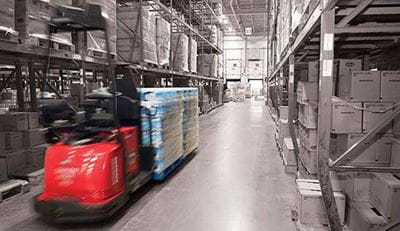
Installing an Automated Guided Vehicle (AGV) system to automate repetitive material handling tasks in your warehouse is a substantial investment. Which type of AGV is right for your business and circumstances? The answer is: it’s complicated. Most warehouse operators end up leveraging the expertise of consultants or vendors to make a final determination. Raymond West is here to help.
Before you engage outside parties, you may want to put together a basic requirements document that you can share both internally with your management and externally with your potential vendors. A good requirements document will address the following items:
Transportation Considerations:
- Identify and list all the material handling systems you have in place today. Forklifts, pallet trucks, conveyors, AS/RS and any other systems.
- What are your working hours? Are you a multi-shift operation?
- How many transports are you doing per hour on average? What about during your peak times?
- What types of loads are you moving? Pallet, bins, cartons, rolls? How far are they moved? How much do they weigh?
Systems Integration Considerations:
- List all of the systems you use in the warehouse on a day-to-day basis, including WMS, ERP, labor management, telematics, and any others.
- Where are your servers and what type of wireless network do you have in place?
- What are your project commissioning requirements with respect to IT systems?
Project Consideration
- What types of applications are you considering AGVs for? What parts of the facility would AGVs be deployed in?
- Do you have site drawings? If so, include them in the document.
- Are there any special site conditions? Do you have cold storage space? Are there outdoor runs between buildings?
- Who are the key contacts from your company that will be involved in the project? What are their roles and responsibilities?
- Do you have a written narrative that describes your operation at an industry and company level?
Performance Expectations:
- How quickly do you want to implement an AGV system?
- Do you have any ROI constraints, (e.g. “this implementation must pay for itself in 3 years and generate a x.x% return going forward to be considered).
- What type of references will you need from vendors?
Beyond the general items above, you may also want to add some AGV specifics. Here are a few items to consider:
- Accuracy – how accurate does your AGV system need to be? Is a 6-10 inch tolerance acceptable, or does the system need to be accurate within a fraction of an inch?
- Flexibility – what happens to your AGV guidance system as you need to make modifications, moves, or changes? Can you afford to shut the system down during modifications, or can you tolerate interruptions?
- Repeatability – does your AGV system need to operate inside, outside or both? If it must travel between buildings, what happens to your sensors and navigation during rain, snow, sunshine, or fog? What is your target goal for repeatability?
- Environment – do you have any unique environmental constraints? For instance, if you are utilizing block-stacking in your warehouse, that may limit navigation targets like lasers for certain AGV systems. Are there temperatures extreme? Many AGV electronics are compromised above 115-120 degrees. Can you think of any other constraints unique to your warehouse?
By thoroughly documenting your project’s requirements and constraints before approaching consultants and vendors, you can often avoid weeks or even months of meetings and emails.
To speak with an AGV expert, call Raymond West today!
Sometimes it's hard to know when to replace a conveyor instead of repair it. Here are some guidelines to follow.
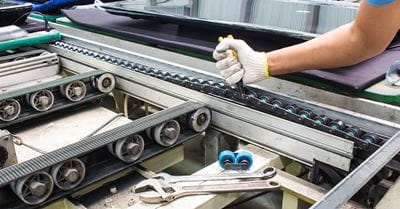
Conveyor wear is inevitable for most warehouse and production facilities. Conveyors can work flawlessly for years, and then almost overnight, it seems like you are constantly halting production and calling in technicians. If you find this description all too familiar, it may be time to get a new conveyor system.
Sometimes it's hard to tell when it's finally time to do something. Replacing a conveyor is costly, and it’s important to get all the use you can out of such a significant capital investment. On the other hand, at some point lost productivity and frequent maintenance expenses will outweigh the cost of replacement.
When To Start Considering Replacement
Your conveyor system is built to last for many years, but eventually it will wear out. If you are experiencing frequent outages, start documenting the cost of service and parts, along with down time for each outage event. This can help you build a business case for replacement.
Also keep seasonal demands in mind as you consider whether you need a new conveyor. Would a prolonged outage right before the holiday season be devastating to your operation?
Would More Modern Equipment Improve Your Efficiency?
Warehouse technology has improved by leaps and bounds over the last couple of decades. More sophisticated conveyor equipment and integration with modern software systems may actually improve your efficiency and productivity, which can often cost-justify equipment replacement on its own.
In other words, keeping that old conveyor system around may actually be costing you money. Between outages, frequent maintenance and opportunity cost, you may be far better off replacing your system now.
Is Your Older Conveyor System Appropriate For Your Current Volume?
Conveyors get more and more use as operations grow, and systems often become inadequate after a few years. If your conveyor system is struggling to keep up with your current volume, it may be time to replace it, even if it still has some useful life left.
Oftentimes, businesses will replace their conveyors in conjunction with some other event like a warehouse move, redesign, or automation effort.
Is Your Conveyor System Becoming Obsolete?
Material handling technology advances every year. What may have been a state-of-the-art conveyor system 20 years ago may now be an outdated clunker. Manufactures move on, and eventually they stop supporting and supplying parts for outdated machinery. While you may be able to keep things running by finding used parts or scouring Ebay, those are not a long-term solution to a growing problem.
When parts begin to fail and you can’t easily find replacements for them, it’s a good indicator that you should start considering a new system.
Can You Justify The Total Cost Of Ownership For Your Conveyor?
Even with regular, meticulous maintenance, components of your conveyor will start to fail with enough use and at some point the total cost of ownership does not justify keeping the equipment online. If you had a car with 200,000 miles on it that was essentially worthless on the used market, would you spend $4,000 for an engine rebuild? Probably not, you would just buy a new car.
The same idea applies to warehouse equipment. At some point, it just makes sense to replace it, and you may find the benefits of more modern equipment to be well worth the purchase price.
Call The Conveyor Experts
If you think it may be time to consider upgrading your conveyor system, talk to a material handling expert at Raymond West today.
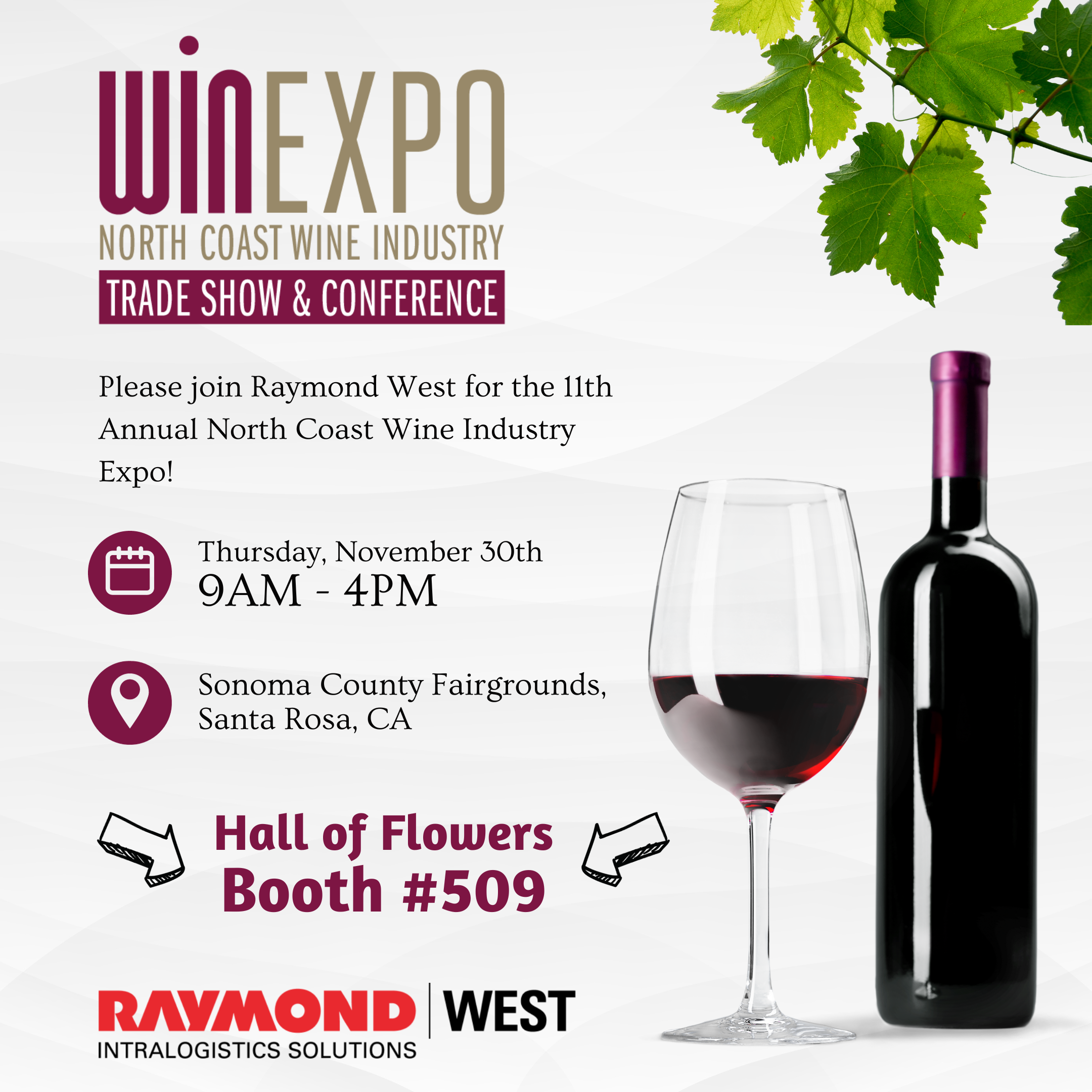
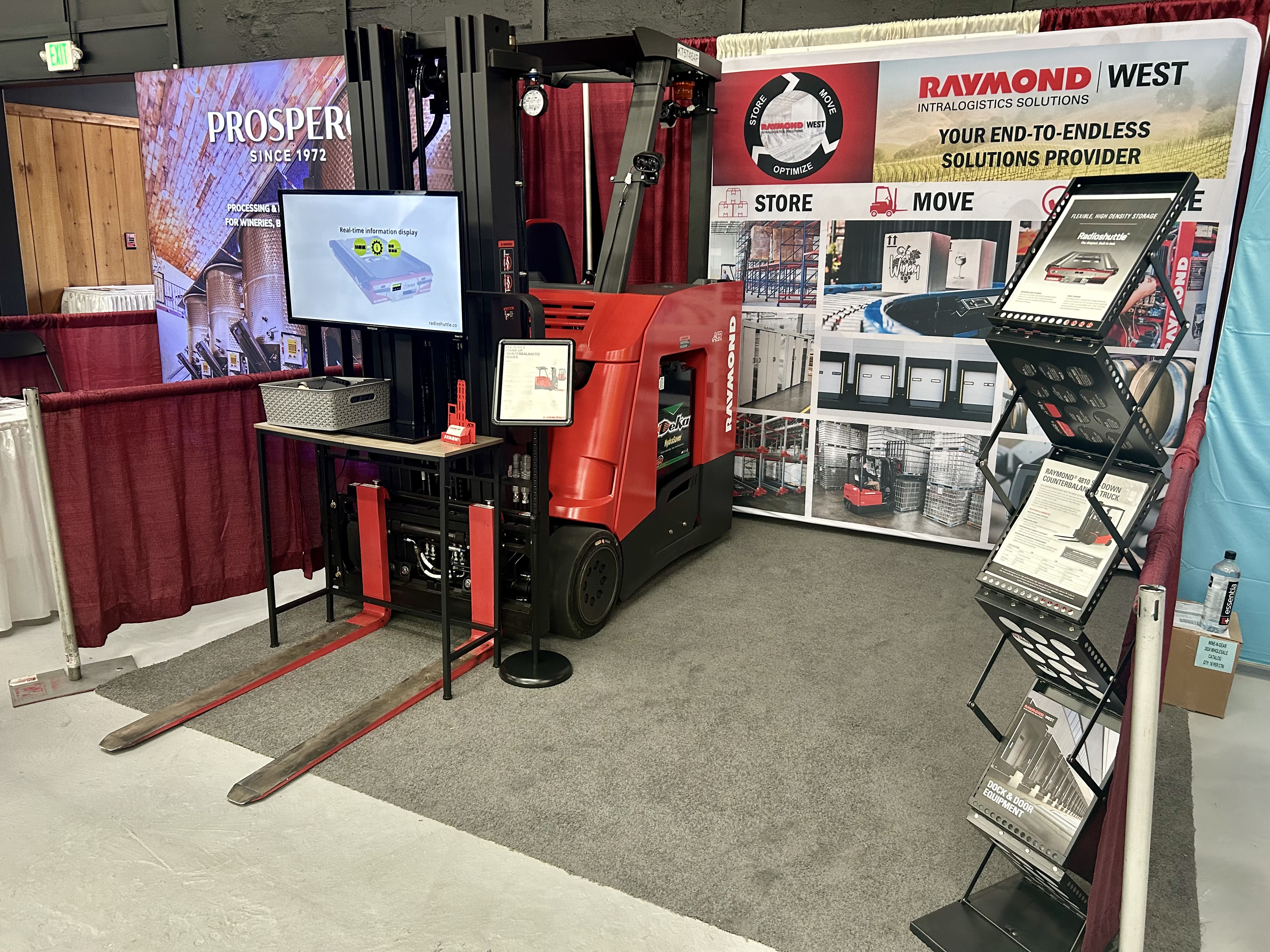
Raymond West is excited to attend the 11th Annual WIN Expo! Visit us in the Hall of Flowers - Booth 509 to discover how we can provide end-to-endless warehouse solutions for your business!
Raymond West Offers Certified Damotech Pallet Rack Repair for Warehouses and Industrial Clients.
Raymond West offers certified Damotech pallet rack repair for warehouses and industrial clients. Rack repairs can often be completed in place with minimal disruption to your warehouse operation, as opposed to unloading, replacing and re-loading entire sections of racking.
Rack Repair Kits
Damotech is the market's leading rack repair solution. This long-term repair solution is intended to repair damaged columns and uprights on any storage rack system. It has no effect on the original load capacity of the pallet rack.
This custom-made product is intended to withstand shocks and impacts caused by forklifts, their blades, outriggers, and the pallets they transport. It is so indestructible that it comes with a lifetime impact warranty. The DAMO PRO, made of 1/4 in thick steel, provides extra protection so you don't have to worry about forklift damage again.
How Does the Rack Repair Process Work?
Our experts will inspect your racking systems and advise you on the scope of the necessary repairs. The technician will design a custom repair kit that will be made to order.
Our rack repair services are designed to adhere to and respect the engineering that went into the design of your existing racking system. The repair kits work in tandem with the racks they are installed on to restore their original capacity while safely and permanently extending their lifespan.
Our repair specialist will assess the condition of your racks and advise you on the type of rack repair kits you require for each location, as well as prepare a proposal for your approval and schedule the installation.
Once you approve the proposal, your units will be manufactured and ready for shipment in less than four weeks. Damotech has the industry's shortest custom-built repair product production time. This is the result of significant investments they've made in their LEED certified manufacturing facility, which features cutting-edge technology and automation. One of the many advantages of using Damotech repair kits over OEM replacement parts is the short lead time.
Raymond West technicians have been trained and certified by Damotech and they are experts in rack repair. Each repair kit generally takes less than an hour to install. Installations are scheduled ahead of time to accommodate your schedule.
Call A Rack Repair Expert Today!
Raymond West proudly offers Damotech-based rack repair services and maintains a team of more than 400 technicians across eight Western states. To speak with a racking expert, give us a call today!